
Stop, Look, and Listen #46
A round-up of what I have been reading and listening to this past week.

Please support my work by becoming a free or a paid subscriber to the newsletter. Paid subscribers can access my full archive of posts at any time, and are vital to me being able to continue producing and expanding this newsletter.
You can also support my work by making a one-off payment, at a price you consider affordable.
This post is part of the newsletter’s ‘Stop, Look, and Listen’ series, a digest of articles and podcasts that I’ve found engaging and insightful over the past week.
Content warning: Violence against women; Genocide.
Five things to look at:
David K. Renton wrote this piece for his newsletter on the way that Keir Starmer’s period as Director of Public Prosecutions presaged the worst aspects of his leadership of the Labour Party and his time as UK Prime Minister, in his tendency to subordinate policymaking to pursuing right-wing press approval.
In this article for Foreign Affairs, Marc Lynch and Shibley Telhami discussed the prospects and drawbacks of more countries recognising Palestinian statehood, if this is not accompanied by material action to counter Israeli encroachment, hegemony, and violence in Gaza, the West Bank, and East Jerusalem.
This post by Ian King for his Unexpected Delirium newsletter revisited the debacle of ITV Digital, whose seemingly lucrative package for screening Football League matches promised to put the lower divisions on a closer footing to the Premier League in the early 2000s, only to instead nearly bankrupt many clubs.
Writing for his Back of Mind newsletter, Dan Davies highlighted the problem of ‘infrastructure brain’ undermining much UK government policymaking, which frames environmental protection as a trade-off with economic growth, when successful development is instead often dependent upon complex ecosystems.
Debbie Sharnak reflected for her Uruguay in Perspective newsletter on the recent conviction in Uruguay of a defendant implicated in the state murder of three young women in 1974, and the long delay in attaining justice for victims of the country’s former dictatorship following the 2011 repeal of its amnesty law.
Five things to listen to:
On the Diasporas Speaking podcast, Rina Limoni spoke to Selma Jahić about her survival as a child of the 1995 Srebrenica massacre and her family’s subsequent escape to and resettlement in Austria, as well as her current work as an activist in sustaining the memory and raising awareness of the Bosnian genocide.
Adam Tooze and Cameron Abadi profiled the twentieth-century US economist John Kenneth Galbraith on Foreign Policy’s Ones and Tooze podcast, exploring Galbraith’s expansive understanding of his discipline, role as public intellectual and political insider, and pessimism over American consumerism and militarism.
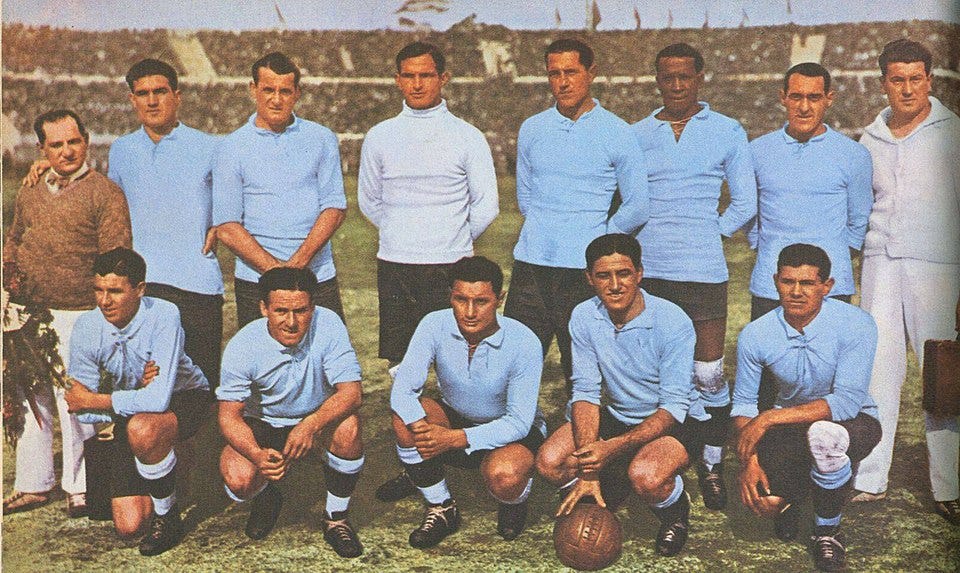
Chris Lee interviewed Will Huddlestone for the Outside Write podcast about his research into the history of Uruguayan football, including its rapid development after independence, role in bolstering the relatively small country’s global profile from the 1920s, and utilisation to both legitimise and challenge dictatorial rule.
On the LRB Podcast, Thomas Jones spoke to Andy Beckett about the Pinochet dictatorship in Chile’s connections with both interwar fascism and the New Right, including British conservatives’ admiration for his violently implemented free market reforms, as well as his subsequent arrest in London in 1998.
Richard McCulloch and Ben Litherland considered the question of ‘Copaganda’ on the Ill Effects podcast, examining the saturation of media with positive, highly partial depictions of policing in both the US and Britain, as well as the question of how far these representations shift public perceptions of the police.
If you’ve enjoyed this post, please consider supporting my work by becoming a free or a paid subscriber to the newsletter. Paid subscribers can access my full archive of posts at any time, and are vital to me being able to continue producing and expanding this newsletter.
You can also support my work by making a one-off payment, at a price you consider affordable.
Otherwise, please show your appreciation by sharing this post more widely, and referring the newsletter to friends.
You might also enjoy these posts from the Academic Bubble archive:
Demolition Man (1993)

Demolition Man’s cryogenic motif served as a metaphor for its treatment of issues of time, progress, crime, and punishment.
Double Jeopardy and Cold Cases

The murder of Stephen Lawrence inspired a rule change that eventually helped convict one of his killers; the process also revealed much about the British state’s relationship to historical injustice.
The Making of the Political Economy of Post-War English Professional Football

English professional football had long functioned as a closed political economy, but changing circumstance after the Second World War resulted in its partial opening up.