Demolition Man (1993)
Demolition Man’s cryogenic motif served as a metaphor for its treatment of issues of time, progress, crime, and punishment.

Please support my work by becoming a free or a paid subscriber to the newsletter. Paid subscribers are vital to me being able to continue producing and expanding this newsletter.
You can also support my work by making a one-off payment, at a price you consider affordable.
This post is part of the newsletter’s ‘Rewound’ series of analyses of objects or episodes from cultural and political history.
Content warnings: Violence; Murder; Death.
Spoiler alert: This analysis of the film Demolition Man and its themes reveals plot details for the purpose of enhancing that analysis.
This month marks the thirtieth anniversary of the release of sci-fi action film Demolition Man. It starred Sylvester Stallone as its protagonist John Spartan, a disgraced Los Angeles police officer placed in cryonic suspension following a bungled rescue operation, only to be unfrozen out in very different circumstances decades later in a seemingly utopian future to capture his old nemesis, Simon Phoenix, played by Wesley Snipes – in a delightfully over-the-top performance – who has also been unfrozen and is rampaging through a society fundamentally incapable of dealing with his brand of ultraviolence. Demolition Man was a box office success in the US and worldwide, and while critical response was more mixed, it remains an enjoyable watch today as an example of genre filmmaking, albeit one whose machoistic, libertarian-populist politics very much date it as a product of the early-to-mid 1990s.
In the first instance, Demolition Man’s treatment of the theme of urban crime and lawlessness (and police violence as a response) tapped into wider media and political concern with this theme. The film was released the year after the 1992 LA Riots, in the same year as the Waco siege ended in a lethal fire, and the year before the passing of the draconian Violent Crime Control and Law Enforcement Act. It also embodied another dominant theme in 1990s culture: a fear of loss of purpose post-Cold War, and accompanying tendency towards conformism and emasculation. These themes were explored by Jamelle Bouie and John Ganz in an episode on the film for their Unclear and Present Danger podcast on 1990s political and action thrillers, which is well worth a listen. What I want to focus in on in this post, however, is the film’s treatment of the issue of cryonic suspension and where that fits in with its understanding of the relationship between present and future, utopia and dystopia, and violence and social order.
Synopsis
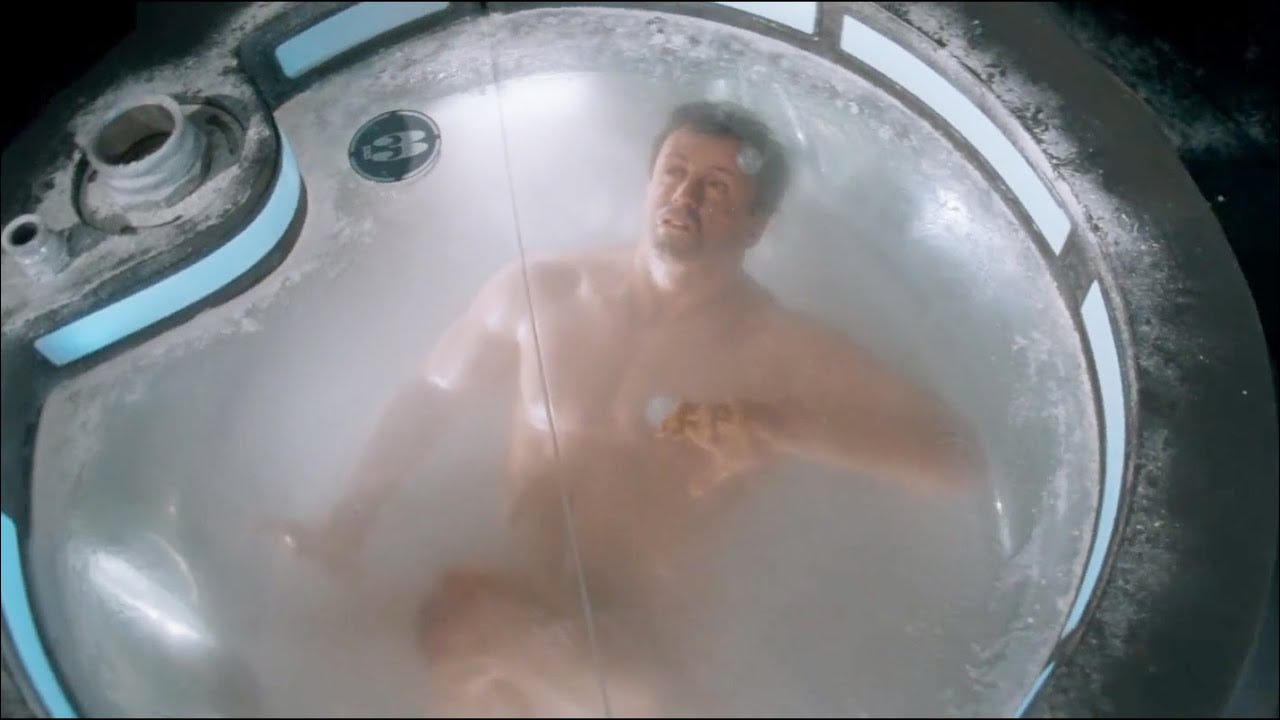
In its opening prologue, set in 1996, Spartan seeks to rescue a busload of passengers Phoenix has taken hostage. During their confrontation, Phoenix sets his own headquarters on fire; Spartan escapes with a captive Phoenix, but the hostages are found dead inside the building. Spartan is found guilty of their involuntary manslaughter; his sentence entails his being cryogenically suspended for 70 years, while being subjected to reformatory subliminal messaging. The film then skips forward to 2032, and the sedate world of ‘San Angeles’, which is disrupted when a thawed-out Phoenix violently escapes. At the urging of veteran officer Zachary Lamb (Bill Cobbs) and the much younger twentieth-century buff Lenina Huxley (Sandra Bullock), police chief George Earle (Bob Gunton) reluctantly agrees to also thaw out Spartan, so he can help once again catch Phoenix.
Spartan finds it hard to readjust in San Angeles, where practices deemed harmful such as eating meat, physical sex, and even swearing are prohibited. He, Huxley, and the more strait-laced young officer Alfredo Garcia (Benjamin Bratt) are unable to prevent Phoenix from stealing a consignment of guns from a museum, but they do seemingly succeed in disturbing him before he can kill Dr Raymond Cocteau (Nigel Hawthorne) – San Angeles’ leader and architect of its pacified social order. However, Spartan remains suspicious, and soon discovers that Cocteau had had Phoenix subliminally trained in new combat and computing skills while in stasis and programmed to kill Edgar Friendly (Denis Leary), the leader of the ‘Scraps’: a tribe of sewer-dwelling outcasts who refuse to abide by San Angeles’ repressive rules. Meanwhile, Phoenix, whose programming also renders him incapable of killing Cocteau, persuades him to release a band of his frozen former criminal associates to help in his mission.
Together with Huxley – with whom he shares a growing mutual romantic attraction – and Garcia, Spartan foils Phoenix and his gang’s efforts to kill Friendly. Phoenix then has a member of his gang murder Cocteau, before Phoenix himself travels to the cryo-prison to defreeze and release all its worst criminals. Spartan tracks him down there, and in their final, destructive confrontation, breaks a cryogenic fluid vial, freezing Phoenix, before decapitating him and escaping from the prison as it explodes. Following Cocteau’s demise, he urges the officers and the Scraps to form a new society that better balances order with freedom, before he and Huxley kiss.
Cryonics and suspended animation
The possibility of freezing humans, principally as a means of defying death, has been a subject of speculation ever since college lecturer Robert Ettinger published his book on the topic, The Prospect of Immortality, in 1962. Underpinning cryonics is the idea that death is relative, with different scientific and legal interpretations as to precisely when a body has died, and that a body or even just a brain preserved through freezing at a point where revival is currently impossible, might be potentially revived in future once science is sufficiently advanced to redress the cause of death. During the 1970s, Ettinger and others established organisations such as the Cryonics Institute and Alcor specifically to freeze corpses with a view to future revival. A handful continue to exist, with small but active memberships, as well as a smaller number of deceased members whose bodies have been frozen. Cryonics is largely viewed as a pseudoscience; its advocates tend to be irreligious, politically libertarian, techno-utopians, with a strong faith in the power of free markets and scientific advancement to cure contemporary ills.1
Before and since the advent of cryonics as an actual practice, the theme of suspended animation is one that has also been frequently explored in fictional works. Through freezing, or some other method such as instigating long-term hibernation, characters in such texts can follow long trajectories across time (and space); this has value as a plot device, with the reanimation of the suspended character, and their resumption of consciousness, functioning as a disruptive device that drives the narrative forward. This has been deployed in different ways, such as preserving a hero figure from the past/present who resumes their duties in the present/future (such as in the Captain America and Buck Rogers serials and films, as well as the film under current discussion); or else to inject a clown figure into a time he is wholly out of step with (as in Sleeper (1973) and Austin Powers: International Man of Mystery (1997)); or to explore the psychological and emotional effects of being taken out of one’s own time and the intersection between love and mortality (as with Forever Young (1992) and Vanilla Sky (2001)).2

Cryo-suspension as a mode of punishment
Demolition Man’s vision of the purpose of freezing humans seems markedly distinct from that of cryonics: coerced suspension of life rather than voluntary revival from death. Yet it is inherently connected, a more authoritarian version of the same utopian conceit: that a technological intervention into the human life-course can facilitate the perfection of humanity itself. It does this in two ways: firstly, through putting the convicted criminal’s life on hold while they are forcibly reformed through subliminal messaging; secondly, by improving wider society through their removal until they are reformed. Of course, this is a rather satirically extreme version of incarceration as a mode of societal improvement itself. It is a conduit between the dystopian present and seemingly utopian future, the only remnant of the Los Angeles of 1996, a founding component of San Angeles, the first of a multiple creeping succession of interventions into ‘natural’ human practices to perfect its moral and social order.
The film is therefore deeply critical of cryo-suspension, and, by implication, the prison system as a reformatory tool. It makes it clear that the practice is far from humane, imposing significant suffering on the prisoner and their loved ones, as Spartan reveals while dining with Cocteau:
Cocteau: John Spartan, for your crimes, you would surely have died in jail before now. Even you must appreciate the persuasively tranquil humanity of the cryo-prison system.
Spartan: I don’t wanna spoil your dinner, pal, but my cryo-sentence was no sweet lullaby. I had feelings and I had thoughts. How about a 36-year nightmare about people caught in a burnin’ building?
Cocteau: You were awake? (Laughing mockingly) I don’t think so.
Spartan: I do think so. And my wife beating her firsts against the block of ice that used to be her husband. Then you were nice enough to wake me up and let me know that everything that meant something to my life is gone. It would have been more humane to stake me down and leave me to the fuckin’ crows.
In this regard, it helps that it is never seriously suggested to the audience that Spartan should be considered culpable for the death of the hostages, and that his punishment and its duration seem wholly disproportionate. The reform process is also ridiculed: as part of his tailored improvement programme, Spartan had been subliminally taught to knit (in contrast to the violent skills that Phoenix had been inculcated with), which is in keeping with the wider emasculation of society, also visible in the police’s incapacity to deal with violent crime, and epitomised by the queer-coded Dr Cocteau and his toadying righthand man, Associate Bob (Glen Shandix).
Unfrozen in utopia
The release of both Spartan and Phoenix from cryo-suspension is the film’s central plot device. It disrupts the status quo in a way that requires resolution, but also means society can be suitably transformed by reintroducing more unrefined elements from its deliberately frozen past. It is also the source of the film’s comedy, whether in the police’s ludicrous inability to handle the threat posed by Phoenix, or Spartan’s incomprehension of and disdain for the sedate, sanitised nature of life in 2032. The sociologist Franziska von Verschuer has characterised the logic of cryonics as separating humanity as an entirely cultural form from nature; something that is true of the order imposed by Cocteau in San Angeles more generally.3 Spartan actively disrupts this through his openly, exaggeratedly crude reembrace of bodily function: lusting for physical sex with Huxley, rather than the sanctioned virtual reality version; his confusion over how to wipe his backside without toilet paper; his willingness to eat a burger produced by one of the Scraps, even after learning it is made from rat meat.
Spartan’s vulgarism is frequently the object of his superiors’ scorn. Chief Earle insultingly refers to him as ‘Caveman’ upon his being thawed out. Cocteau later sneeringly tells him:
You, my Cro-Magnon friend, are dead. Your family’s dead, your past is dead. Dead things cannot affect the living. So, enjoy your moment of prehistoric bravado, because after you leave here it will be over…like everything else in your life.
Yet this unconstrained primitivism is not just out of place in 2032; after all, it had been deemed excessive and in need of constraint in the very-near future (at the time of film’s making) of 1996 too. Demolition Man needs to be understood in conjunction with the high proportion of Stallone’s previous filmography, in which he played a type of special operative within the police, armed forces, or intelligence services, against the backdrop of the late Cold War – perhaps best epitomised by the Rambo trilogy. Such films often marked Stallone as a national hero in exile, embodying an unrestrained American individualist masculinity. He was at odds not only with evils of communism or terrorism or criminality, but also liberal, rules-based systems of governance, and the conformist, civilian society it oversees. Demolition Man was a tongue-in-cheek addition to this canon, but it also continues a theme: of Stallone as embodying American authenticity, best realised in combat situations; as a necessary corrective to the squeamishness about conflict and violence in visions of political and social progress.
Destroying the Cryo-penitentiary
One striking theme of Demolition Man is its identification of Spartan and Phoenix as each other’s doubles. Spartan’s mantra, which he utters at the start of the film and again later, is ‘Send a maniac to catch one’. The film poster itself positioned Stallone and Snipes (in character) face-to-face with each other; it implied that either or both might be ‘The Demolition Man’ (although it is revealed early in the film that it is indeed Spartan’s nickname). Unlike Spartan, Phoenix’s response to life in San Angeles in 2032 is relish at the absence of any effective impediment on his own wanton criminality. He nonetheless delivers his own mock-horrified denouncement of Cocteau: ‘Look, you can’t take away people’s right to be assholes…that’s who you remind me of: Like an evil Mr Rogers.’ Phoenix’s own dystopian vision for San Angeles also centres on the cryo-penitentiary: unfreezing inmates deemed too dangerous to be at liberty, but retained perpetually for programmes of long-term reform, and releasing them to terrorise society.
Spartan’s and Phoenix’s final confrontation in the cryo-penitentiary also deliberately replicated their first fight from the start of the film, with Spartan repeating Phoenix’s line as he incinerated his own headquarters, ‘Is it cold in here, or is it just me?’. Having used the cryogenic vial to incapacitate Phoenix, he this time summarily executes him with a kick that severs his frozen head from his body. When the cryo-prison is spectacularly destroyed, so are all its thawing inmates, as well as the deceased Cocteau’s vision of perfection and order. The upshot of Demolition Man is that programmes of social engineering – cryogenics, incarceration, prohibition – founder on their misplaced faith that investing time and deferring gratification will bring about the transformation of individual and collective human nature. The film holds that it is neither natural nor possible to change people from what they really are, to curb their baser instincts.
There is also a fundamental difference between the libertarian but pro-social conduct of Spartan – or indeed of Friendly and the Scraps – and the murderous antisocial conduct of Phoenix and his affiliates. Spartan and Phoenix mirror each other, but the film also makes it clear that one is good and the other evil; there is no blurring of that moral boundary, and when Spartan causes destruction or even death, it is sanctioned for that reason. There is no changing human nature, the film suggests, and some humans are bad and beyond reform, and the threat of violence they bring must be met immediately with retaliatory, even eliminatory violence, rather than placing their lives on hold today in hope of their being better tomorrow.
If you’ve enjoyed this post, please consider supporting my work by becoming a free or a paid subscriber to the newsletter. Paid subscribers are vital to me being able to continue producing and expanding this newsletter.
You can also support my work by making a one-off payment, at a price you consider affordable.
Otherwise, please show your appreciation by sharing this post more widely, and referring the newsletter to friends.
For more on cryonics as an industry and movement, see: Tiffany Romain, ‘Extreme Life Extension: Investing in Cryonics for the Long, Long Term’, Medical Anthropology, Vol. 29, No. 2 (2010), pp. 194–215; Oana Mara Stan, ‘Cryonics Suspension – Debating Life Finitude, Extending Time Capital and Cancelling Death’, Journal of Comparative Research in Anthropology and Sociology, Vol. 7, No. 2 (2016), pp. 71–91; Franziska von Verschuer, ‘Freezing Lives, Preserving Humanism: Cryonics and the Promise of Dezoefication’, Distinktion: Journal of Social Theory, Vol. 21, No. 2 (2020), pp. 143–161.
For more on depictions of suspended animation in science fiction, see: Justin Morris, ‘Suspended Animation: Ace Drummond, Buck Rogers, and the Sustained Desires of Seriality’, The Velvet Light Trap, No. 79 (2017), pp. 67–80; Grant Shoffstall, ‘Freeze, Wait, Reanimate: Cryonic Suspension and Science Fiction’, Bulletin of Science, Technology & Society, Vol. 30, No. 4 (2010), 285–297; H. G. Stratman, Using Medicine in Science Fiction: The SF Writer’s Guide to Human Biology (Cham: Springer International, 2016), ch. 7.
Von Verschuer, ‘Freezing Lives, Preserving Humanism’.


I didn't anticipate my Sunday culminating in thoughts of watching Demolition Man 😂 I'd forgotten about the 'taught to knit' thing tho. You can do good stabbing with knitting needles...
There is something about cryogenics that just bewilders me: the trust in not just the future but all the time in between to have fuctioning electricity, monitoring of the frozen person, and businesses that don't go bust (or cut too many corners) surviving to keep frozen persons 'in stasis'.
As ever, really enjoyed reading (am catching up on Substack this evening).
It’s a film with quite dodgy politics, some clever ideas, and very enjoyable acting!
A friend of mine recommended this podcast on the cryonics industry, which I’ll need to give a listen at some point: https://spotify.link/RDiuccLxYDb