
Postman Pat: Special Delivery Service (2008–2017)
The BBC’s readaptation of the adventures of Britain’s most famous fictional postman mirrored many concurrent neoliberal transformations of its postal service.

Please support my work by becoming a free or a paid subscriber to the newsletter. Paid subscribers can access my full archive of posts at any time, and are vital to me being able to continue producing and expanding this newsletter.
You can also support my work by making a one-off payment, at a price you consider affordable.
This post is part of the newsletter’s ‘Rewound’ series of analyses of objects or episodes from cultural and political history.
Postman Pat: Special Delivery Service was first screened on CBeebies for three series in 2008, 2013, and 2016–17, with each series comprising 26 episodes of around 15 minutes in running length. It is the most recent televisual instalment at present of a programme whose very first series was first shown on BBC One in 1981. Written by John Cunliffe and directed by Ivor Wood, the original Postman Pat was a stop-motion animated programme about its eponymous postman Pat Clifton doing his rounds, accompanied by his cat Jess, in the fictional village of Greendale, which Cunliffe had based upon his own experiences of living in rural Cumbria. Postman Pat had been periodically updated with new characters and expanded settings during the 1990s and 2000s, without Cunliffe’s involvement.
In these newer iterations, original characters such as postmistress Mrs Goggins, farmers Alf and Dorothy Thompson, vicar the Reverend Timms, doctor Sarah Gilbertson and handyman Ted Glen, as well as schoolchildren Sarah Gilbertson, Charlie Pringle, Lucy Selby, and Bill Thompson, were appended with new additions: Pat’s wife Sara and son Julian, teacher Jeff Pringle, the retired Major Forbes, and police officer Arthur Selby in the second series, which broadcast in 1997; and then from the third series, screened in 2004, train driver Ajay and café owner Meera Bains, and their children Nikhil and Nisha, with veterinarian Amy Wrigglesworth joining from series five in 2007. The mid-2000s series also saw older characters such as the elderly Granny Dryden, verger Rebecca Hubbard, farmers Peter Fogg and George Lancaster, and mobile shop owner Sam Waldron, as well as Major Forbes, all being written out of the programme. Orchard farmer Julia Pottage and her twin children Katy and Tom, and teacher Jeff Pringle, would also not feature again after series five.
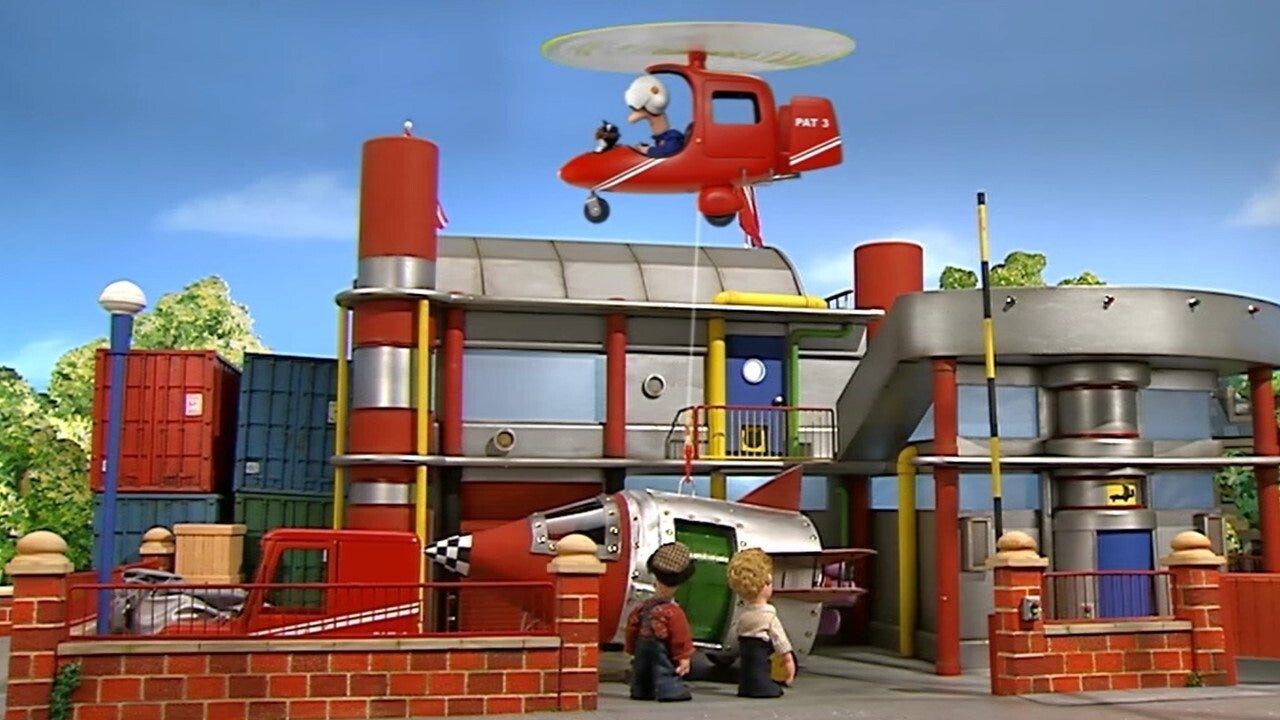
In Postman Pat: Special Delivery Service, Pat still lives with Sara and Julian in Greendale, but he now works for the Special Delivery Service, whose local centre is in the nearby town of Pencaster. The centre is run by a new character, Ben Taylor; his wife Lauren has taken over as Greendale’s teacher, and their daughter Lizzy attends the school with the other children. Other new characters are mobile shop operator Michael Lam, and from the third series, lighthouse keeper Chris Beacon.
Virtually every episode begins with Ben ringing Pat and instructing him to come to the mail centre to undertake a highly distinctive delivery on behalf of one of the other regular characters. His trademark red van has now been supplemented with a range of other specialist vehicles, including a larger van, a helicopter, a jeep, and a motorcycle with side-cart, to match the broader range of deliveries he is charged with. The formulaic plots usually surround an unforeseen event holding Pat up, and threatening to stop the delivery occurring on time. However, a combination of his own problem-solving ability and help from his friends always enables Pat to complete the task satisfactorily, each episode concluding with Pat signing off by stating, with both thumbs up, ‘Special Delivery Service: Mission accomplished!’
SDS and the transformation of the postal sector
There was notable thematic shifts between the first and second series of Postman Pat alone, the latter coming as it did a decade and a half after the former, and without Cunliffe’s involvement. Simultaneously, there has been a stylistic continuity, with Cosgrave Hall – the long-established animation studio that BBC has commissioned to make Postman Pat since the 2000s – retaining the likenesses of Wood’s characters and usage of stop-motion.
Yet what is particularly striking about the Special Delivery Service series, compared to their predecessors, and especially that very first iconic series, is the difference in Pat’s work. Those earliest episodes focused entirely on their main character at work, wholly separate from his off-screen personal life (hinted at by references to ‘the wife’), albeit in a role that embeds him within his rural community and involves extensive sociable interaction. That work itself is depicted as socially valuable, given the importance of the letters and parcels he delivers to their recipients, but utterly routine in nature, occasional (usually weather-related) mishaps aside.
Special Delivery Service, by contrast, reflected two major shifts that had occurred since the outset of the twenty-first century. Under New Labour (and subsequently the Coalition government), Britain’s postal services underwent a process of incremental privatisation and marketisation, including the differentiation of the ‘Royal Mail’ brand from the ‘Post Office’ one, and then the end of its monopoly on postal deliveries. SDS likewise functions as a distinguishing occupational identity for Pat, connecting him to the Pencaster mail centre, and involving far less interaction with Mrs Goggins and Greendale’s own Post Office. Secondly, with the rising advent of the internet, the volume of letters being handled by the postal services declined, in contrast to the increasing delivery of goods being ordered online, as highlighted in a 2008 government-commissioned review of the sector. Pat’s shift to standalone deliveries of big-ticket items with particular rationales behind them likewise reflected this change.
Keeping on time
Timeliness is another major theme of this work. Most episodes begin with Pat at home with Sara and Julian when Ben contacts him on his mobile phone, their interactions typically a variation or not on: ‘I’ve got an unusual one for you today, Pat; how soon can you get here?’; ‘We’re on our way!’. Pat is then tracked during his delivery by Ben back at the postal centre. Occasionally this focus on being on time is commented on, slightly tongue-in-cheek. In ‘Pat’s Special Delivery: A Super Magnet’, for example, Ben commends Pat for getting to the centre in thirty seconds’ less time than the day before. The possibility of Pat being constantly on-call potentially conflicting with his personal life is far less frequently commented on, save with the notable exception of ‘Postman Pat and the Seaside Special’, where a sudden call interrupts Pat’s planned family outing:
BEN: I’ve got an urgent delivery.
PAT: Oh, but I’m just off to the seaside.
BEN: I know, I’m really sorry, Pat; I’d do it myself but we’re really…busy.
PAT: Don’t worry, Ben, I’m on my way.
Subsequently he has to reassure Julian that he will be at the station on time to make the trip. And indeed this anxiety over whether Pat will indeed be on time, except for his deliveries, with disappointment looming for other named characters if he is not, is the dominant emotional underpinning of his adventures, albeit with reassurance through repetition that he will overcome whatever obstacles have inevitably beset him and get there just in time, to the gratification of the intended recipient(s) of his delivery.
Difficult deliveries and agile work
The deliveries always threatening to go wrong is an outcome in many ways of their diversity, the un-routine nature of his work (the routinisation comes instead through the standardised narrative structure). Sometimes Pat is charged with delivering animals, such as a cow or a beehive to the Thompsons’ farm, or fruit bats or duck eggs to Amy. At other times it is advanced, often improbable, technology, such as robots, a super magnet, a disco machine, a solar-powered karaoke machine, and a weather machine. With both of these types of delivery, there is a high propensity for chaos, arising from the animals’ own independence of mind, or the machinery’s capacity for malfunctioning.
Such high-hazard transportation work in real life requires different forms of specialisation. Pat, however, brings a resilience and ingenuity to the role that enables him to correct setbacks, including ones resulting from his own carelessness, and make his deliveries after all. He does so with the aid of a broad range of available vehicles that augment his capacity to do this breadth of work, though this too often still requires him to make adaptations to them or overcome their own breakdowns.
The point is that Pat is an agile worker – sometimes quite literally performing somersaults and stunts in his efforts to get his deliveries through. In the episode ‘Pat’s Special Delivery: A Surprise’, Ben plans to award Pat with the ‘SDS gold star’, explaining ‘Pat’s the best of the best…he’s never been late with a delivery’. When Ben and Pat’s other friends attempt, however, to keep Pat occupied while they organise a surprise party at which to award him the star, the postman predictably overcomes whatever delays they arrange. Though still a decidedly communal figure, Pat is not an ordinary employee, nor a standard representative of public service, as had been the case in those early 1980s episodes. He is, rather, a remarkably resourceful and adaptive embodiment of a world of work in which punctuality in the face of unpredictability, aided by technological solutions rather than professional specialisation, is the guarantor of societal good.
If you’ve enjoyed this post, please consider supporting my work by becoming a free or a paid subscriber to the newsletter. Paid subscribers can access my full archive of posts at any time, and are vital to me being able to continue producing and expanding this newsletter.
You can also support my work by making a one-off payment, at a price you consider affordable.
Otherwise, please show your appreciation by sharing this post more widely, and referring the newsletter to friends.
You might also enjoy these posts from the Academic Bubble archive:
Troublesome Engines (1950)

The Rev. W. Awdry’s Troublesome Engines centred on a Christianised notion of moral economy, in which industrial action was pitted against unitary righteous authority.
Progressive Politics, Popular Culture, and Public Memory in Contemporary Britain

In which our intrepid author agrees to write a book about how both politicians and cultural producers vie to tell ‘progressive’ stories about Britain’s, and British culture’s, past.
Katie Morag (2013–2015)

Set on a fictional Hebridean island, this children’s television series gently and thoughtfully reflects on tradition and change in rural community life, from the perspective of its young protagonist.