Progressive Politics, Popular Culture, and Public Memory in Contemporary Britain
In which our intrepid author agrees to write a book about how both politicians and cultural producers vie to tell ‘progressive’ stories about Britain’s, and British culture’s, past.

Please support my work by becoming a free or a paid subscriber to the newsletter. Paid subscribers can access my full archive of posts at any time, and are vital to me being able to continue producing and expanding this newsletter.
This post is part of the ‘Research and Reflections’ occasional series, consisting of pieces based on my ongoing academic research, as well as on my musings on and responses to current affairs and personal developments.
2024 drew to a close with a pretty positive professional development: I signed a contract with Palgrave Macmillan to write what will be my first solo-authored book, provisionally titled Progressive Politics, Popular Culture, and Public Memory in Contemporary Britain. It is extremely exciting news and I’m really looking forward to working on it over the next two years or so, and writing regularly about the research I do for it here for the newsletter.
(Shameless request: I ought to mention here that being on a fixed-term, teaching-only contract, the research and writing I am doing for the book is virtually entirely unpaid, so if you want to support it, please do consider taking out a paid subscription to the newsletter. It also enables me to keep producing work for this outlet. Paid subscriptions are £3.50 per month or £35 for a year at the time of writing, and give you access to my full archive of posts; however, new subscribers get 50% off for the first 12 months, so please do consider taking advantage of this offer. Thank you!)
Anyway, the book’s key argument (as I see it, at the outset of writing it) is that culture has become increasingly important as a realm in which the contours of different forms of progressive politics are shaped and contested; and that, though ostensibly future-oriented, these expressions of progressive politics have often been retrospective in focus, concerned with their own histories.
This has happened at the intersection of three broader developments. Firstly, the of evolution of progressive politics in Britain in the late 20th and early 21st century, particularly as the Labour Party in and out of power went through phases of convulsion over the question of what social democracy should look like in the wake not only of Thatcherism and the erosion of the post-war settlement, but also of the rise of intersecting social movements beyond the traditional left.1
Secondly, the transformation of cultural industries as part of a post-industrial, informational society, in which they have been feted as new sources of economic growth and as traditional barriers and hierarchies have been dismantled through digitisation, but also in which external and internal conditions that made a career in the sector possible, particularly for those without inherited wealth and contacts, dissipated.2
The third phenomenon is a transformation in public memory itself in the age of the so-called ‘memory boom’, whereby the strengthening of generation as a basis of identity, the erosion of the institutions and norms of industrial society, and the advent of new forms of media radically expanded, transformed, and pluralised the ways in which the past is remembered.3
Defining progressive cultural memory
In taking ‘progressive politics’ – and its intersection with popular culture and public memory – as the book’s focus, I am putting forward the argument that from the late 20th century onwards, there was a closer alignment of economically redistributive political positions with socially liberal ones, particularly related to combating discrimination on grounds of race, gender, and sexuality. Certainly, the Labour Party was – as with Western social democratic parties elsewhere – the principal actor in high politics that most embodied this trend, although other parties such as the Liberal Democrats and the Scottish National Party also competed on this terrain.4
Yet this ideological congealment extended further and deeper, speaking to the priorities of a wider social constituency, and expressed not only as a coherent doctrine or set of policies, but also more nebulously as a form of cultural aesthetics and personal dispositions. It has been marked by fragmentation and internal contradictions, including accommodations with or even embraces of communitarianism and neoliberalism. These flaws have inhibited its effectiveness and appeal as a political project, but not its wider cultural preponderance. It has manifested as support for Labour at times, but also around other political events such as the campaign against leaving the European Union (on which Labour was far more circumspect).
It has been marked, above all, by a sense of modernity, that the beliefs and affects it entailed were future-oriented, in opposition to a series of perceived retrograde equivalents that were associated particularly (but not solely or consistently) with the Conservative Party. Yet staking a claim for the hegemony of these values also necessitated their legitimisation through reference to the past and could also be expressed in ways that were heavily nostalgic, particularly in the face of perceived setbacks. This is why I have opted for the term ‘progressive’ as that which best encapsulates this political tendency and its parameters.5
It is therefore the contention of the book that while Labour is the principal actor in setting out this progressive project, it did not possess wholesale hegemony over it, and when it came to articulating a vision of the place of the past that adhered to progressive values, it did so in dialogue with a broader set of actors – especially within the cultural industries – that it had far less authority over.
Labour and cultural heritage
One of the book’s central areas of focus is Labour's relationship with cultural history and heritage, something I intend to explore through two principal case studies. One is how Labour politicians have articulated their own personal cultural histories as guests on the BBC radio programme Desert Island Discs, and how that relates to the way they understand the history of Labour and progressive politics, their own relationship to that history, and their conception of a progressive approach to culture.
These guests assembled a ‘soundtrack to their own lives’ as part of a wider process of canon reformation, including the shifting high/popular cultural divide, music’s role in generational, national, and political identities, and its relationship with other cultural forms. I also want to consider the reception of these episodes and their place in Desert Island Discs’ broader output, and their relationship with the formulation of Labour cultural policy in government and opposition. I am particularly concerned with how Labour politicians attempted to use the show to articulate an account of the cultural past that adhered to their broader ideological agenda, but in doing so had to adhere to an expressive framework set by BBC Radio in anticipation of the preferences of its listeners.
The other case study considers how considers how Labour councils have eroded subversive and radical cultural heritage through commercially driven urban regeneration projects. It does so through the prism of the famous The Four Aces Club in Dalston, Hackney: a disused former theatre and cinema turned into one of London’s most pioneering Black music venues in the 1960s and 1970s, and which later became the renowned indoor rave venue Club Labrynth in the 1990s. The club closed after Labour-controlled Hackney Council repossessed the premises in 1997, and was subsequently demolished it in 2007 to make way for a residential development.
I aim to explore the material and ideological concerns that drove the council to eradicate a site of such multi-layered cultural significance, as well as of the determined but ultimately unsuccessful movement to oppose the demolition. I also intend to look at the way The Four Aces has lived on in public memory since its demolition, and subsequent efforts by the council and developers to appropriate local Black history for the sake of granting their policies a progressive sheen. In seeking to impose a modern vision of urban life through regeneration, the council erased a crucial component of the Black cultural past, in a way that highlighted the limitations of Labour’s commitment to racial justice.
Mediating progressive cultural legacies
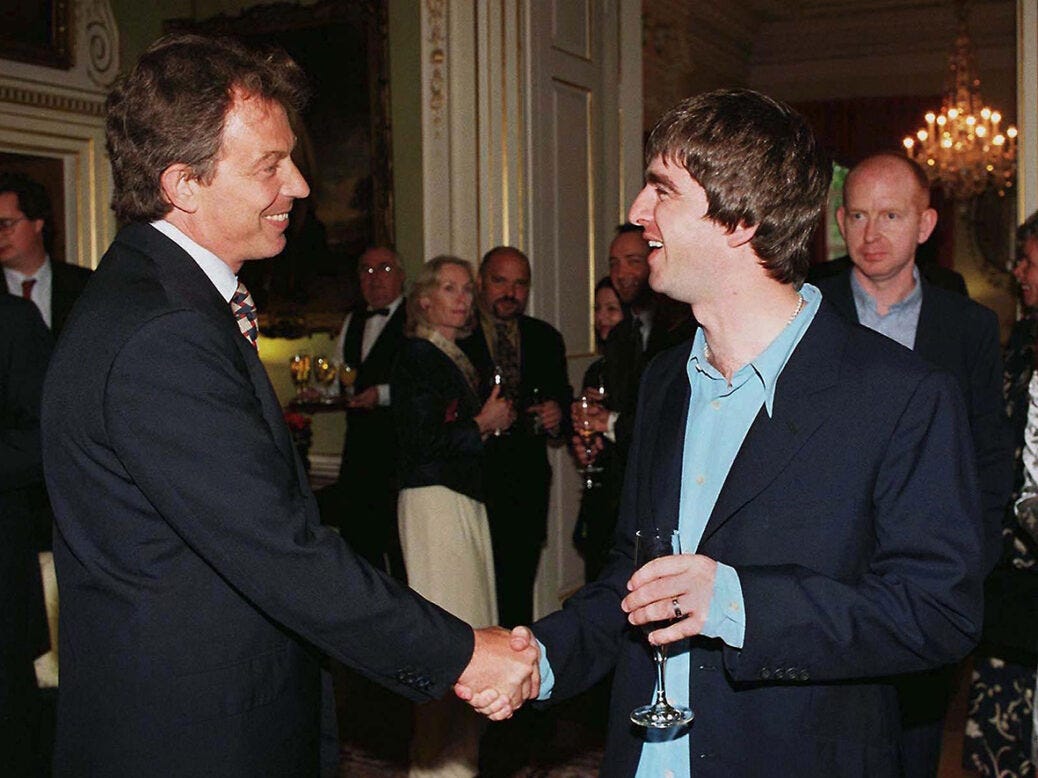
The book is also concerned with specific cultural projects with progressive connotations that they partly owed to their associations with New Labour, but which also had their own logic that went beyond that connection, and continued to evolve long after New Labour had left office. One of those is the afterlife of New Labour’s best remembered dalliance with popular culture, with Britpop: the surge of bands producing guitar-centred rock music within an explicitly British music canon and who enjoyed substantial domestic commercial and critical success during the mid-1990s, when – like the New Labour opposition – they seemed to capture a mood of national optimism.
This legacy soured, however, as Britpop bands and the wider media – left and right – came to look at the mutual endorsement of New Labour and Britpop with increased cynicism after the former entered government, and especially after the Iraq War. The New Labour-Britpop relationship, however, later came to be seen as a template for future governments’ relationships with the cultural industries, while former Britpop artists continued to be expected to act as commentators on politics. Ultimately, a new nostalgia emerged for Britpop as a hallmark of a period of working-class prominence in music and popular culture more widely, in contrast to the apparent overrepresentation of a privileged minority in the contemporary cultural industries.
(This is, incidentally, a topic I have previously written about for this newsletter).
Another legacy the book will explore is that of the 2012 London Olympics, which functioned as a beacon for public remembering of the New Labour government that successfully bid for it, and the Ken Livingstone mayoralty that did much to deliver it, at a point when the Conservatives governed both London and Britain. These related to a broader emphasis on the idea of ‘legacy’ both in the planning of the 2012 Games and in the modern Olympic movement more broadly, as well as with the narratives of a progressive, inclusive British history projected through and around the Games.
Yet the 2012 Olympics itself subsequently became an object of progressive nostalgia following the UK’s narrow vote to leave the EU, as it came to be seen as emblematic of a more tolerant and outward-looking form of nationhood that had since been taken away. This elided much of the context of and tensions around the 2012 Games, and promoted critiques of this allegedly Olympic-centred worldview from both left and right.
Progressive historical fictions
Finally, the book also aims to consider narratives originating wholly outside of elite politics, in fictions constructed by the cultural industries, but that were nonetheless characterised by many of the same political inclinations as those discussed above. This includes, for example, Made in Dagenham and Pride, which relayed histories of industrial action intersecting with histories of women’s and gay liberation respectively. (Again, these are two films that I have previously covered for this newsletter).
Made in Dagenham originated through encounters with the memories of the striking women machinists at Ford Dagenham from 1968; Pride with those of members of the Lesbians and Gays Support the Miners movement of 1984-85. These events were transformed into semifictional cinematic narratives that presented whiggish stories about the advancement of women’s and gay rights while marginalising the element of class struggle equally integral to these events, and therefore evaded more challenging narratives of deindustrialisation and de-unionisation. Yet these film narratives – and connected para-narratives – were shaped by the industrial logics of a fragmented UK film production sector reliant on multiple funding streams and an older niche of cinemagoers. They persisted and developed in the reception and afterlives of these films, most notably in the adaptation of Made in Dagenham into a stage musical.
This type of progressive cultural memory is also discernible in children’s television. CBeebies programmes Postman Pat and Katie Morag offered early 21st-century depictions of traditional remote communities – one in approximate vicinity of the Yorkshire Dales and The Lake District, the other in the Scottish Highlands. The former is rooted in the original children’s television series written by John Cunliffe and screened on BBC in the early 1980s; the latter in the series of books written by Mairi Hedderwick from 1984.
I want to consider how the two programmes portrayed rural communities interconnected by and connected to the wider world through the mail, at a time when electronic mail was increasingly supplanting paper-based communication. They were also made at a point when mail services were more broadly undergoing cuts and privatisation, as well as against a backdrop of real rural communities often facing environmental, infrastructural, economic, and social problems. Postman Pat ‘Special Delivery Service’ depicted a more ideologically neoliberal and technologically advanced postal service, whereas Katie Morag offered a more traditional vision of the local post office. Both shows need to be understood within the context of the BBC’s ambitions for high-quality public programming intended to both educate and entertain young children, while itself facing increasing financial challenges post-2010.
Drawing these themes together
These might seem disparate threads to intertwine; they certainly do not comprise a comprehensive account of all progressive visions across all popular cultural forms over the past thirty years or so. They do, however, adhere to the logic I outlined above: that British politicians have offered progressive visions of the past through the prism of cultural policy, but that cultural industries and producers have also crafted their own retrospective progressive narratives that have proven just as impactful.
While much attention has been given to nostalgia as an aspect of right-wing politics, and the role of ideas about the past in fuelling radical or issue-based social movements has also received some coverage, I hope the book also draws attention to the role of ideas about the past in informing broadly mainstream progressive norms. In doing so, I hope to explain how certain progressive norms, rooted in optimistic histories of Britain, have become at times seemingly culturally hegemonic, without that necessarily translating into political hegemony.
If you’ve enjoyed this post, you can also show your appreciation by sharing it more widely, recommending the newsletter to a friend, and if you’d like, by buying me a coffee.
You might also enjoy these posts from the Academic Bubble archive:
On the evolution of progressive politics in Britain, see:
Andy Beckett, The Searchers: The Searchers: Five Rebels, Their Dream of a Different Britain, and Their Many Enemies (London: Penguin, 2024).
Colm Murphy, Futures of Socialism: ‘Modernisation', the Labour Party, and the British Left, 1973–1997 (Cambridge: Cambridge University Press, 2023).
Andrew Murray, The Fall and Rise of the British Left (London: Verso, 2019).
Emily Robinson, The Language of Progressive Politics in Modern Britain (London: Palgrave Macmillan, 2017).
Lucy Robinson, Gay Men and the Left in Post-war Britain: How the Personal Got Political (Manchester: Manchester University Press, 2011).
On the changing cultural industries, and their relationship with politics, see:
Phoenix Andrews, I Heart Politics: How People Power Took Over the World (London: Atlantic Books, 2024).
Toby Bennett, Corporate Life in the Digital Music Industry: Remaking the Major Record Label from the Inside Out (London: Bloomsbury, 2024).
David Hesmondhalgh, Kate Oakley, David Lee, and Melissa Nisbett, Culture, Economy and Politics: The Case of New Labour (Basingstoke: Palgrave Macmillan, 2015).
Robert Hewison, Cultural Capital: The Rise and Fall of Creative Britain (London: Verso, 2014).
Dave O’Brien, Cultural Policy: Management, Value and Modernity in the Creative Industries (Abingdon: Routledge, 2014).
On the changing nature and practices of memory, see:
Agnes Arnold-Forster, Nostalgia: A History of a Dangerous Emotion (London: Picador, 2024).
Tobias Becker, Yesterday: A New History of Nostalgia (Cambridge, MA: Harvard University Press, 2023).
Red Chidgey, Feminist Afterlives: Assemblage Memory in Activist Times (Cham: Palgrave Macmillan, 2018).
Red Chidgey and Joan Garde-Hansen, Museums, Archives and Protest Memory (Cham: Palgrave Macmillan, 2024).
Peter Mitchell, Imperial Nostalgia: How the British Conquered Themselves (Manchester: Manchester University Press, 2021).
On the broader development of this trend on the left, see Herbert Kitschelt, The Transformation of European Social Democracy (Cambridge: Cambridge University Press, 1994).
As a very rough exercise, I put the term ‘progressive’ through a Google Ngram analysis of the British English corpus, which suggests it went from a post-war nadir in the mid-1990s to a 50-year peak in the mid-2000s, before declining again.


