
First Blood (1982)
The increasingly destructive competition between Vietnam veteran John Rambo and small-town Sheriff Will Teasle is at essence a battle between two rival, right-wing visions of America.

Please support my work by becoming a free or a paid subscriber to the newsletter. Paid subscribers can access my full archive of posts at any time, and are vital to me being able to continue producing and expanding this newsletter.
This post is part of the ‘Rewound’ series of analyses of objects or episodes from cultural and political history.
Content warning: Cancer; Death; PTSD; Violence.
Spoiler alert: This analysis of the film First Blood and its themes reveals plot details for the purpose of enhancing that analysis.
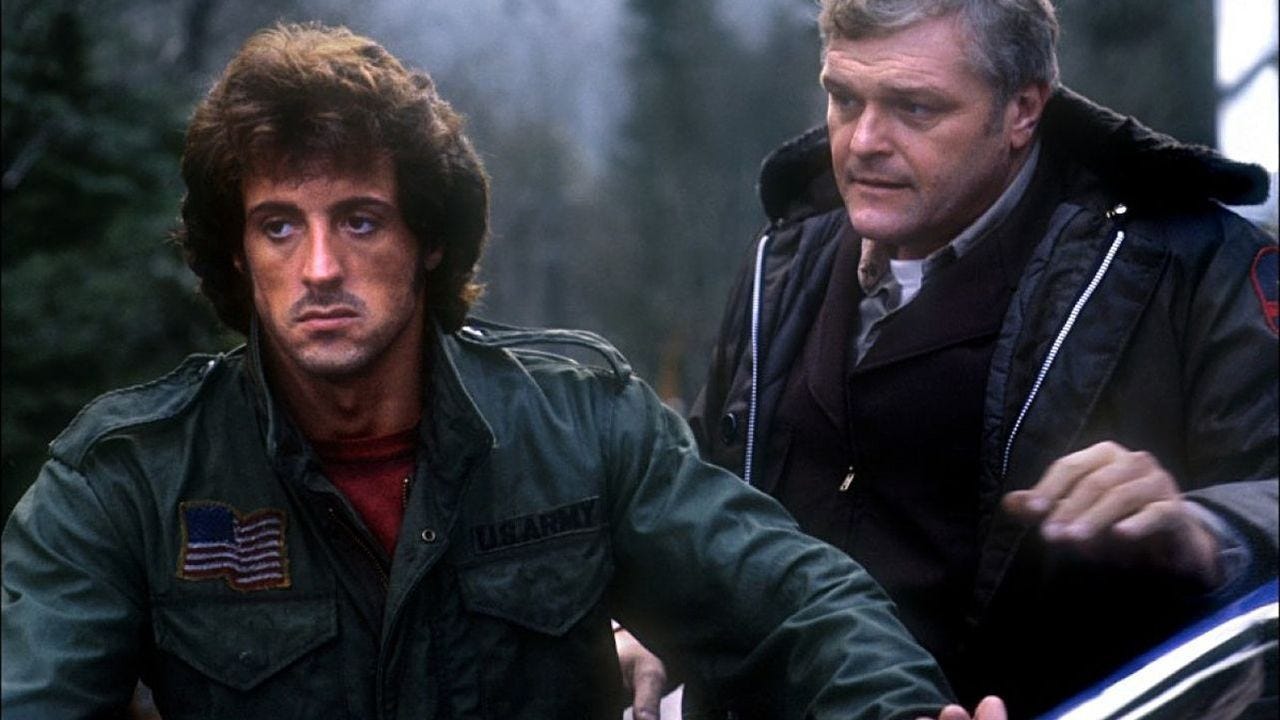
Adapted from David Morell’s novel of the same name, First Blood was the first in what became the ‘Rambo’ franchise of films. Green Beret and Vietnam veteran John Rambo (Sylvester Stallone) visits the home of the only other surviving member of his unit, Delmar Barry, only to find out that Barry has died from cancer caused by exposure to Agent Orange during the conflict. Rambo subsequently travels to the small town of Hope, Washington. There, he immediately catches the hostile attention of Sheriff Will Teasle (Brian Dennehy), who sees him as an undesirable vagrant, and transports him out of town; when Rambo defiantly tries to immediately return to Hope, Teasle arrests him.
At the police station, Rambo is taunted and brutalised by Teasle’s men, particularly the sadistic senior officer Art Galt (Jack Starrett), causing him to experience flashbacks to being tortured in Vietnam. He overpowers the policemen guarding him and escapes from the station, stealing a motorcycle and heading for the local woods. The furious Teasle leads a search party to track Rambo down, including helicopter surveillance featuring a vengeful Galt. When Galt spies Rambo, he ignores Teasle’s orders and tries to shoot to kill him; Rambo is wounded in trying to escape, but throws a rock that cracks the helicopter windshield, leading to Galt falling out to his death.
Rambo tries to intimate to Teasle that Galt’s death was an accident, but Teasle and his deputies open fire. Rambo flees but, as they give chase, he subsequently subdues them all with a series of booby traps and ambushes, before holding Teasle himself at knifepoint, warning him to end his pursuit, and then escaping further into the woods. Instead, the town’s police are joined by Washington State Patrol and the National Guard in an increasingly largescale manhunt. At this point, Teasle is visited by Rambo’s former commanding officer, Colonel Sam Trautman (Richard Crenna), who seeks futilely to warn him of his former charge’s vast resourcefulness and lethality. At Teasle’s behest, Trautman makes radio contact with Rambo and unsuccessfully tries to persuade him to hand himself in. Rambo is clearly moved to hear from Trautman, but refuses to heed his request.
The National Guard subsequently corner Rambo at an abandoned mine and instead of heeding Teasle’s order to await his arrival, fire a rocket launcher at it, destroying the mine and seemingly killing Rambo. However, he survives the blast and manages to dig himself out from being trapped underground, before hijacking a military truck and again making his way back to Hope. Once there, Rambo unleashes a wave of destruction, destroying a gas station and cutting the town’s power supplies. Teasle tries to stake Rambo out from the police station roof, but Rambo breaks into the building and shoots and wounds the Sheriff, only refraining from killing him due to Trautman’s intercession. Rambo then breaks down in front of his former commander, sobbingly recounting his traumatic experiences in Vietnam and subsequent alienation and neglect as a veteran back in the US. Trautman comforts Rambo, and accompanies him as he is taken into federal custody.
Rambo, Trautman, and Vietnam
As a character, Rambo in First Blood combines an almost childlike innocence with a ruthless capacity for violence, his motivations partly masked by Stallone’s often passive portrayal. There is a certain boyish naivete to the way he first introduces himself to his former comrade’s widow at the start of the film, disregarding her insistence that Barry is not there, excitedly chattering on as he presents her with a photo of the two of them and the remainder of their unit. The revelation of his death is clearly shattering and leaves him psychologically adrift.
Rambo routinely responds to the police’s hounding of him by expressing a sense of hurt and self-pity at being picked upon. ‘Why are you pushing me?…I didn’t do anything,’ he asks Teasle as he tries to escort him out of Hope. ‘It’s not my fault. I don’t want any more hurt,’ he later tells the search party in vain after Galt’s death. Such protestations alternate with Rambo stubbornly defying authority, and responding to violence by escalating it. He states the logic of his conduct in his radio call with Trautman, doggedly insisting that ‘They drew first blood’.
Trautman takes a barely concealed paternalistic and professional pride in Rambo’s one-man war, in his capacity for survival and destruction beyond the ken of the civilian authorities. He introduces himself to Teasle with the announcement that ‘God didn’t create Rambo. It was me.’ He subsequently expands: ‘I recruited him, trained him and commanded him for three years in Vietnam. He belongs to me.’ The relationship between Trautman and Rambo, as both men (and others) view it blurs the lines between father/son, maker/machine, and officer/soldier.
Yet it is apparent that Trautman’s Vietnam is not quite Rambo’s. Rambo’s flashbacks to his military service prompt him to equate the dehumanising treatment inflicted upon him as a prisoner of war with that he receives from the police in Hope. This leads him to readopt the same methods of survival and pursuit of victory here that he did there. As Trautman puts it:
He’s the best with a gun, a knife, and his bare hands. He was trained to ignore pain and the weather, and to eat things a goat would puke up. In Vietnam his job was to get rid of enemy personnel, to kill them. Winning by attrition. And Rambo was the best!
But if the exercise of self-reliance, ingenuity, and retributive violence provide Rambo with a comfort zone, it is not one he has chosen for himself. He cannot get over either the violence he experienced in Vietnam, nor the loss of the camaraderie and esteem he had there. As he tells Trautman in his monologue at the end of the film:
Nothing is over! Nothing! You can’t just switch it off! It wasn’t my war. You asked me, I didn’t ask you!…Civilian life means nothing to me. There we had a code of honor. You watch my back, I watch yours. Here there’s nothing!…There I flew helicopters, drove tanks, had equipment worth millions. Here I can’t even work parking!
He subsequently recounts the death of one of his fellow soldiers, dismembered by a booby-trapped shoe shine box, in blow-by-blow detail, and with a frenzied emotion that makes clear that the brutality he witnessed there remains very much a live experience for him. ‘I can’t get it out of my head. It’s seven years ago. I see it every day.’ The war has trapped Rambo in an arrested adolescence, incapable of moving beyond the structures of close fraternal bonding and clearly defined (but legitimate) hierarchies of military service, while also ensuring none of his comrades would get to grow old.
Teasle, policing, and the civilian order
The subsequent evolution from First Blood into a whole ‘Rambo’ franchise invites a teleological reading of the film as being entirely about Rambo, entirely on the side of him against the police, on the side of the Vietnam veteran against a callous society. Yet that would be an oversimplification. It is more meaningful to see it as a clash between two right-wing visions of America, with their overlaps as well as contrasts. One of them is epitomised by Rambo, an authentic version of America that cannot be realised in America any more, who would subsequently find his wild frontier again in Vietnam and Afghanistan in the film’s sequels. But the other, the conservative America of small towns, of productivity, respectability, and conformity, is Teasle’s world. And he is almost as much First Blood’s protagonist as Rambo is.
Not that we are invited to sympathise with him; at least, not at first. Aided by Dennehy’s sneering countenance, the viewer is inclined to share Rambo’s consternation that Teasle is running him out of town just for wanting to stop for something to eat. Yet a shift certainly comes with Galt’s death, when one of the younger (and more humane) deputies, Mitch Rodgers (David Caruso) expresses bemusement as to why they are pursuing a man who, they have just discovered, is a Green Beret and war hero. Teasle responds furiously: ‘That’s Art Galt, boy! We were friends when your mother was still wiping your nose!’ Galt’s awfulness in life, apparent to the audience, does not render us unempathetic to Teasle’s emotional and vengeful response to his death.
In the scene that follows, as Rambo turns from hunted to hunter, we find ourselves in the company of Teasle and his deputies, unsure as to where Rambo is, sharing in their fear and suspense as he violently ambushes them one-by-one, resembling the stalking, psychotic killer in a slasher flick, until only Teasle is left unmaimed. This initiates a partial transferral of our identification towards the sheriff that persists as the film proceeds.
It is increasingly clear by this point that Teasle has an ethos, again not initially a particularly sympathetic one, but that also motivates him as clearly as Rambo’s own moral code does him. As he explains when Rambo asks why he is driving him out of Hope:
We don’t want people like you here in our town. Drifters. Before you know it there’s a whole pile of people like you. That’s why! Besides, you wouldn’t like it here, it’s a quiet place. Some would even call it boring. But we like it that way. I get paid to keep it like that. Boring.
As much as Rambo is compelled to reject infringement on his autonomy by illegitimate authority, so Teasle is to ensure his own unitary authority is uninhibited by illegitimate challenges to it. He is not party to Galt’s brutal treatment of Rambo in the cells, and when subsequently confronted with it as the cause of Rambo’s escape and Galt’s subsequent death, he refuses to brook the validity of either:
If one of the deputy sheriffs goes too far, the prisoner comes to me! If he’s right, I kick the deputy sheriff’s ass! I’m the law! And that’s how it should be. If you trample on the law, there’s hell to pay!
Yet Teasle’s status as the epitome of the law is already clearly fraying, first and foremost in the face of the chaos wrought by Rambo, but also from the arrival of the Washington State Police and the National Guard, and then by the military in the form of Trautman. The latter’s belittling of Teasle and his men’s capability to deal with a superior form of expertise clearly rankles with the sheriff, who nonetheless seeks to maintain an uneasy but effective collaboration with the Colonel. This is a product of Teasle’s own relentless though embattled professionalism, which also prompts his dismay when the National Guardsmen – whom Teasle subsequently derides as ‘a bunch of weekend warriors’ – apparently kill Rambo and blow up the mine rather than waiting on his arrival and order.
Trautman repeatedly chastises Teasle for his incomprehension and underestimation of Rambo, but is guilty of the same shortcoming in his dealings with Teasle. ‘But you’re a civilian,’ Trautman tells him, when Teasle remains frustrated by his own failure to bring Rambo to justice. ‘You’re going back to your wife and your house. You don’t have to make sense out of all this.’ Yet when Rambo returns alive and lays siege to Hope, Trautman unsuccessfully pleads with Teasle to recognise the mounting evidence that he is outmatched, only to be told: ‘It’s my job, Trautman, it’s my town! I’m not giving it up to you, Rambo, or anyone else!’
First Blood, then, is a film above all about a clash between two men who cannot and will not back down in the face of each other’s intransigence, precisely because their respective codes embody wider social worlds and worldviews that are both comparable and incompatible. It captures latent contradictions inherent in the conservative American political coalition so dominant in the era of the Reagan presidency, between overseas military adventurism and domestic prosperity and orderliness, the former only capable of coexisting with the latter only as long as it could be concealed or held at arm’s length, as long as the war never comes home.
If you’ve enjoyed this post, you can show your appreciation by sharing it more widely, recommending the newsletter to a friend, and if you’d like, by buying me a coffee.
You might also enjoy these posts from the Academic Bubble archive:


