The Living Daylights (1987)
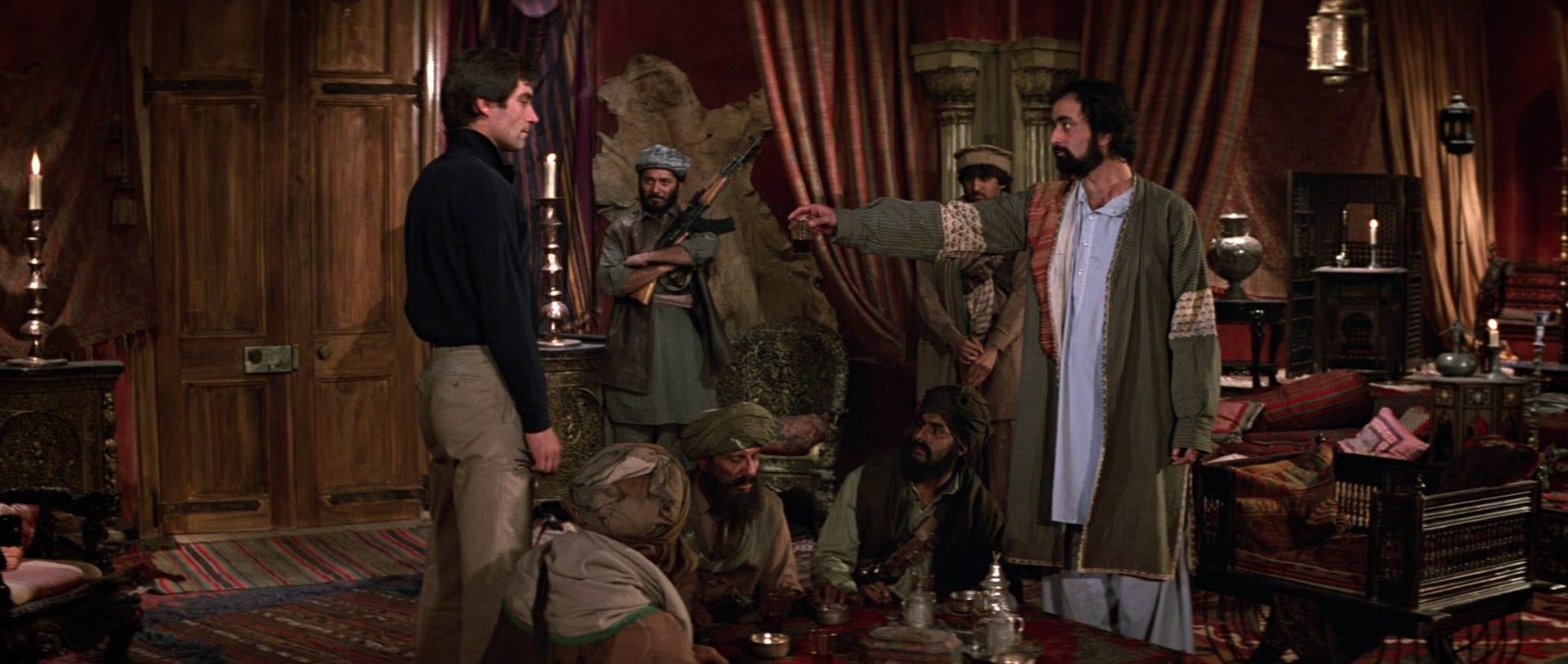
The Living Daylights both deviated from and demonstrated some of the hallmarks of the Bond franchise in its depiction of the Soviet-Afghan War.

Please support my work by becoming a free or a paid subscriber to the newsletter. Paid subscribers can access my full archive of posts at any time, and are vital to me being able to continue producing and expanding this newsletter.
This post is part of the ‘Rewound’ series of analyses of objects or episodes from cultural and political history.
Content warnings: Violence; Murder; Narcotics.
Spoiler alert: This analysis of the film The Living Daylights and its themes reveals plot details for the purpose of enhancing that analysis.
As far as action heroes go, James Bond and Rambo could not seem more different. Suave, sophisticated, womanising secret agent versus traumatised outcast veteran commando. A suit and bowtie versus a tank-top and khaki trousers. A fantasy of continued British influence in contemporary global affairs versus a dystopian product of America’s actual pre-eminence in them.
Yet when the two latest instalments in these film series appeared in 1987 and 1988 respectively, they featured one strong parallel. The Living Daylights was set partly, and Rambo III mostly, in Afghanistan – the site of a by then drawn-out, hugely destructive conflict between occupying Soviet forces and Islamist guerrilla fighters, the Mujahideen, who sought to expel them and their ideological influence from the country.
These two films then, viewed side by side, are valuable for the insights they offer into how the war and its combatants were viewed within the West. Yet more than this, the way both films integrate this conflict into their own wider, imagined worlds sheds light on the respective series’ narrative conventions and protagonists, and the way these were steeped within particular understandings of the Cold War.
In this first post, I’ll provide some of the context of the Soviet-Afghan War, before examining The Living Daylights and its place within the broader Bond film franchise. Part II, which will appear next month, will consider the ‘Rambo’ film series and Rambo III specifically, before finishing with a comparison of The Living Daylights and Rambo III.
The Soviet-Afghan War
In 1978, the People’s Democratic Party of Afghanistan (PDPA), with Soviet support, overthrew the autocratic regime of Mohammad Daoud Khan and established a new Democratic Republic of Afghanistan along Marxist-Leninist lines. The PDPA were, however, riven by factional infighting, lacked broader legitimacy in Afghan society, and faced staunch opposition from influential Islamist groups. In September 1979, president Nur Muhammad Taraki was deposed by his second-in-command Hafizullah Amin, who sought rapprochement with the US and with the Islamists. Alarmed by these developments just across the border, the Soviets invaded in December, deposing Amin, and replacing him with the more moderate Babrak Karmal.1

The invasion sounded the death knell for the already waning détente that had existed between the US and the Soviet Union during the 1970s. The situation was further exacerbated by domestic economic and ideological malaise and political instability in the Soviet Union – which had three elderly leaders die in office between 1982 and 1985 – and the election of the hawkish Ronald Reagan as US president. Tensions in the early 1980s reached their severest levels in two decades.
Reagan’s government channelled aid via Pakistan to various Mujahideen groups – who were themselves divided on ethnic, tribal, and personal (and to a lesser extent religious) lines – as well as funding the transportation of Islamist fighters from elsewhere in the world to Afghanistan, and (with Saudi Arabia) the education of Pakistanis and Afghan refugees in jihadist Islam. They fought a hugely effective guerrilla war against the Soviets and the Afghan government, who failed to win the support of either the Afghan people or the international community, and to maintain effective control of territory. Civilian casualties and displacement occurred on a huge scale, while death toll among military personnel was also high.

As with so much else, Mikhail Gorbachev’s appointment as Soviet leader in 1985 proved a watershed for the conflict. Committed to implementing economic and political reforms in the ailing Soviet Union and establishing far more harmonious relations with the US, he wanted to end the war in Afghanistan as soon as possible, albeit while saving Soviet face. He signed the 1988 Geneva Accords, which set the timeframe for Soviet withdrawal.
In their absence, the (now renamed) Republic of Afghanistan only survived until 1992, when the Islamic State of Afghanistan was established by some of the Mujahideen groups. With the Soviets gone and the Cold War coming to an end, the US was disinterested in the transition process, but Pakistan and other neighbouring states backed different Mujahideen factions who continued to battle for control of the country throughout the 1990s.
The James Bond film series
James Bond was the creation of novelist Ian Fleming, who published a series of novels about the spy between 1953 and his death in 1966. Fleming’s Bond embodied a rising professional class, as well as ideas about masculinity and about Britain as an imperial and Cold War actor, and pitted him against the fictional Soviet counterintelligence agency SMERSH.
The first Bond film adaptation, Dr No (1961), was made in Britain by EON Productions, set up especially for this purpose by US producer Cubby Broccoli and Canadian counterpart Harry Saltzman, with United Artists’ backing, and starring Sean Connery as Bond. This occurred at a time when American filmmakers were responding to declining domestic audiences by making fewer, bigger productions, prioritising international audiences more, and making films in cheaper locations. It was also encouraged by the British government’s policy of offering subsidies and tax breaks to films made in UK.2

In comparison with Fleming’s novels, the films placed a greater emphasis on entertainment, celebrating lavish Western lifestyles and Bond’s sexual prowess. Against the backdrop of détente, they were also far less focused on East-West rivalry. Instead, the films pitted Bond against mercenaries, terrorists, and megalomaniacs focused primarily on self-enrichment and world domination, epitomised by the global criminal enterprise SPECTRE who provided Bond’s main antagonists in many of the films of the 1960s and 1970s. Moving into the 1980s, the Bond films in many ways anticipated the geopolitical concerns of the post-Cold War world, as Klaus Dodds and Lisa Funnell have argued, becoming increasingly concerned with illicit processes of extracting and circulating resources.3
The Living Daylights
The 15th film in EON’s Bond franchise, The Living Daylights was partly based upon Fleming’s 1962 short story of the same name, in which Bond was tasked with providing sniper cover to help a British agent escape from East Berlin. It was the first of two films in which Timothy Dalton portrayed James Bond, taking over from Roger Moore (who was some two decades his senior).
The film begins in earnest with Bond aiding in the defection of a KGB officer, General Georgi Koskov (Jeroen Krabbé), during a concert in Bratislava, foiling an apparent assassination attempt by a female cellist in the orchestra, Kara Milovy (Maryam d’Abo), but deliberately aiming his shot to disarm rather than kill her. Once in England, Koskov informs MI6 that the new KGB head General Leonid Pushkin (John Rhys-Davies) has revived a policy of Smiert Spionam, meaning ‘Death to Spies’. Bond, who has crossed paths with Pushkin before, is sceptical, but is directed by MI6 head M (Robert Brown) to kill Pushkin during a visit to Tangier, to prevent an escalation of East-West tensions. Koskov is then apparently snatched by the KGB from his safehouse.
Bond tracks down Milovy, who is revealed to be Koskov’s girlfriend, and to have staged the assassination attempt. Posing as a friend of Koskov, he helps her escape the attention of the Czechoslovak secret police and to cross, under hot pursuit, the border to neutral Austria. Meanwhile, Pushkin is shown meeting American arms dealer Brad Whitaker (Joe Don Baker) in Tangier, where he cancels an arms deal Whittaker had previously signed with Koskov.
In Vienna, Bond and Milovy grow closer, and Bond enlists the assistance of Saunders, the MI6 agent whom he had collaborated with in aiding Koskov’s defection, to secure the necessary documentation for Milovy to travel over to the West. Saunders also informs him of the connection between Koskov and Whitaker, shortly before being brutally murdered by Koskov’s henchman, Necros (Andreas Wisniewski).
Bond subsequently travels over to Tangier, where he confronts Pushkin, who provides him with further details about Koskov’s arms deal with Whitaker. Bond then fakes the assassination of Pushkin, leading Koskov and Whitaker to believe the stage is clear for them to escalate their plans. Koskov and Necros kidnap Bond and Milovy from Tangier and fly them over to Afghanistan, where they are held prisoner on a Soviet military base, only to escape along with another prisoner, Kamran Shah (Art Malik), who turns out to be a local commander in the Mujahideen.
Bond and Milovy accompany Shah and his men to a meeting with Koskov, who is acquiring opium from them, the money from which will help fund their own operation. However, Bond tells Shah that Koskov is embezzling Soviet funds to acquire the opium, and then use the additional money from its sale to buy cutting-edge arms from Whitaker for Soviet usage in Afghanistan, while Whitaker and Koskov split the profits between them.
Bond sneaks on board the Soviet plane carrying the opium with the aim of destroying it with a timed bomb but is recognised back at the Soviet military base by Koskov and is forced to try and escape on the plane himself. He is aided in this by the sudden arrival of Shah with Milovy and the Mujahideen, who engage the Soviet forces there in combat. Bond escapes in the plane, which Milovy also boards but so too does Necros, whom Bond manages to kill. They then drop the bomb on a bridge to aid the Mujahideen’s escape from the pursuing Soviet forces.
Bond then travels to Whitaker’s base in Tangier, where he kills him after a fight between the two, before Pushkin arrives to arrest Koskov. At the end of the film, Milovy has been allowed to defect to the West and is performing as part of an orchestra in London, while she and Bond are now in a romantic relationship.
A British secret agent in Afghanistan
As an agent of the British state, Bond is depicted in The Living Daylights as both hugely professional and independent. He is mildly insubordinate towards his colleagues and superiors in MI6, deviating from Saunders’ plan in enabling Koskov’s defection. He is subsequently less credulous than M about the information passed on by Koskov and plots his own course in first pursuing Kara in Czechoslovakia rather than going directly to Tangier, because he had grasped that she was not a KGB assassin. At the same time, his commitment to his role and to his colleagues is demonstrated by his determination to avenge the killing of other British agents, particularly Saunders.
Though serving British interests, Bond spends most of the film’s running time performing a genteel Britishness – albeit in a far sedater and restrained manner than Dalton’s predecessors in the role had – in overseas and exotic locations, where he is perennially on the run or disguising his true intentions.
As with the earlier Bond films, The Living Daylights is not centred on the East-West divide per se. Scenes in the Eastern Bloc follow familiar tropes regarding the authoritarian nature of life there and the relative impermeable nature of borders. Yet even Bond’s confrontation with the Czechoslovak police when he is escaping the country with Kara is played out somewhat comically rather than involving lethal violence.
Moreover, Kara as a classically trained musician embodies a classed Europeanness which she shares with Bond, while Pushkin’s integrity and sense of humour render him an unexpected collaborator rather than adversary. Rather, the villains are those motivated primarily by greed, such as Koskov and Whitaker, both of whom betray their own countries’ interests for pursuit of wealth through trading in illicit goods.
In many ways, the film’s penultimate act in Afghanistan sits at odds with all this. Bond films typically drew upon the Cold War as a general milieu within which to locate their hero and his exploits; they much more rarely used specific contemporary developments within the Cold War as plot devices. With only its first part being based on an original Fleming story, The Living Daylights afforded space for a timelier representation of one of the Cold War’s ongoing hot conflicts.
Accordingly, the Soviets in Afghanistan are more portrayed as more conventionally villainous, particularly Bond’s, Kara’s, and Shah’s cruel jailer (played by Ken Sharrock). By contrast, when Bond first encounters the Mujahideen, he tells Kara they are ‘the Afghan resistance’, subtly illustrating where his sympathies lie. Furthermore, unlike in Bond’s earlier encounter with the Czechoslovak police, the film is also far more willing to show lethal violence being meted out to Soviet soldiers in Afghanistan.
Integral to this section is the introduction of Kamran Shah as an object of audience identification. He is a Mujahedeen but is Oxford-educated, speaks with a cultivated English accent (Malik being a British-Pakistani actor), and has a dry sense of humour – qualities that render him analogous to Bond and his world, despite his being rooted in an otherwise non-Western culture. Despite having his own mission to fulfil, he is willing to make concessions to help Bond achieve his efforts to bring down Koskov, recognising Bond’s interests in this regard as his own, and to later try and rescue Bond and Milovy. Bond reciprocates when aiding the Mujahideen’s escape from the Soviets. This intelligibility and identification between the Mujahideen and Britishness are reinforced when Shah and some of his men come to London to visit Bond and Milovy at the film’s finale.
You can the post on Rambo III, and its comparisons with The Living Daylights and Rambo III, here:
Rambo III (1988)
In Rambo III, the eponymous soldier hero exhibits a strained relationship with the country he serves, and forms a far warmer one with the Afghan mujahideen he becomes allied with.
If you’ve enjoyed this post, you can show your appreciation by sharing it more widely, recommending the newsletter to a friend, and if you’d like, by buying me a coffee.
For a more detailed account of the Soviet-Afghan War, and the broader intersection between radical Islamism and the late Cold War, see Amin Saikal, ‘Islamism, the Iranian Revolution, and the Soviet Invasion of Afghanistan’, in Melvyn P. Leffler and Odd Arne Westad (eds.), The Cambridge History of the Cold War: Volume III: Endings (Cambridge: Cambridge University Press, 2010), pp. 112–134.
For further analysis of the James Bond film series, see:
Jonathan Bignell, ‘Spies, Style and the Cold War: James Bond in the 1960s and 1970s’, Symbolism: An International Annual of Critical Aesthetics, Vol. 10 (2010), pp. 81–92.
James Chapman, License to Thrill: A Cultural History of the James Bond Films, 2nd edn. (London and New York: I. B. Tauris, 2007).
Lisa Funnell and Klaus Dodds, Geographies, Genders and Geopolitics of James Bond (London: Palgrave Macmillan, 2017).
Klaus Dodds and Lisa Funnell, ‘Going Atmospheric and Elemental: Roger Moore’s and Timothy Dalton’s James Bond and Cold War Geo-Politics’, in Henrik G. Bastiansen, Martin Klimke, and Rolf Werenskjold (eds.), Media and the Cold War in the 1980s: Between Star Wars and Glasnost (Cham: Palgrave Macmillan, 2018), pp. 63–85.


