
The Living Daylights (1962)
This short James Bond story explores the ambiguities of the Cold War, the professionalism and hierarchies of intelligence work, and the limitations of its protagonist’s brand of masculinity.

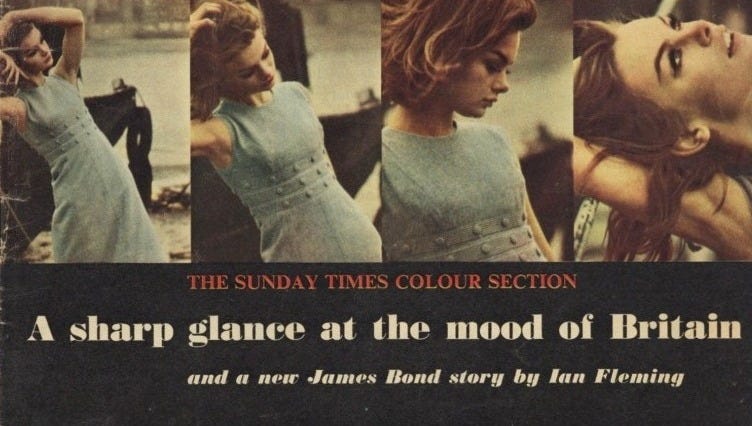
Please support my work by becoming a free or a paid subscriber to the newsletter. Paid subscribers are vital to me being able to continue producing and expanding this newsletter.
You can also support my work by making a one-off payment, at a price you consider affordable.
This post is part of the newsletter’s ‘Rewound’ series of analyses of objects or episodes from cultural and political history.
Content warning: Murder; Alcohol; Misogyny; Rape.
Spoiler alert: This analysis of the short story The Living Daylights and its themes reveals plot details for the purpose of enhancing that analysis.
The 1962 short story The Living Daylights begins with James Bond practicing hitting a narrow target with a high-accuracy rifle late one night at the National Shooting Centre in Surrey. Having impressed and intrigued the watching range officer, he departs for London to catch a flight. Earlier that day, Bond had been briefed by M., his commander at MI6, of his forthcoming mission. A British agent, ‘Number 272’, has obtained valuable information about the Soviet nuclear weapons programme, and has since been pursued by the KGB to East Berlin. 272 was to make a break across the – then still unwalled – crossing to West Berlin, but a double agent had revealed the scheduled place and time of his exit to the KGB, who will have one of their best snipers, codenamed ‘Trigger’, on hand to assassinate him as he makes his escape. Bond is tasked with sighting and shooting Trigger dead before he can fire on 272. The prospect of deliberately killing a man fills the agent with a sense of looming dread.
Bond arrives at a residential building in West Berlin on the corner of Kochstrasse and Wilhelmstrasse, overlooking the bomb-damaged terrain where 272 is to make his crossing in three days times. Within the building is the upstairs apartment Bond is to conduct his assignment from. There he meets Captain Paul Sender, the stuffy second-in-command at Station WB, to whom Bond takes an instinctive dislike. Sender shows Bond the Haus der Ministerien across the border in East Berlin, along which there is a row of darkened windows, one of which Trigger is likely to take his shot from. A Secret Service car parked nearby will backfire at the time when Bond takes the shot, to cover the noise.
Over the three days, Bond alleviates the stress of the upcoming job by consuming sleeping pills and whiskey, touring the western portion of Berlin – a city he considers rather drab – and reading a titillating thriller. In the evenings, he nervously surveys the likely portion of the Haus der Ministerien where Trigger will shoot from, himself watched by an equally nervy Sender. Sure enough, they spot the barrel of a Kalashnikov poking out from one of the darkened windows. Part of the building is occupied by the East German Ministry of Culture, where a women’s orchestra regularly practice. Bond watches the orchestra arrive at the building and is struck in particular by the beauty of their blonde cellist, whom he becomes infatuated with, mentioning her attractiveness while making small talk with Sender.
The evening of 272’s escape arrives. An increasingly tense Bond tries to calm his nerves, ahead of taking up his sniping position, with another drink of whiskey – much to Sender’s open disapproval. Just after 6:00pm, 272 makes his move. Sender breathlessly describes his progress across the broken ground along the border, while Bond trains his gun on the darkened window from which the Soviet gunman is likely to take aim. At the point where 272 is most visibly exposed, Bond spies the Kalashnikov and is stunned to realise that it is being wielded by the cellist from the women’s orchestra. He rapidly adjusts his aim and shoots the machine gun out of her grasp instead, enabling 272 to complete his passage to safety in the West. A hail of bullets is directed back at them, a fragment from one burning Bond’s hand.
As Bond reels over his discovery as to whom Trigger was, Sender apologetically informs him he will have to include in his report that Bond deliberately adjusted his aim so as not to kill the sniper, against orders, and potentially jeopardising the mission’s success. Bond admits that Trigger was in fact the cellist, which Sender indifferently states will also have to go in the report. Bond accepts this with equanimity, opining – as they await the armoured car sent to fetch them from the apartment – that his shot had likely still physically or psychologically harmed her enough that she will no longer be of use to the KGB as a sniper.
The Cold War, espionage, and Berlin
Christopher Lindner has argued that the staunch Cold War binaries of Ian Fleming’s 1950s Bond novels dissipated in his final works of the early 1960s, particularly in his shift of focus to criminal organisation SPECTRE as Bond’s principal enemy.1 This is partly evident in The Living Daylights. The KGB is here the principal antagonist – it is a Cold War story. Yet it is also marked by ideological and moral ambiguities. M. tells Bond early in the story that 272’s intelligence about Soviet atomic plans “Makes nonsense of the Geneva Conference and all this blather about nuclear disarmament the Communist bloc is putting out.”2 Yet with the KGB largely invisible – save for the revelation of Trigger’s identity near the end – there is little further exploration of differences in British and Soviet motives. This, in a story written and published between the 1961 Berlin Crisis and the 1962 Cuban Missile Crisis.
Instead, there is a great deal of mirroring. The Living Daylights pits two extremely adept intelligence agencies against each other, and while its portrayal of professional expertise is wholly centred on that of Bond and MI6, this operates in countercheck with the moves made by their unseen Soviet opponents, visible to the reader only inasmuch as they are gleaned by Britain’s secret service. As Sender acknowledges to Bond about the limitations to what they know, “They’re careful chaps, the opposition.”3 This word choice in itself implies sporting competition between equals rather than heroes and villains operating according to different rules – he also refers to them as ‘the other side’.4 By contrast, Sender uses the word “friend” as euphemism for colleagues and co-operators, in an explicitly insincere manner, extending to the US and their lukewarm support for the operation:
Their hideout was in the American Sector, and while their American “friends” had given Station WB clearance for this operation, the “friends” were naturally anxious that it should be a clean job and without repercussions.5
A further doubling occurs between the two marksmen. Trigger’s expertise with a gun necessitates that of Bond also be called upon; the former again rendered legible to us only second-hand, the latter manifest throughout. With that comes mutual humanisation, because to take another life in this way is not merely a feat of great skill, but morally debilitating. Bond weighs up the quandary in his mind after receiving the assignment: ‘After all, it was the life of this man Trigger against the life of 272. It wasn’t exactly murder. Pretty near it, though.’6 When chastised by Sender before and after the shooting for his conduct, Bond on both occasions expresses a self-sabotaging hope that it result in the burden of the Double-O, the license to kill, being lifted from his shoulders.7
The morally and ideologically murky nature of the Cold War is also embodied by Berlin itself. The as-yet physically indeterminate nature of the border between the city’s East and West, the proximity of the apartment block to the Haus der Ministerien, illustrates in spatial terms the ambiguity and arbitrariness of the Cold War divide. Yet it is this very closeness and indistinctness that facilitates and compels the impending violence the story is built around. It is also a product of past interstate violence, a legacy of the Allied bombing campaign of the Second World War, as Sender’s explication of 272’s planned route to Bond illustrates:
“That’s bombed ground in front of you. Plenty of cover. A hundred and thirty yards of it up to the frontier. Then the frontier—the street—and then a big stretch of more bombed ground on the enemy side. That’s why 272 chose this route. It’s one of the few places in the town which is broken land—thick weeds, ruined walls, cellars—on both sides of the frontier. . . . 272 will sneak through that mess on the other side, and make a dash across the Zimmerstrasse for the mess on our side. Trouble is, he’ll have thirty yards of brightly lit frontier to sprint across. That’ll be the killing ground. Right?”8
This legacy of degradation and deprivation is therefore visible across Berlin’s border, and Bond is disdainful of the city as a whole, his view of it described by Fleming as ‘a glum, inimical city, varnished on the Western side with a brittle veneer of gimcrack polish rather like the chromium trim on American motorcars’.9 This simile suggests the vaunted better standard of living in capitalist West Berlin is more illusion than reality, its hollowness emphasised by association with the US as principal vocal champion of this economic model.
Hierarchy, class, professionalism, and taste
James Chapman has described Fleming’s Bond stories as epitomising a professional society rather than a class-bound one, with Bond standing somewhat outside of the latter.10 The Living Daylights, however, demonstrates that this is not a clearcut distinction. The story begins with Bond practicing his shooting repetitively, the necessity of which, as Susan L. Austin has highlighted, signifies his human fallibility.11 Yet it also exhibits the volume of work that goes into Bond’s elite status, his possession of a license to kill. The chief range officer remarks to him afterwards:
“Damned good firing with this visibility. You ought to come back next year and have a bash at the Queen’s Prize. It’s open to all comers nowadays — British Commonwealth, that is.”12
The Queen’s Prize, awarded by the National Rifle Association that operates the National Shooting Centre, with its royal charter, its connections to Empire and to the Ministry of Defence – and yet for all these markers of rarefied status, it ostensibly operates on a meritocratic basis. The reward for being so able a marksman as Bond, the story also indicates, is the custom-modified Mark IV Bentley R-Type Continental he drives away from the range, of which the chief officer is almost as admiring of as his shooting.13 Hard work breeds expertise, which brings economic reward, which facilitates more exclusive forms of consumption – a show of distinction amid the more generally rising affluence of early 1960s Britain.
Merit is what apparently underpins the hierarchy evident in the world of British intelligence; that is partly a product of ability, but also of responsibility. As M. briefs Bond about 272, his planned escape across the Berlin border, and the Soviet deployment of Trigger to target him, Bond – suspecting the nature of his assignment and impatient for it to be spelt out – asks his superior, “Where do I come in, Sir?”. M.’s response, and Bond’s reading of its undertone, is instructive:
“Where do you come in, 007?” M. looked coldly across the desk. You know where you come in. You’ve got to kill this sniper. And you’ve got to kill him before he gets 272. That’s all. Is that understood?” The clear blue eyes remained cold as ice. But Bond knew that they remained so only with an effort of will. M. didn’t like sending any man to a killing. But, when it had to be done, he always put on this fierce, cold act of command. Bond knew why. It was to take some of the pressure, some of the guilt, off the killer’s shoulders.14
Bond’s reflection on the balance of moral burdens legitimises the authority M. exercises over him: he does not like being tasked with killing a man, ‘but on the whole he’d rather have it himself than have the responsibility of ordering someone else to go and do it’.15
At the same time, Bond often chafes at his subordination to others within the service, sometimes vocally. This manifests most clearly in his relationship with Captain Sender, whom Bond measures up extensively in their first encounter, based upon his manner and dress:
Number Two of Secret Service Station WB was a lean, tense man in his early forties. He wore the uniform of his profession — well-cut, well-used, lightweight tweeds in a dark green herringbone, a soft white silk shirt, and an old school tie (in his case Wykehamist).16 At the sight of the tie, and while they exchanged conventional greetings in the small musty lobby of the apartment, Bond’s spirits, already low, sank another degree. He knew the type—backbone of the civil service . . . overcrammed and underloved at Winchester . . . a good second in P.P.E. at Oxford . . . the war, staff jobs he would have done meticulously—perhaps an O.B.E. . . . Allied Control Commission in Germany where he had been recruited into the I Branch . . . And thence—because he was the ideal staff man and A-one with Security, and because he thought he would find life, drama, romance—the things he had never had—into the Secret Service.17
Given their closeness in rank, age, and class, Bond is contrasted with Sender instead based on small but meaningful differences in status, and greater ones of taste. Bond reads the different public school Sender went to as begetting a cautious, technocratic approach to his life and work.18 He is subsequently sneering in his interpretation of other aspects of Sender’s conduct and taste, including his ‘Wykehamist snore’ and his regular tea-drinking.19
As for Bond, his penchants combine the high and low in ways that signal both class and classlessness, but perhaps above all his individuality, especially when set against Sender’s. Whereas Bond is disinterested in (if vaguely familiar with) classical music, Sender can identify the pieces being played by the women’s orchestra. Bond’s cultural consumption in the story is much more utilitarian, having the purpose principally of distracting him from the job at hand – from the trashy novel he reads in the apartment, to spending his third day in Berlin in ‘an almost lunatic program of museums, art galleries, the zoo, and a film, hardly perceiving anything he looked at’.20
Food and drink are equally significant in this regard. Having awoken after his first night in the Berlin apartment, Bond ‘…brewed himself a vast dish of scrambled eggs and bacon, which he heaped on buttered toast and washed down with black coffee into which he had poured a liberal tot of whiskey.’21 Later that day, while out in Berlin, however, Bond:
‘…greatly enjoyed a high tea consisting of a double portion of Matjeshering, smothered in cream and onion rings, and two Matte mit Korn. (This Berlin equivalent of a boilermaker and its assistant was a schnapps, double, washed down with draught Lowenbrau.)22
The mundane and (to the British reader) unfamiliar, with the common feature of alcohol consumption. When Sender on the third night threatens to report Bond for drinking on the job, their differences in taste become visibly bound up with differences in attitudes to their work, with Bond telling him: “Look, my friend…I’ve got to commit a murder tonight. Not you. Me. So be a good chap and stuff it, would you?” In response to this show of vulgarity and subordination, ‘Captain Sender, icily silent, went off into the kitchen to brew, from the sounds, his inevitable cuppa.’23
Masculinity, misogyny, knowledge, and control
When, early in the story, the chief range officer recommends Bond take part in the next Queen’s Prize, Bond vaguely replies “Thanks. Trouble is I’m not that much in England.”24 Bond apologetically adds that he has to get back to an appointment in London; the officer wrongly assumes to himself that the appointment would be with a girl, having estimated Bond as the ‘Sort of fellow who got all the girls he wanted’.25 This association of Bond’s geographic mobility with his sexual prowess and prolificacy is certainly a logic of the Bond novels and subsequent films. His is a form of British masculinity realised primarily outside Britain: his perennial absence from his homeland connotes a rejection of domesticity; his bestriding of exotic foreign climes involves violent and sexual forms of action and knowledge.
Berlin in The Living Daylights is decidedly not exotic and his knowledge of it, his sexuality, and his professional activity are connected in a far tawdrier manner. On his first afternoon out in the city:
Bond, closing his mind to the evening, debated with himself about ways to spend the afternoon. It finally came down to a choice between a visit to that respectable-looking brownstone house in the Clausewitzstrasse known to all concierges and taxi drivers and a trip to the Wannsee and a strenuous walk in the Grunewald. Virtue triumphed. Bond paid for his coffee and went out into the cold and took a taxi to the Zoo Station.26
Faced with what feels like an interminable wait to perform an act of brief and grisly but anonymous violence, Bond is tempted to try and release some of the built-up tension with a transactional, equally impersonal sexual act, converting his urban into carnal knowledge, of the Berlin brothel that lies behind a ‘respectable’ façade. He apparently chooses ‘virtue’, but rather displaces his frustration into the book he purchases on his travels:
James Bond’s choice of reading matter, prompted by a spectacular jacket of a half-naked girl strapped to a bed, turned out to have been a happy one for the occasion. It was called Verderbt, Verdammt, Verraten. The prefix ver signified that the girl had not only been ruined, damned, and betrayed, but that she had suffered these misfortunes most thoroughly. James Bond temporarily lost himself in the tribulations of the heroine, Gräfin Liselotte Mutzenbacher, and it was with irritation that he heard Captain Sender say that it was five-thirty and time to take up their positions.27
Bond’s knowledge, this time of German, enables him to participate in sexual fantasising that is explicitly coercive and violent, in which the balance of agency between Bond and the object of his desire is tilted even further towards him, as reader to fictional character rather than client to sex-worker, and yet whose consummation is therefore ultimately impossible. He ceases it for an equivalent act: of pointing his rifle surreptitiously out of the window, seeking a target he will not on this occasion fire on, while, with the cowl hooding his head, he sweats profusely.
He unknowingly finds this target twice through the sniperscope: first when he first spots the cellist; and then the Kalashnikov that she – though neither he nor we know it yet – is pointing out of the darkened window. Just as instantly as he took a dislike to Sender, Bond becomes besotted with her:
The girl was taller than the others, and her long, straight, fair hair, falling to her shoulders, shone like molten gold under the arcs at the intersection. She was hurrying along in a charming, excited way, carrying the cello case as if it were no heavier than a violin. Everything was flying—the skirt of her coat, her feet, her hair. She was vivid with movement and life and, it seemed, with gaiety and happiness as she chattered to the two girls who flanked her and laughed back at what she was saying. As she turned in at the entrance amidst her troupe, the arcs momentarily caught a beautiful, pale profile. And then she was gone, and, it seemed to Bond, that with her disappearance, a stab of grief lanced into his heart. How odd! How very odd! This had not happened to him since he was young. And now this single girl, seen only indistinctly and far away, had caused him to suffer this sharp pang of longing, this thrill of animal magnetism!28
After sighting the Kalashnikov, as he continues to survey the building through the sniperscope, Bond cannot stop his mind returning to the cellist:
How old would she be? Early twenties? Say twenty-three? With that poise and insouciance, the hint of authority in her long easy stride, she would come of good racy stock—one of the old Prussian families probably or from similar remnants in Poland or even Russia. Why in hell did she have to choose the cello? There was something almost indecent in the idea of this bulbous, ungainly instrument between her splayed thighs.29
He soon wrestles again with this idea of the girl, pondering, ‘Was she married? Did she have a lover? Anyway, to hell with it! She was not for him.’30 The following evening he has ‘two more brief rendezvous, via sniperscope, with the girl’; he is unsuccessful in occupying his thoughts the afternoon after that, ‘his mind’s eye divided between the girl and those four black squares and the black tube and the unknown man behind it’.31
In this encounter, the balance of power is different yet again. Bond is conducting what Fleming later describes as a ‘long-range, one-sided romance with an unknown girl’, by way of the very weapon he is to surprise and kill Trigger by.32 And yet he is attracted to her very aliveness, not in control of his yearning, nor able to remove her from his thoughts, find out where she lives, make her his. He strives chauvinistically to mentally categorise and discipline her, to identify her class and ethnicity in dehumanising ways, to chastise her for playing so masculine an instrument that both phalluses and despoils her, and displaces him. The target of his gun, and of his affections, meld into one in his mind, but it is also a unity he cannot wholly perceive – because just as he cannot brook the idea of her playing the cello, so he cannot imagine her aiming the Kalashnikov, until the time to kill arrives, and he sees it for himself:
And then, in the sniperscope, Bond saw the head of Trigger—the purity of the profile, the golden bell of hair—all laid out along the stock of the Kalashnikov! She was dead, a sitting duck! Bond’s fingers flashed down to the screws, inched them round, and as yellow flame fluttered at the snout of the submachinegun, squeezed the trigger.33
After adjusting his aim and sparing her life, Bond seeks to reassert his own control over the situation, and with it his masculinity, by retrospectively piecing together the details of what must have occurred. The very purpose of the orchestra’s playing was to cover up the sound of Trigger’s Kalashnikov; she probably carried the weapon in the cello case; possibly the whole orchestra are KGB agents; he had likely shot her in the hand and wounded her, causing her to drop the weapon; in any case she would likely be court-martialled or even expelled from the KGB for failing to kill 272. ‘Poor little bitch!’ he thinks to himself.34
Yet this narrative is challenged by another that holds more material sway: Sender’s report back to Station WB about the assignment:
“Afraid Head of Station needs your reasons in writing for not getting that chap. I had to tell him I’d seen you alter your aim at the last second. Gave Trigger time to get off a burst. Damned lucky for 272 he’d just begun his sprint. Blew chunks off the wall behind him. What was it all about?”35
Previously, Sender had been disinterested when Bond mentioned the attractiveness of the cellist, implying a sexlessness in keeping with the other decidedly unmacho aspects of his conduct that Bond disdains of. When Bond tells him Trigger was a woman, he is equally unaffected:
“So what? KGB has got plenty of women agents—and women gunners. I’m not in the least surprised. The Russian women’s team always does well in the World Championships. Last meeting, in Moscow, they came first, second, and third against seventeen countries.”36
As the car arrives to retrieve them, Bond has the final word:
“Okay. With any luck it’ll cost me my Double-O number. But tell Head of Station not to worry. That girl won’t do any more sniping. Probably lost her left hand. Certainly broke her nerve for that kind of work. Scared the living daylights out of her. In my book, that was enough. Let’s go.”37
This statement ostensibly re-stakes Bond’s narrative authority and omniscience – but the logic of the story’s outcome subverts that. Bond’s sexism, so tied up with his manhood, with his expertise as an agent, has constrained him; it has culminated in a naivete and sentimentality, which is on the one hand humanising, and on the other a liability. Even in his final remarks, he continues to underestimate Trigger. By contrast, bland, pernickety Captain Sender, dull in his tastes, but whose judgement is unencumbered by the vices and prejudices that impair his colleague’s, offers an alternative model of professional masculinity that, however much Bond has invited the reader to scorn it, is also perhaps more modern, more up to the task of winning the Cold War.
If you’ve enjoyed this post, please consider supporting my work by becoming a free or a paid subscriber to the newsletter. Paid subscribers are vital to me being able to continue producing and expanding this newsletter.
You can also support my work by making a one-off payment, at a price you consider affordable.
Otherwise, please show your appreciation by sharing this post more widely, and referring the newsletter to friends.
You might also enjoy these posts from the Academic Bubble archive:
Service Games

Reading footballers’ autobiographies from between the 1940s and 1960s, and their accounts of national service, offers a useful insight into the hard practicalities underpinning national identities.
The Living Daylights (1987)

The Living Daylights both deviated from and demonstrated some of the hallmarks of the Bond franchise in its depiction of the Soviet-Afghan War.
The Political and Moral Economies of Post-War British Culture

The transformation of Britain’s political economy during and after the Second World War likewise reshaped its cultural industries, and the moral economies represented in their outputs.
Christopher Lindner, ‘Criminal Vision and the Ideology of Detection in Fleming’s 007 Series’, in Christopher Lindner (ed.), The James Bond Phenomenon: A Critical Reader (Manchester and New York, NY: Manchester University Press, 2003), pp. 76–88 (p. 81)
‘The Living Daylights’, in Ian Fleming, Octopussy: The Last Great Adventures of James Bond 007 (New York, NY: Signet Books, 1967), pp. 57–93 (p. 66).
Ibid., p. 74.
Ibid, p. 72.
Ibid., p. 77.
Ibid., p. 70.
Ibid., pp. 86–87, 92.
Ibid. pp. 72–73.
Ibid, p. 75.
James Chapman, License to Thrill: A Cultural History of the James Bond Films, 3rd ed. (London: Bloomsbury, 2024), 26–27.
Susan L. Austin, ‘Masculinity in The Living Daylights: The Story, the Film, and a Dream of a Man’, in Susan L. Austin (ed.), War, Espionage, and Masculinity in British Fiction (Wilmington, DE, and Malaga: Vernon Press, 2023), pp. 133–146 (p. 135).
Fleming, ‘The Living Daylights’, p. 63.
Ibid., p. 64.
Ibid., p. 67.
Ibid., p. 68.
‘Wykehamist’ is the term given to Winchester College’s alumni, after the school’s medieval founder, William of Wykeham.
Fleming, ‘The Living Daylights’, p. 71.
Bond was revealed in a subsequent novel to have attended Eton briefly (being expelled for ‘some alleged trouble with one of the boys’ maids’), and then Fettes. Ian Fleming, You Only Live Twice (New York, NY: Signet Books, 1964), p. 151. It is perhaps worth noting that one particular high-profile Old Wykehamist of the time, Hugh Gaitskell, was both leader of the Labour Party and had been conducting an affair with Ian Fleming’s wife, Ann. Andrew Lycett, ‘Fleming [née Charteris], Ann Geraldine Mary [Other Married Names Ann Geraldine Mary O’Neill, Lady O’Neill; Ann Geraldine Mary Harmsworth, Viscountess Rothermere] (1913–1981), Society Hostess’, Oxford Dictionary of National Biography (23 Sep. 2004).
Fleming, ‘The Living Daylights’, pp. 74, 85, 87.
Ibid., pp. 76, 86–87.
Ibid., p. 75.
Ibid., p. 76.
Ibid., pp. 86–87.
Ibid., p. 63.
Ibid., p. 64.
Ibid., p. 76.
Ibid., p. 79.
Ibid., p. 81.
Ibid., p. 84.
Ibid., p. 86.
Ibid., p. 86.
Ibid., p. 92.
Ibid., p. 89.
Ibid., pp. 90–92.
Ibid., p. 91.
Ibid., p. 91.
Ibid., pp. 92–93.