
Pride (2014)
Based on real events, Pride offers a message of solidarity between oppressed groups, albeit while centring a whiggish narrative of gay rights and evading some of Thatcherism’s consequences.

Please support my work by becoming a free or a paid subscriber to the newsletter. Paid subscribers can access my full archive of posts at any time, and are vital to me being able to continue producing and expanding this newsletter.
This post is part of the ‘Rewound’ series of analyses of objects or episodes from cultural and political history.
Content warnings: Homophobia; Homophobic violence; HIV and AIDS.
Spoiler alert: This analysis of the film Pride and its themes reveals plot details for the purpose of enhancing that analysis.
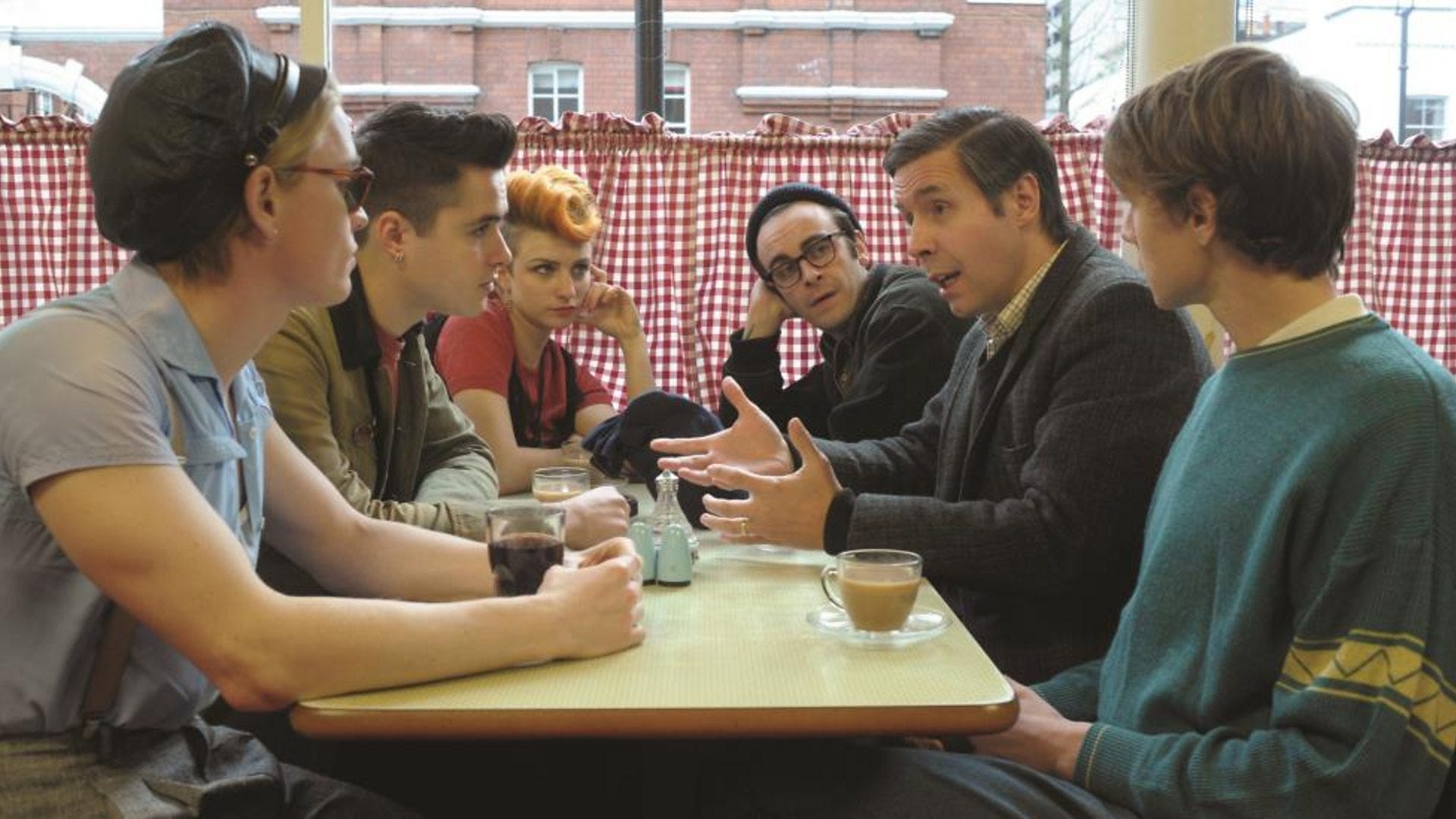
Based on historical events, Pride commences with the 1984 Gay Pride march in London, at which viewers are introduced to several characters (mostly based on real-life figures): outgoing Mark Ashton (Ben Schnetzer); his more reserved best friend Mike Jackson (Joseph Gilgun); feisty Steph Chambers (Faye Marsay); suburban student, Joe ‘Bromley’ Cooper (George McKay), who hides his sexuality from his family; and slightly older couple Gethin Roberts (Andrew Scott) and Jonathan Blake (Dominic West). Under Mark’s leadership, they form the Lesbians and Gays Support the Miners (LGSM) group out of sympathy for mineworkers who have commenced an all-out strike against planned pit closures, and whom they see as a fellow oppressed group.
LGSM begin raising money to support miners and their families in the Welsh village of Onllwyn, in Dulais. Upon first visiting Onllwyn, they receive an initially cautious but eventually hugely warm welcome. Some of the striking miners, union leader Dai Donovan (Paddy Considine), and women’s support group members like Hefina Headon (Imelda Staunton) and Siân James (Jessica Gunning) in turn visit the LGSM members in London for a fundraising concert (see below). Despite LGSM’s continued efforts and visits, the strike fails, and the miners eventually return to work.
Back in London, Gethin is the victim of a homophobic attack, Joe’s family discover the truth about his sexuality, and Mark becomes temporarily estranged from the rest of the group after discovering he is HIV positive. Nonetheless, the film ends on an upbeat note, with the Onllwyn miners returning to London to participate in the 1985 Pride march in a show of solidarity with the gay community. A postscript notifies viewers about the subsequent fates of the characters, including Mark’s death two years later from AIDS-related pneumonia.
Depicting communities
As with Made in Dagenham, which I recently covered for this section of the newsletter, Pride centred on an ensemble cast. The closest it has to a protagonist is Mark Ashton, but Schnetzer was not one of the film’s better-known actors at the time and billed below far more established character actors such as Imelda Staunton and Bill Nighy (as retired miner Cliff Barry). Unlike Made in Dagenham, however, which presents a uniform community existing in essentially benevolent national conditions, Pride depicts an intolerant and divided 1980s Britain.
The gay community in the film are tightknit outsiders, defiant in the face of persistent hostility. They are geographically diverse in origin – Mark from Northern Ireland, Mike from Accrington, Gethin from Rhyl – but now reside in rundown inner London: a world of stripped-down bedsits and nightclubs, striking haircuts, and leather clothing, accompanied by an electropop-laden soundtrack. They subtly or overtly defy normative gender roles: the men are either flamboyant or gentle, the women militant.
Onllwyn’s mining community, by contrast, is traditional, homogeneous, and intimate; geographically rooted within a village context, mobilised by a crisis to establish institutions to safeguard its welfare, within which its natural leaders assume positions of authority. Yet again, in this historical context, the struggle against social and economic oblivion constitutes a harsh new reality.
Sexuality and class
Pride for the most part treats sexuality and class as mutually distinctive, comparable categories. Thus, the gay community in Pride is portrayed as an unclassed subculture: with a few exceptions, its members’ occupations and socioeconomic statuses are not indicated. Their lifestyles are rather defined by an absence of paid work, and participation instead in both political activism and hedonistic leisure. By contrast, the Onllwyn community were defined entirely by occupation and socioeconomic status, although its heteronormativity is destabilised by the strike and encounter with LGSM. The village’s women are shown taking on increasingly public leadership roles, while Cliff quietly reveals towards the end of the film that he is himself gay.
Pride therefore takes a pluralistic view of society as composed of distinct communities displaying intra- and inter-group solidarity against common adversaries. It also somewhat elides over the causes of the miners’ strike and the reasons LGSM supported it. Ashton’s real-life background in the Young Communist League, for example, was omitted from the film. Rather, when explaining why he thinks the gay community should support the miners, he reels off a list of ‘who hates the miners’: Thatcher, the police, the tabloid press. By focusing merely on its authoritarian approach to ‘enemies within’ as common denominator, the film avoids exploring Thatcherism’s complementary and contradictory economically liberal and socially conservative elements.
The mining community’s attitude to their gay allies, meanwhile, is depicted as wary, then intrigued, and finally wholly accepting. The only significant characters depicted as homophobic in the film are Cliff’s sister-in-law Maureen Barry (Lisa Palfrey) – who affects a respectability that sets her apart from the rest of the community – and her two sons, and Joe’s middle-class family. For the most part, the threats to both the gay and mining communities are anonymous or scarcely seen, but ominously present: Thatcher, through a series of televised clips shown throughout the film; the police; Gethin’s assailant; and AIDS, the implications of which are increasingly emphasised during the second half of the film.
An optimistic denouement
The film’s historical context was unpromising for a happy ending, given continuing contemporary hostile public attitudes to homosexuality, rising numbers of deaths from AIDS, and Section 28 (which banned local authorities from ‘promotion of sexuality), as well as of course the miners’ defeat. There could be no remaking of the nation in the present or near future according to the depicted communities’ values. Nonetheless, the film manages to end on an upbeat note for two reasons. Firstly, it relegates the end of the miners’ strike to a relatively brief scene in which Joe and Mark watch the miners returning to work, before thereafter focusing on the LGSM members’ lives. The strike is in truth somewhat peripheral to Pride’s primary focus on gay and lesbian support for and acceptance by the miners.
Culminating with a Pride march led by LGSM and miners, the film ultimately celebrates the indefatigability of communal spirit in adversity and offers an optimistic conclusion that signals to the audience that they live in a more enlightened era. Pride’s conclusion intersperses shots of its principal characters with written postscript. This includes telling viewers that National Union of Mineworkers’ support helped enshrine gay and lesbian rights in Labour manifestos from 1985 – offering a promise of more liberal future political leadership. In the contemporary context, of rapid recent growth in acceptance of gay rights and legalisation of gay marriage, a narrative of national progress could be presented and presumed. The film could also demonise Thatcher without addressing her economic legacy for Onllwyn or Britain.
The contrasting implications of AIDS for LGSM members are also treated in line with the film’s dominant ideological logics. The postscript notes that Jonathan, the second ever person in the UK to be diagnosed as HIV-positive, recently celebrated his 65th birthday. By contrast, it forewarns of Mark’s death at the age of 27. This offers a final moment of poignancy, without distracting from Mark’s evident joy and triumph on-screen. Audience understanding of Jonathan’s and Mark’s very different fates is underpinned by knowledge of continuing advancements in HIV and AIDS treatment. Pride extracts pathos from its depiction of the epidemic while chronologically bounding it as something people died from (rather than lived with) within that period.
If you’ve enjoyed this post, you can show your appreciation by sharing it more widely, recommending the newsletter to a friend, and if you’d like, by buying me a coffee.
Thank you for writing this. It's a film close to my heart and beloved by a number of friends.