Made in Dagenham (2010)
Based on a real strike by women workers, Made in Dagenham depicts its protagonists as overcoming class and gender divisions, but its narrative of progress elides the subsequent effects of Thatcherism.

Please support my work by becoming a free or a paid subscriber to the newsletter. Paid subscribers can access my full archive of posts at any time, and are vital to me being able to continue producing and expanding this newsletter.
This post is part of the ‘Rewound’ series of analyses of objects or episodes from cultural and political history.
Content warnings: Suicide; Domestic violence.
Spoiler alert: This analysis of the film Made in Dagenham and its themes reveals plot details for the purpose of enhancing that analysis.
Based on real events that occurred in 1968, Made in Dagenham introduces its audience to an intergenerational group of women sewing machinists at Ford’s Dagenham factory on the outskirts of London. They include Rita O’Grady (Sally Hawkins), whose husband Eddie (Daniel Mays) also works for Ford; middle-aged Connie (Geraldine James), married to traumatised RAF veteran George (Roger Lloyd Pack), and the younger Brenda (Andrea Riseborough) and Sandra (Jaime Winstone). The apparently contented suburban working-class community presented is disrupted by a dispute over the machinists’ pay under Ford’s new grading system, which they feel underestimates the skill that their work involves, on the basis of their gender.
With neither Ford nor their union’s senior officials taking their complaint seriously, Rita leads her co-workers out on strike and begins advocating for women’s equal pay, with their demonstrations capturing national media attention. Though Eddie and the other male workers are initially supportive, the strike leads to car production ceasing and their being temporarily laid off. The resulting financial hardship and Rita’s newfound fame placed strain on their marriage, while tragedy also strikes Connie when George commits suicide. The standoff over the wage dispute is ultimately resolved when employment secretary Barbara Castle (Miranda Richardson) intervenes, securing the women an immediate pay rise and promising equal pay legislation, duly introduced in 1970.
Portraying community
Though Sally Hawkins, fresh from her acclaimed performance in Mike Leigh’s Happy Go Lucky, received top billing among the cast of Made in Dagenham, it featured several other notable actors (including the aforementioned Richardson). Her character in the film is likewise a first among equals, a budding communal figurehead rather than sole protagonist. Her community is relatively affluent, but still engaged in working-class collective forms of leisure. The conflict at the heart of the movie divides this community. It is essentially between female factory workers and male management, but the position of working-class men in the dispute is ambiguous. The union leadership patronise the women strikers, while the support of male factory workers cools as the strike goes on.
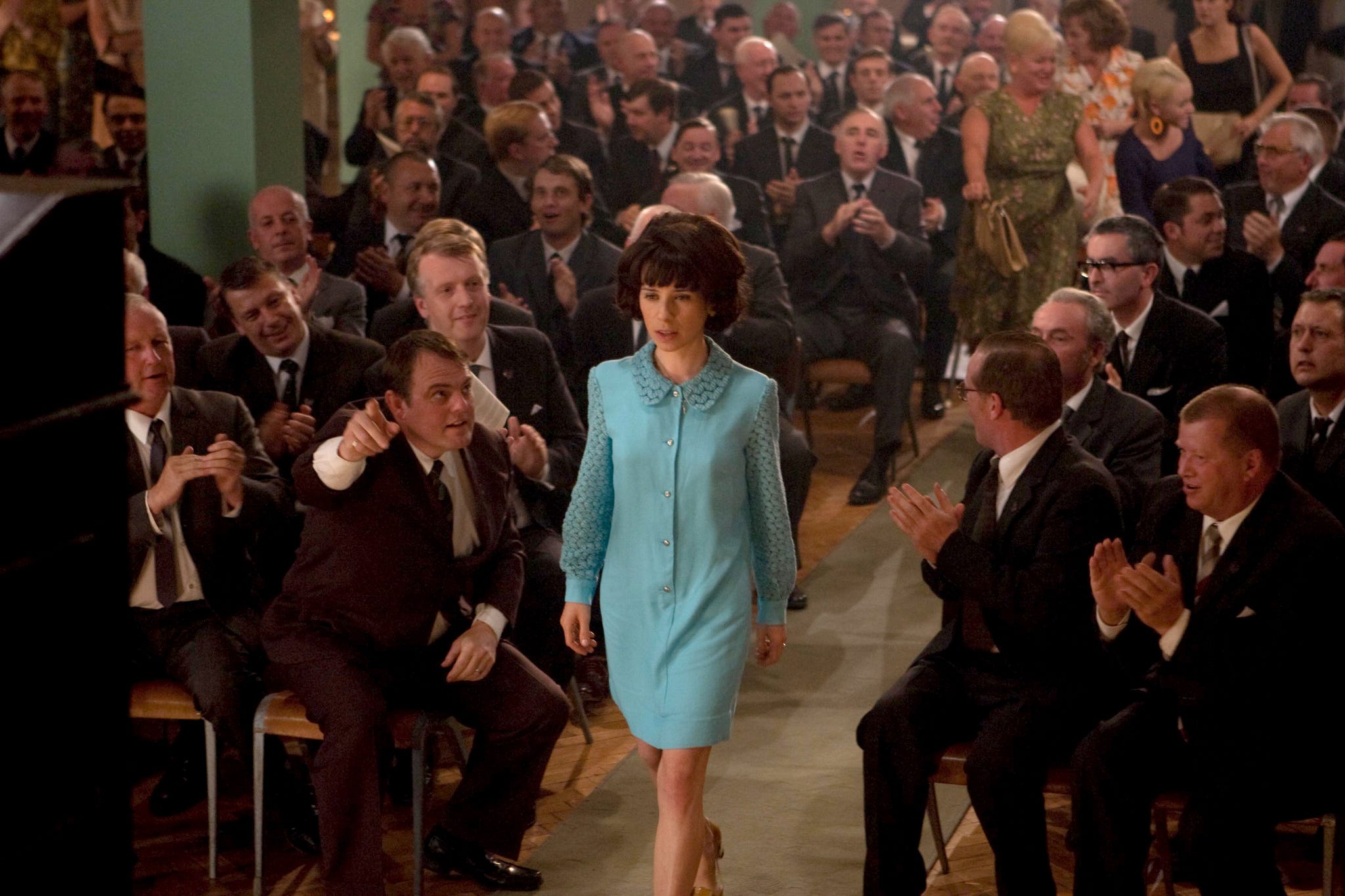
Gender relations within the working class are represented in microcosm by Rita and Eddie: a companionate marriage of two working parents, but with the latter taking the former slightly for granted. This is encapsulated by an exchange between them as Rita gets ready to head off for a union conference, against Eddie’s will (depicted in the clip above). When Eddie protests that he is a good husband because he has never cheated on or struck his wife, Rita retorts that this was no less than ought to be expected from him and relates it to the strike: ‘It ain’t about us gettin’ special treatment...It’s been about fairness.’ Eddie subsequently follows Rita to the conference for a reconciliation; again, this scene has a wider symbolism, coinciding with the union delegates opting to back the sewing machinists’ cause.
Uniting across class and gender lines
In addition, the strikers succeeded in attaining solidarity with women from other classes. Rita strikes up a friendship with Lisa (Rosamund Pike), the wife of one of the managers at Ford (Rupert Graves), and whose son attends the same school as Lisa’s. The two share a sense of being degraded because of gender sex that transcends class boundaries. Lisa encourages Rita to persist with the strike, explaining that despite having a first-class honours degree, she is treated like a fool by her husband.
Barbara Castle, meanwhile, is also shown throughout the film as sympathetic to the striking women. She relates their situation to her own when passionately defending the justness of equal pay to her sceptical undersecretaries, whom she then accuses of having chauvinistically patronised her as well. Castle’s introduction of equal pay legislation is not only a gesture of female solidarity, but also of national rapprochement, on women’s terms.
In her earlier speech at the union conference, Rita unites the women’s cause with that of both the working class and of the country. Recalling the story of the late George’s war service, she queries: ‘When did we, in this country, start bein’ happy, to do nothin’? On what day did we decide we had no duty to fairness no more?’ Calling for equal pay for women, she tells delegates, ‘We are the working classes. The men and the women. We are the furnace which fires the world and without us no-body earns tuppence ha’penny!’ Met with rapturous applause, Rita’s speech reframes the battle for equal pay not as divisive but rather a cause to unify around, comparing it to the Second World War itself.
Nostalgia and deindustrialisation
The conflation of nationhood with a romanticised working class and their wartime role is implicitly underpinned by the uniform whiteness of the film’s cast, which was also the tacit racial base of the post-war social contract. Made in Dagenham’s popular cultural references likewise evoke both era and the social background of its characters. Its soundtrack features a combination of 1960s soul, reggae, and beat groups, while the muted décor of the O’Gradies’ apartment evokes modest contemporary working-class consumption.
Fittingly, the film’s most threatening villain, Robert Tooley (Richard Schiff), is not British, but an American – a senior Ford official sent over to deal with the strike, sharp and ruthless where his British subordinates are incompetent and stubborn. He threatens Castle that continued industrial unrest would convince Ford to move its car manufacturing operations elsewhere – a harbinger of deindustrialisation amid globalisation, and forewarning of the fragility of the bases of British social democracy.
Yet it is a threat not realised within the film itself: Castle calls his bluff, accedes to the sewing machinists’ demands, and harmony is restored. A postscript notifies the audience about the passing of the 1970 Equal Pay Act; the ensuing final scene shows male and female Ford workers cycling to the factory, deliberately mirroring a similar scene at the start of the film.
Made in Dagenham is on the one hand an optimistic narrative of progress: assumed victory in the fight for women’s equality implies a better, enlightened present. On the other, it also presents its working-class community and their national social contract as timeless, having ridden through the crises that the film manifests. In doing so, it simultaneously denies the reality of the post-Thatcherite settlement, including a shrunken, deunionised manufacturing class.
If you’ve enjoyed this post, you can show your appreciation by sharing it more widely, recommending the newsletter to a friend, and if you’d like, by buying me a coffee.


A postscript notifies the audience about the passing of the 1970 Equal Pay Act - and I think that is one of the reasons why I both appreciate this film and simultaneously bristle against it. Because the passing of that Act was important and symbolic (like this strike) but the intent is STILL unfulfilled. 44 years on. (I also can’t help but note the film was released in 2010 so provides a narrative born and told within the Labour government years, with all the optimistic nostalgia that era loved…)
This is exactly it. Also the whole purpose of the strike was not that they were doing the same work as men and getting less for it (which is what the legislation outlawed), it’s that jobs comprising “women’s work” were systematically undervalued and underpaid.
But, I do think it deals with the specific intersection of being working class and being a woman well (even if it somewhat oversimplifies the possibilities for shared identity across class and gender lines).