

Please support my work by becoming a free or a paid subscriber to the newsletter. Paid subscribers are vital to me being able to continue producing and expanding this newsletter.
You can also support my work by making a one-off payment, at a price you consider affordable.
This post is part of the regular ‘One Take’ series analysing the politics of a film currently showing at the cinemas.
Content warning: Paedophilia; Religious cults; Mental illness; Racism; Violence; Murder.
Note: Given that, at time of writing, Eddington is still showing in UK cinemas, this analysis only lays out as much of the film’s scenario as is necessary so as to avoid spoilers. It is therefore suitable to be read either before or after watching the film, while hopefully still enriching the viewer’s appreciation of it either way.
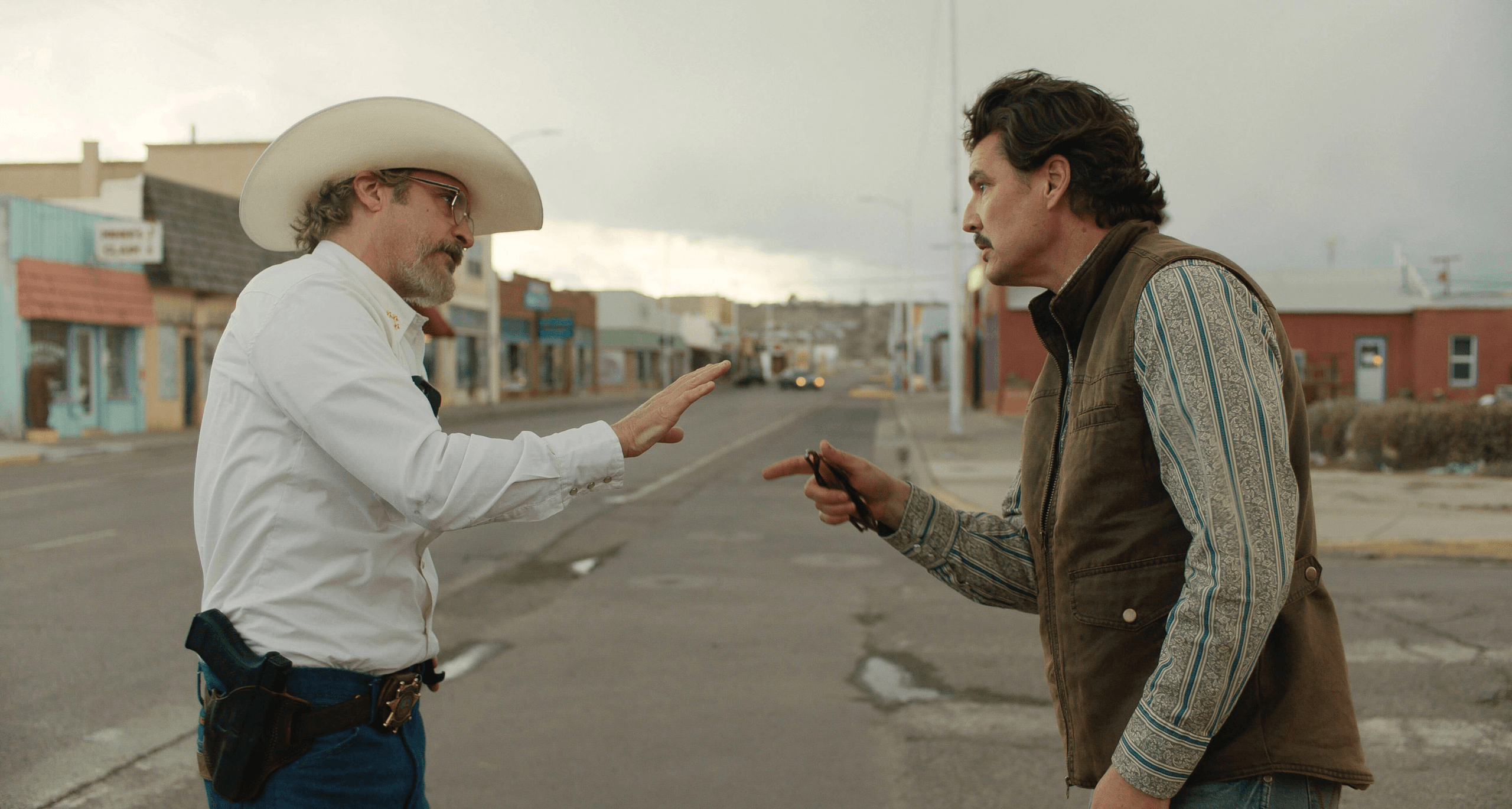
Eddington takes us back to 2020 and the unfolding COVID-19 pandemic, as seen from the fictionalised New Mexico town from which the film takes its name. Eddington’s conservatively inclined sheriff, Joe Cross (Joaquin Phoenix) is disconcerted by the raft of new public health measures being imposed by the town’s liberal mayor, Ted Garcia (Pedro Pascal), at the behest of the state’s governor, which Joe sees as infringing civil liberties and dividing the community. Their rivalry is exacerbated by an alleged dalliance between Ted and Joe’s younger wife, Louise (Emma Stone) – the daughter of Joe’s deceased predecessor as sheriff – when the latter was a teenager. Joe dotes on Louise, who is recovering from a serious mental illness. However, their relationship is strained by the unwelcome presence of Louise’s mother Dawn (Deidre O’Connell), a rabid conspiracy theorist who sees Joe as an unworthy successor to her late husband, and who has moved in with the couple against Joe’s wishes.
With Ted seeking re-election as mayor, Joe spontaneously decides to run against him on an anti-lockdown platform, with the help of his deputies, Guy Tooley (Luke Grimes) and young African-American Michael Cooke (Micheal Ward). Joe’s decision antagonises Louise, who fears the media attention will detrimentally affect her recovery. She accompanies her mother to meet the charismatic cult leader Vernon Jefferson Peak (Austin Butler), who alleges to have been the victim of a shady network of child traffickers, and under whose sway Louise increasingly falls.
A further dimension is added to the town’s political divisions by the murder of George Floyd in Minneapolis and the spread of the Black Lives Matter movement to Eddington. Teenage social justice activist Sarah Allen (Amélie Hoeferle), who had briefly dated Michael, is heavily involved in the protests, prompting Ted’s cynical son Eric (Matt Gomez Hidaka) and Eric’s naïve best friend Brian (Cameron Mann), both of whom are vying for her affections, to get involved as well. Joe is bewildered by the protests. Yet as his own health worsens, his relationship with Louise becomes more strained, the mayoral race even more bitter, and civil unrest in the town worsens, he becomes caught up in an escalating spiral of allegation, conspiracy, and violence.
Ideology, COVID, and the Internet
Eddington is, to a large degree, an in-depth study of the workings of ideology and the causes of political polarisation, particularly within the context of two exacerbating factors. The first is the pandemic. Setting a film in the Spring of 2020 – a period of time that most people can agree has deeply and negatively impacted Western societies, but rarely want to revisit, least of all in the prism of popular culture – is a rather striking choice. It takes us back into an era of isolation and confinement, whereby new and unfamiliar rules around masking and social distancing now govern interactions and are (sometimes wilfully) inconsistently implemented in ways that rachet up the tensions in individual encounters.
It also sets the stage for the confrontation between Joe and Ted. In Joe’s view, COVID is something occurring outside of his community, and yet the state governor has chosen to impose arduous public health regulations on New Mexico, and Ted to impose them upon Eddington itself. Moreover, while Ted’s remit is to set these rules, Joe as Sheriff is charged with implementing them, thus creating two competing centres of local power around their respective offices, particular when Joe sets his sights on Ted’s.
The second factor is the internet, in the guise of smart phones, social networks, podcasts, and online videos. Eddington presents an increasingly fragmented media environment in which people can readily access a wide range of information of dubious veracity, providing seemingly instant answers that they lack the critical faculties to meaningfully evaluate and interpret. The literally maddening nature of this mostly clearly manifests in shots of characters scrolling through their social media feeds, faced with contrasting radical political messaging and misleadingly skewed content.
These destructive contexts underpin Eddington’s sharp but sour view of ideology, as something lightly worn and frequently engaged in for personal or professional gain. Characters are depicted as laughably insincere (when not naively earnest) in the worldviews they espouse. They tell stories about themselves and others that often touch upon genuine sources of suffering or legitimate causes of grievance, and yet are exploitatively framed for political gain. Their positions deviate rapidly based upon whom they encounter, whom they want to impress, which alliances and allegiances they are pursuing. And this combination of opportunism and fanaticism ultimately leads characters to engage in shocking acts of violence.
Representing the right
At its strongest, Eddington offers a darkly funny but also sensitive and insightful picture of the rapidly disintegrating firewall between centre right and far right. Joe’s politics at the outset are those of a mildly libertarian conservative. He is not in denial about the existence of the pandemic, but merely appears sceptical about the necessity and efficacy of what seem to him heavy-handedly but also inconsistently implemented public health measures, which he denounces as divisive (and also resents having to follow). Regarding race, he also appears initially to be a colour-blind moderate, one who can recognise the tragedy in George Floyd’s death, though not the necessity of protests over it, and willing to promote Michael in recognition of his abilities as an officer. Fundamentally, he cannot grasp how and why what seem to him real but distant problems are relevant to, and should shape the politics of, his own small town.
Yet Joe also finds himself occupying a similar political, and indeed often physical, space with more extreme versions of right-wing politics, paradoxically out of perhaps his most sympathetic quality: his clear affection for the deeply vulnerable Louise, whose mental fragility and hidden trauma renders her more susceptible to conspiratorial worldviews. Joe takes a quietist position towards his mother-in-law’s flooding of his home with the sonic, visual, and material accoutrements of anti-medical, anti-state paranoia. By contrast, recognising the sexual challenge that Vernon poses, he makes little attempt to hide his derision for the cult leader’s story of widespread trafficking and abuse of children, rejecting an account of how the world works that is palpably false, even as it resonates – for very real reasons – with his wife.
The blackly comic tragedy of the piece is, however, that Joe’s insecurities and resentments, his striving to demonstrate his adequacy in comparison with both his late father-in-law – a shrine to whom now dominates his own home – and with Ted, compel him to tear down those walls between reality and unreality. His respectable homespun conservativism itself comes to seem insincere as he readily abandons it when there is more personal and political capital to be gained through espousing the more provocative tropes of the terminally online far right; by making lurid allegations against his opponents and concealing his own misdemeanours in ways that play upon those same hatreds. As his descent accelerates, it becomes clear that Joe has been infected, both metaphorically and literally, and the deeper he gets into the maelstrom, the more patent it is that he is fundamentally out of his depth.
Representing the left
Eddington is also pretty scathing in its portrayal of the political left, in its different manifestations. One of these is the sort of small-town elite liberal politics embodied by Ted. The incumbent mayor demonstrates considerable ease engaging in wholly gestural identity politics, whether speaking out on racism as a light-skinned Latino, or on the importance of community as a single father (belied by his strained relationship with his son). Yet the real motors of his mayoralty are his his close ties to the tech sector that underpin Eddington’s clean energy-centred economic progress, and his political alignment with the state governor, including on public health, both of which smooth his career advancement.
This contrasts with the movement-based, intellectually and emotionally invested social justice campaigning epitomised by Sarah. And yet her own awareness of her positionality as an affluent young white woman demonstrates another limitation of this type of politics, as she and others wrestle convolutedly with articulating arguments about racial oppression from a place of privilege under the same system. Eric, who seemingly has no real truck with this cause, is nonetheless happy to use the way he is coded in her worldview to his sexual advantage, as well as to deploy the privileges and associations inherited from his father to his interest (and the denigration of others, including Joe). Yet perhaps the hollowest embodiment of all is Brian, a willing blank slate who rapidly absorbs and regurgitates antiracist rhetoric without really comprehending or especially deeply believing in it, out of the same combination of low esteem, jealousy, and resentment that fuels Joe’s rightward turn.
This is not to say that Eddington does not take racism, or social injustice more broadly, seriously in itself. It captures the genuine racial inequalities at play in the town, particularly in its policing, from Michael’s paradoxical position as a Black policeman handling a mostly white BLM protest, to the pretty shallow limits to the inclusiveness and meritocracy of the Sheriff’s office, to the contempt demonstrated in particular towards the indigenous Pueblo officer Butterfly Jimenez (William Belleau) whose policing skills and professionalism far outstrip those of his white counterparts. The perennial presence of the raving, alcoholic vagrant Lodge (Clifton Collins Jr), meanwhile, serves as an on-the-nose commentary on the claims of others to care about suffering and inequality.
Channelling the madness
However, the film’s portrayal of what really drives the left do not carry the same force of its mapping out of the webs of ideology and interests on the right. This is partly due to a political imbalance in its plotting and characterisation: there is simply no full equivalent to Joe (and Phoenix’s performance in the role) as an object of the film’s study, even if a decreasingly sympathetic one; he has a complexity – undergirded by screen time – that his ostensible near-equivalent in importance, Ted, simply does not – let alone the town’s teenage activists. As such, they lack the humanity that underpins Joe’s political trajectory. Yet it is also in part a product of the reality of the situation the film riffs on: the sheer asymmetry of the radicalisation of the right compared to the left, the immateriality of many of its concerns, and crucially, its much greater propensity for violence.
What Eddington captures extraordinarily well, however, is the senselessness and incomprehensibility of contemporary American politics – a dimension whose prescience only grew more apparent following the murder of the right-wing political activist Charlie Kirk a week or so after I watched the film. It is a portrait of how individual idiosyncrasy and obsession, and physical and mental suffering, perpetuate both persistent harm and visceral instances of violence, in ways that political ideology, as an apparently coherent and abstract map of beliefs and cues to action, obfuscates as much as it explains.
If you’ve enjoyed this post, please consider supporting my work by becoming a free or a paid subscriber to the newsletter. Paid subscribers are vital to me being able to continue producing and expanding this newsletter.
You can also support my work by making a one-off payment, at a price you consider affordable.
Otherwise, please show your appreciation by sharing this post more widely, and referring the newsletter to friends.
You might also enjoy these posts from the Academic Bubble archive:
American Fiction

Writer-director Cord Jefferson’s debut film is part blistering satire about the shallowness of diversity politics in cultural industries, part enrapturing character study and family drama.
First Blood (1982)

The increasingly destructive competition between Vietnam veteran John Rambo and small-town Sheriff Will Teasle is at essence a battle between two rival, right-wing visions of America.
The Apprentice

The depicted relationship between Roy Cohn and Donald Trump links law, real estate, and politics, as well as establishing a lineage of the American right running from the 1950s to the present day.