
Doubt (1991)
Jesus Jones’ breakthrough second album combines post-Cold War optimism, a rejection of moral certainties, and a multivalent response to postmodernity.

Please support my work by becoming a free or a paid subscriber to the newsletter. Paid subscribers can access my full archive of posts at any time, and are vital to me being able to continue producing and expanding this newsletter.
This post is part of the ‘Rewound’ series of analyses of objects or episodes from cultural and political history.
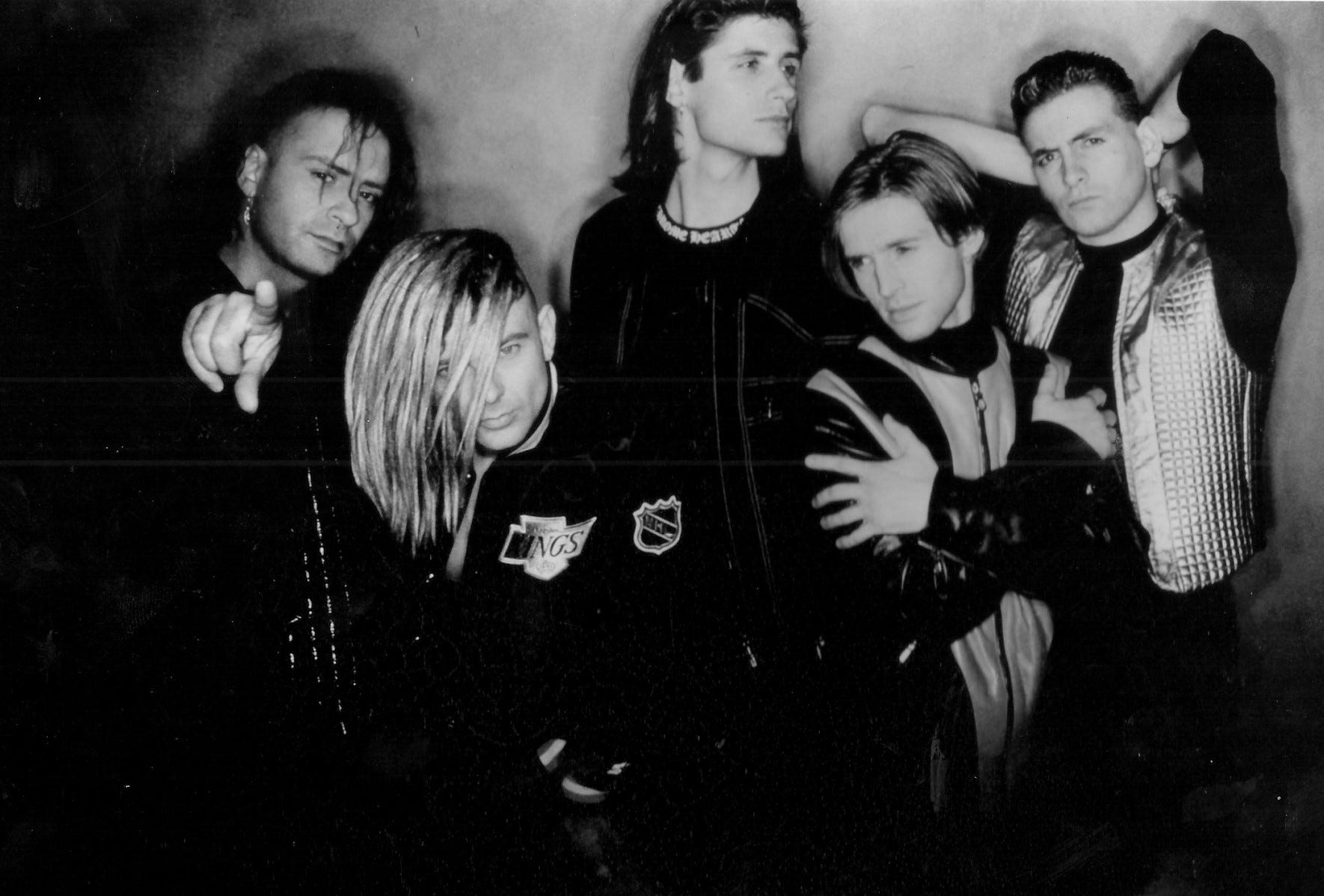
Released in late January 1991, Jesus Jones’s second album Doubt entered the UK charts at No. 1. It completed a momentous 12 months for the band, who comprised vocalist, guitarist, and main songwriter Mike Edwards, guitarist Jerry De Borg, bassist Al Doughty, keyboardist Iain Baker, and drummer Simon ‘Gen’ Matthews. Their debut album Liquidizer had been released by independent label Food in the autumn of 1989. Its fusion of guitar rock with sampling and dance beats epitomised a convergence between previously discrete genres that was very much of its moment. Liquidizer brought Jesus Jones critical acclaim, but not yet the kind of commercial success Edwards had hoped for: the three singles released from it had all narrowly missed out on the UK Top 40, and the album itself stalled just outside the Top 30.
As Edwards himself subsequently recalled, he was able to use the downtime during the band’s extensive gigging around the time of Liquidizer’s, abetted by advances in music technology that rendered it more portable, to craft a new set of songs, of which at least some were built around electronic elements rather than grafting them onto pre-written analogue instrumentals. They were also unabashedly more melodically and sonically straightforward in their appeal, with new singles ‘Real Real Real’, ‘Right Here Right Now’, and ‘International Bright Young Thing’ achieving peak positions of 19, 31, and 7 in the UK charts respectively during 1990. Jesus Jones were also proving equally popular overseas, having in February that year become one of the first bands to tour Romania after the overthrow of dictator Nicolae Ceaușescu just two months earlier, and with ‘Real Real Real’ getting to No. 4 and ‘Right Here Right Now’ to No. 2 in the US Billboard Hot 100.
Doubt itself opens with the brief, pleading, driving ‘Trust Me’, before ‘Who? Where? Why?’ combines psychedelic guitar with samples of African chants, a pulsating beat, and Edwards’ wondering vocal. Then comes ‘International Bright Young Thing’, which maintains the psychedelic feel, but with a groovier bass and guitar line, and an anthemic chorus. ‘I’m Burning’ builds more slowly, its medium tempo underpinned by a slightly more insistent, pulsing beat. ‘Right Here Right Now’ swells with a sense both of its own import and of the significance of the contemporary moment it describes – more on that below – Edwards’s wide-eyed, plaintively delivered lyrics accompanied by fanfare-like synths. Side A closes with the darker, staccato ‘Nothing to Hold Me’, featuring Edwards rapping in a laconic, detached manner about a relationship turned sour.
Side B begins with ‘Real Real Real’, its cooing opening vocals giving way to another mid-tempo, swinging song, its catchy chorus built around the repetition of its title refrain. ‘Welcome Back Victoria’ is built around an acoustic guitar, with Edwards sensing and warning against an impending spirit of reaction, while ‘Two and Two’ is a more straight-ahead fast-paced rock song, in which he denounces other people’s certainties. The penultimate ‘Stripped’ is an industrial track, with squalling electronics and guitar, and Edwards howling the song’s title. Closer ‘Blissed’ is much quieter, with ambient electronica and sampled birdsong, and Edwards’ suitably spaced-out vocal and lyrics.
Optimism at the end of history
Discussing the album on a podcast some 32 years later, Edwards spoke of his strong belief that music should capture the moment in which it was made. The song on Doubt that encapsulated this most was ‘Right Here Right Now’, its title epitomising this sense of present-ness. Edwards was a fan of Prince’s ‘Sign o’ the Times’ and wanted to write an updated equivalent for the contemporary moment. Yet whereas that song commented on AIDS, gang violence, narcotics, poverty, and infanticide, ‘Right Here Right Now’ was concerned with the apparently far more positive developments of the end of the Cold War and the collapse of repressive communist regimes across Eastern Europe. It was even originally based around a sample from ‘Sign o’ the Times’, and although the sample itself was dropped for legal reasons, ‘Right Here Right Now’ still directly referenced the title of the Prince song in its lyrics.
Indeed, this sense of the political import of the moment and its significance to popular culture is evident throughout the song, from its very opening:
A woman on the radio talks about revolution
When it’s already passed her by
Bob Dylan didn’t have this to sing about
You know it feels good to be alive
It has frequently been assumed that the ‘woman on the radio’ is Tracey Chapman, whose song ‘Talking about a Revolution’ – which she famously performed at Wembley to mark Nelson Mandela’s 70th birthday – was released just two years earlier. I have not come across an admission of this by the band themselves, but given the choice of words, the proximity of the two releases, and Edwards’ frequent outspokenness about their peers, it seems highly likely.
This, ‘Right Here Right Now’ tells us, is the moment, is the revolution, not the ones Dylan in the 1960s or Chapman in the late 1980s almost sought to usher into existence, but the one that had now come to pass. Edwards had, as he sings in the song’s second verse, ‘…seen the decade in, when it seemed the world could change/At the blink of an eye’. This was the watershed, ‘watching the world wake up from history’ as the chorus so famously has it, echoing Francis Fukuyama’s notion that the historical process, as we had come to understand it, came to and end with the conclusion of the Cold War, the ultimate victory of liberal democracy over all other models of polity.1 Of course, this all rather misses the point that the critiques of the existing order and demands for change that Dylan, Prince, and Chapman all made were directed against liberal democracies, and particularly that of the Cold War’s victor, the United States, with its severe inequalities, especially racial ones, that had widened over the 1980s.
Equally integral to ‘Right Here Right Now’ is the significance of Edwards being there to document this moment. ‘I was alive and I waited, waited, I was alive and I waited for this’, he sings. In the song’s video, projections of contemporary news footage wash over him; he is given significance as witness to it. It is an affirmation of his generation: not ‘Your sons and your daughters’ whom Dylan had sung about in ‘The Times They Are A-Changing’; but rather those sons’ and daughters’ sons and daughters, who are there to see the real revolution and to make culture bound up with that moment. As he would also demand on ‘Blissed’, ‘…I expect so much more from today/Than just a time between tomorrow and yesterday’ – a call for an extended, weightier present.
Reaction and hardship
Yet, in their heartfelt optimism, ‘Right Here Right Now’ and ‘Blissed’ are one extreme end of a spectrum on Doubt, the most hopeful expressions of a worldview that is rather darker elsewhere. ‘Welcome Back Victoria’ is about the threat of the dead hand of the past, of reversion and return, of time that goes in circles rather than passing thresholds, in which ‘the pendulum swings back’. Edwards rails against the desire to ‘cover up what you don’t understand’, against ‘double standards’.
Margaret Thatcher, deposed as Prime Minister merely two months before Doubt was released, had often famously harked back to Victorian values, and while she generally in referencing to these meant economic values of self-reliance and hard work rather than policing of sexuality, her government had also exhibited reactionary tendencies in that regard too, not least with the passing of Section 28. Edwards, by contrast, was as he sang, ‘a child of the sixties’, a decade that in the year of Doubt’s recording was denounced by Norman Tebbit, that especially socially conservative stalwart of the Thatcher governments, as marked by an ‘insufferable, smug, sanctimonious, naïve, guilt-ridden, wet, pink orthodoxy’.2
‘Two and Two’ persists with this theme, its chorus lambasting the moral certainty of those for whom ‘Two and two always equals four/And life is simple when you’re sure’. Here Edwards’ lyrics at least obliquely reference themes of selfishness, inequality, and unfairness, though not necessarily in a material sense, denouncing those for whom ‘The world’s on someone else’s shoulders’, while decrying the notion that ‘The weak shall inherit the Earth – that’s absurd!’ This in turn sets up ‘Stripped’, ‘Right Here Right Now’s’ antithesis, in which the weight of the moment threatens to become overwhelming: ‘Too much, too much/Let all in, don’t let it all pass you by’. Inspired by their trip to post-revolution Bucharest, and based upon the band’s interpreter’s description of the situation there, its brutal refrain capturing and universalising the social Darwinist ethos of the post-Cold War world:
Everyone is hungry
Everyone needs to know
At the end of it all, you’ve got to get what you want
Or you’ll have nothing else to show
The uncertain present
One of Doubt’s paradoxes is that it is at its most optimistic when considering the multiple possibilities of the moment and most scathing when it rails against binaries and moral certainty; and yet it is elsewhere, and perhaps above all, at least quantitatively, preoccupied with the impossibility of maintaining one’s identity and authenticity. As Edwards subsequently reflected, the album’s very title reflected his own uncertainty that he could produce songs capable of bringing and sustaining commercial success. The early 1990s was a period where bands on independent labels, mixing elements of dance and rock, proved capable of breaching the UK Top 10 singles charts, and Doubt is deeply cognisant of what was at stake.
At times on the album, Edwards seems to be trying to convince himself and others of that which he is deeply unsure of. ‘Trust me, trust me, trust me’, he sings on the opener, a message contradicted by the desperation in his vocal and the repetition of his request. ‘Who am I? Where am I? And why do I feel this way?’, he asks on ‘Who? Where? Why?’, revisiting this theme later on ‘Real Real Real’:
Real, real, real
Do you feel real?
And if so, I’d like to know
How to feel real real
Do you feel real?
The circularity and reproduction inherent in these lyrics, and mirrored in the music, is paradigmatic of Doubt’s postmodernity, deconstructing both the identity of the vocalist and the reality he seems to inhabit.
Again, there is the connection here between the personal and the geopolitical. Jesus Jones becoming big not just in Britain, but also the US, the former Eastern Bloc, and Japan, fitted into a broader story of globalisation. As Edwards sings on ‘International Bright Young Thing’:
Pleeeeeeeease introduce yourself
Let’s shock the world with what we know
Squeeeeeeeze the world
‘Til it’s small enough to join us heel to toe
That sense of the world getting smaller, of the collapsing of different geographic scales into each other is also evoked by the video for the song, with its succession of shots of a spinning globe and footage of different landmarks, while members of the band pogo in and out of view. The constant cycling between the words ‘here’, ‘there’ ‘nowhere’, ‘somewhere’, and ‘anywhere’ in this and other songs encapsulates an absence of set place. Yet this is not a negative, at least not wholly, as framed by Edwards, as liberating as it is bewildering: ‘When I thought I came from nowhere/I came from everywhere instead’.
If you’ve enjoyed this post, you can show your appreciation by sharing it more widely, recommending the newsletter to a friend, and if you’d like, by buying me a coffee.
The End of History?’, The National Interest, No. 16 (Summer 1989).
The Independent (24 Feb. 1990).