
‘The Weather Was More Unkind than the People’
Having come to Britain from Uganda as a refugee, Conservative politician Ravi Govindia’s reflections on this experience emphasised aspiration and successful integration, but also a sense of loss.

Please support my work by becoming a free or a paid subscriber to the newsletter. Paid subscribers are vital to me being able to continue producing and expanding this newsletter.
You can also support my work by making a one-off payment, at a price you consider affordable.
This post is part of the ‘Research and Reflections’ occasional series, consisting of pieces based on my ongoing academic research, as well as on my musings on and responses to current affairs and personal developments.
Content warnings: Ethnic cleansing; Anti-Asian racism; Anti-Black racism; Death; AIDS; Bereavement.
I am currently working on a book chapter on Ugandan Asian narratives of expulsion and resettlement, focusing on a 2012 episode of BBC Radio 4’s programme The Reunion on the subject, and on the accounts of that episode participants on that programme have told more broadly across different media. You can read more of my writing on this topic here. The episode saw host Sue MacGregor in dialogue with a panel consisting of the writer and journalist Yasmin Alibhai-Brown, businessman and community organisation leader Manzoor Moghal; health practitioner and charity trustee, Tahera Aanchawan; Ravi Govindia, then the Conservative leader of Wandsworth Council; and the dentist and Hindu priest Chandrika Joshi.
In this two-part post, I want to focus specifically on Govindia, and on how his public image as a Conservative politician and as a Ugandan Asian refugee have interacted, and his own role in this presentation. In this first part I’ll briefly sketch out his biography, then discuss his contribution to the episode of The Reunion, and thereafter other instances when he has told his backstory as a refugee, and opined on the history of Ugandan Asian expulsion more broadly. In the second part, I will examine his time as leader of Wandsworth Council between 2011 and 2022, and how he articulated his politics, and how those politics were received, in relation to his status as a former refugee.
From Jinja to Wandsworth
Ravi Govindia was born (in 1954) and raised in the Ugandan city of Jinja to parents of Indian heritage (his mother having also been born in Uganda). He had been preparing to sit his A-Levels when Uganda’s military dictator Idi Amin announced in 1972 that the country would be expelling its relatively economically prosperous Asian minority, who had migrated there from the Indian subcontinent over previous decades under British colonial rule. Britain initially responded to the expulsion order by trying unsuccessfully to pressurise Amin into reversing his decision. It then persuaded India and Pakistan to accept some of the 50,000 British passport holders leaving Uganda, and for other states including Canada, West Germany, and Malawi to receive a portion as well, with Britain itself accepting 28,000 in total – one of whom was Ravi Govindia.
After a time at a refugee camp in Dartmoor, Govindia and his family moved to Plymouth, where he completed his schooling, before heading to study at Queen Mary University in London. There he became involved in the Conservative Party, eventually being elected to Wandsworth Council in 1982, and later serving as leader of the council from 2011 until 2022, receiving a CBE for services to local government in 2017. In addition to this, Govindia also spent a period during the 1990s and 2000s as a director with both Battersea Arts Centre and the Asian arts organisation Tara, as well as managing a property company from 2004.1
Ravi Govindia on The Reunion
I have discussed the ‘Ugandan Asian’ episode of The Reunion in greater depth in this previous piece, but will outline its content more summarily here. The discussion began firstly by exploring the nature of Asian life in Uganda prior to Amin’s ascent to power, and then the expulsion order, the panellists’ reaction to it, and their exit from Uganda. They then shared alternatively comical and poignant anecdotes from their experiences of settling in Britain, including naïve expectations and the difficulties of adjusting, the racism from some quarters Ugandan Asians had to negotiate, and the aptitude for education and hard work that they felt had stood them in good stead in their new country. The final portion dealt with their longer term reflections, the nature of their relationships with Uganda following the fall of Amin, and the extent to which they now felt at home in Britain.
The conversation was directed unobtrusively by Sue MacGregor as host, and further structured by interceding audio montages of archival news coverage and interviews that set the scene and facilitated transitions between different aspects of the discussion. There were commonalities across the panellists’ experiences and interpretations of them, but also distinctions between their perspectives that occasionally led to slight or overt tension, on issues such as anti-Black racism among Ugandan Asians, the British state’s response to expulsion, and Amin’s legacy.
In contrast to Yasmin Alibhai-Brown and Manzoor Moghal, who used the programme to try and articulate an account of the Ugandan Asian experience as a whole, Govindia’s contributions were predominantly personal in nature. He engaged only hesitantly and reactively with explicitly grander narratives, albeit while making broader implicit points through references to his own experience. When Alibhai-Brown raised the question of Asian ‘privilege’ in Uganda, he sought to disown the implications of this, at least as it applied to his own family: ‘As for the kind of, being well off…I’m not sure, really. We had a part-time servant who came for two hours to wash the clothes, and that’s it.’ In his view, it was more that they possessed ‘a middle-class outlook’.
Although he described Uganda retrospectively as ‘the only land I knew’ prior to his family’s expulsion, Govindia largely eschewed a continuing sense of attachment to the country, save for his former school and a cross-racial, socially elite, masculine identification with now decreased Black schoolmates, killed by a combination of state violence and the AIDS pandemic. This sense of personal loss only really surfaced towards the end of the episode, when he spoke about revisiting Uganda in later life:
…it was…incredibly distressing when I went to my school to see if anyone knew any of the people in my year. And the school had a diary, and a record of all the year, and their addresses…and I was told very categorically they didn’t find any of them. This is twenty-five…young men…with huge promise, who would have been part of Uganda’s future…completely not in that country, or in this world.
He otherwise distanced himself from Ugandan Asians’ continuing collective attachment to their former country post-expulsion, expressing barely veiled bewilderment when this question of nostalgia for Uganda came up in the discussion:
I think one of the oddest things I find…about Ugandan Asians is that the…how incredible emotional attachment to a country that kicked them out…and I try and connect, try and look for that feeling from people who left Kenya, or Tanzania, or Zanzibar…and I don’t get that emotional ah…hankering for a, for a…for a land of their birth, or…or their past.
Yet Govindia also adhered to elements of a Ugandan Asian subjectivity that fitted a conservative ideal of ‘the model minority’, in their ambition, work-rate, and resilience. When asked by MacGregor whether he had been aware of the severity of the racist sentiment awaiting Ugandan Asians in Britain, he replied:
Yes, well I mean– local papers had covered some of it, and we’d heard it on the [BBC] World Service, and so on…[adopting a slightly more dismissive tone] I don’t think it was enough to dissuade us to make the decision that…my father made – I was too young to make that on my own. But he did make the decision of coming here, or going to India, and his choice of coming here was largely to say, I have a young family, their prospects are going to be better in the UK than they would be in India.
Govindia’s response did not simply play down the question of British racism; he actively sought to restore agency to his father, primarily, albeit while speaking for him, in making a responsible, aspirational choice to relocate to Britain and, by implication, adopt British-ness (over Indian-ness) as a national identity. He also expressed his own positive attachment to Britain, particularly the Southwest where his family had originally relocated to. Between finishing his A-Levels and beginning his degree at Queen Mary, Govindia had spent eight months working as a bus conductor for Western National Buses, ‘travelling all over the Southwest, er, counties…I loved it. I really, really loved it.’ Though there were a handful of other Ugandan Asian conductors on the route, ‘I was the youngest kind of clippie in town, spoke differently, and when the bus was quiet read books that most of the passengers would not think of reading’.
Though Govindia did not discuss his own passage into politics on the programme, his attachment specifically to Edward Heath’s Conservative government of the time manifested, again reactively, when Moghal criticised it for its handling of the crisis:
MOGHAL: When I came to Leicester [clearing throat], I deliberately avoided the er, refugee camps, because I had been quite disillusioned with the attitude of the British government, and I did not want to be a dependent on their handouts. Of course, they did some valuable work, but that was much later after they had been upbraided for their…callousness from the logistic point of view, and they were trying to dump us on countries like Canada, and the European countries, where the Asians went.
GOVINDIA: Manzoor –
MOGHAL: Yes.
GOVINDIA: I perhaps have lived in a parallel world…
MOGHAL: Yes.
GOVINDIA: Er, my recall certainly is that, um, there was an attempt through the Commonwealth to deal with people who were deemed stateless. There are people who were taken in sum to Australia, New Zealand, they went to Canada, the various Scandinavian countries…that was a deal arranged through the Foreign Office with other Commonwealth partners to support the people who were stateless.
This reply, couched in a slightly mocking differentiation between his and Moghal’s concurrent realities, reasserted a version of expulsion that recast Britain’s role and response from postimperial to humanitarian, using diplomatic channels to address a problem he defined in legalistic terms, his reference to ‘Commonwealth partners’ invoking international relationships between equals. It also illustrated his own sense of identification with the British state, particularly in its Conservative-helmed guise.
Further accounts of expulsion and resettlement
Govindia has spoken about his experiences as a refugee across other public fora too, although it has not comprised as central a component of his public persona as for some of the other panellists, such as Moghal. Shortly after becoming Wandsworth Council leader in 2011, and a year before his appearance on The Reunion, he was interviewed by the Plymouth Herald about his time in the Southwest. The article stressed his sense of continued attachment to Plymouth, despite his having moved to London several decades ago, mentioning the practical guidance offered by his neighbours to help them settle:
I have warm regard for the city and the people. It must be something in the air in the city that makes them disposed to being warm and friendly.
What any person goes through leaves its mark into the future.2
Govindia made wry observations in the interview about the social and climatic differences between life in Jinja and in Plymouth, but also – again recalling his time as a bus conductor – noted the ‘beauty and charm’ of Devon’s moors as he witnessed them on his travels.3
On the occasion of the 50th anniversary of Amin’s expulsion order, in August 2022, Govindia was interviewed via video call on the BBC News channel about his experience of leaving Uganda for Britain. In line with dominant framings of this episode, he characterised expulsion as a moment of unexpected rupture and betrayal:
You know, I was a Ugandan national, because I was born in the country, as was my mother, and so, legally, we were all fine…or that’s what it looked like, until that fateful day on the fifth of August, [correcting himself] fourth of August, when we learnt that, ah, we were no longer wanted. And everything changed.
Asked as to how ‘traumatic’ being expelled was, he noted that it took time for the realisation set in that Amin was sincere, and that the order had the support of the African majority, ‘and therefore a degree of hostility started building up in the towns, and so on’. He highlighted his sense of loss in terms of the personal relationships interrupted, again echoing the sense of scholastic identity, and recognition of the worse suffering that was to come for the African majority, that he had also evoked on The Reunion a decade earlier:
I mean, I was at school where, I was one of the four Asian pupils, and all the others in my class of 28 were Ugandan Africans…I was going to leave them, they were not going to be able to – in a sense – withstand the Amin onslaught; I could get away…um, so that was a great wrench that, you know, all your ex- expectations suddenly…extinguished in a weft.
When asked ‘How welcome were you made to feel in the UK?’, he replied in a manner that re-emphasised his positive individual experience, knowingly closing down the possibility of implication of anti-Asian racism that was also a frequent common trope in broader discourses of resettlement, while leaning heavily into another, that of the shock of climatic difference:
Well my experience is, you know, whether- whether that’s genuinely everybody else’s or not, I don’t know, but my experience was…that the weather was more unkind than the people [laughter], people were warm, and er, actually landing in the middle of, ah, towards late October, in Dartmoor in about four ‘o’ clock in the afternoon was not a very nice thing to do [laughter]…er it was, rain driving into our faces, a kind of rain I’d never seen before. But you know, there was warmth in the local population, I joined the local comprehensive school at Tavistock, where I was made welcome…by my fellow sixth form students; several teachers took me and the other Ugandan Asian boys and girls er, under their wing…and sort of, took through the transition from a Ugandan curriculum to a, er UK curriculum.
Again, we see here the way Govindia voiced a sense of belonging and collective identity through the institution of the school, and the success of resettlement through the prism of educational achievement.
Re-evaluating Ugandan Asian life?
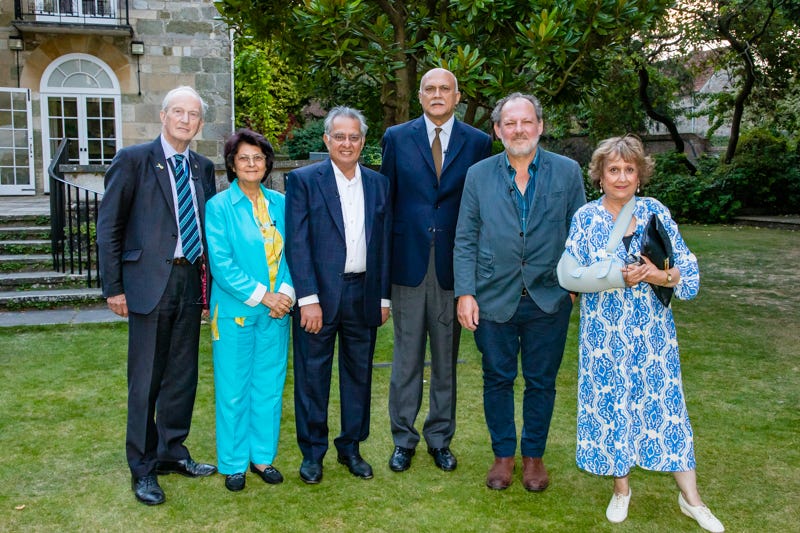
The following month, Govindia took part in a panel discussion entitled ‘The Uganda Asians Crisis 50 Years On: From Controversy to Success’ at Arundell’s, Edward Heath’s former residence in Salisbury. Chaired by Praveen Moman, the founder of Volcanoes Safaris – which sponsored the event – it also featured Nimisha Madhvani, Uganda’s ambassador to Britain; the former Conservative Cabinet minister Lord Hunt; Yasmin Alibhai-Brown; and writer Giles Foden, author of the 1998 novel about Amin, The Last King of Scotland.
In his contributions to this discussion, Govindia reiterated many of the themes from his previous public commentary on his experience of expulsion and resettlement: the importance placed on education and attainment; his sadness at learning of the deaths of his former schoolmates (at which point he was audibly emotional), and the broader suffering of Ugandan Africans under Amin; the shock of the British weather; and the warmth of the reception, and absence of racism, he encountered in Plymouth (suggesting this might have owed to its ‘internationality’ as a naval town).
Yet in the first instance, asked directly by Moman about what life was like in Jinja, Govindia discussed life pre-expulsion in much greater depth, and generality. He highlighted rather matter-of-factly the way Uganda’s racial hierarchy was built into colonial Jinja’s urban geography, with the white colonial elite occupying the most desirable locations along Lake Victoria and the White Nile, the Indian population in the centre of the town, and the African Township a little further out.
…you could walk from one end to the other, but you couldn’t necessarily live in each of its three bits; you had to be of one type to live wherever, and in fact if we visited the European townships in the middle of the afternoon, the chances are that you would get chased, because you were then seen as unwelcome visitor…and yet in the evening, we would walk through it, drive through it, and sit by the Sunset Point looking- overlooking the lake, and eat our peanuts and mogo chips, and that was the kind of lifestyle that a lot of Asians had.
Govindia emphasised Jinja’s Asian-ness: the Indian style of architecture, their key roles in its local industries, and above all, the vibrancy of its community, within which he located his own family:
…my own- you know, my father worked in the Ministry of Works, he was a carpenter, he worked in two jobs to make ends meet with a large family, we lived in a small house…but all of that that, kind of, being not-so-rich didn’t seem to matter, we were an absolutely happy family in a very happy community, we looked after each other, we played with each other…in fact a lot of the community, within a very divided Asian community with- in terms of caste, and religion, and so on, none of those matter in your neighbourhood; you played as one, you were as one, and you went out as one, lots of rules and rituals respected and honoured, and…we lived out of each other’s homes. Every difficulty was supported by somebody who could help you out, so poverty was there, maybe, was supported by the wider community, in which we lived and that was the warmth of the community which got shattered in ‘72. And that shattering of that warmth and togetherness is what old Asians still talk about with deep, deep regrets…
This was substantially more sympathetic to, perhaps even engaged in, the Ugandan Asian nostalgia he had spoken dismissively of on The Reunion ten years earlier. Nonetheless, it also fed rather logically back into the aspirational values he routinely emphasised in his autobiographical narratives:
…so this was a very happy, very satisfied community: rich, poor, middle-class, and a lot- and all of them investing huge effort into educating their children; they sacrificed a lot to make sure that the children were as well-educated as they could be. But then they saw education as the ladder; and that is the virt- virtue which they have brought to, with them to this country, which is- which is instilled in every Asian household: do well, and you will do well for you, for your future.
This was present in his own ambition as an A-Level student in Uganda, to go on and study at Makare University in Kampala, as:
…I thought if I got a degree I would carry on doing something important, better than a carpenter would be…[rapidly] which is in fact exactly what my father would say, that if you fail at- at school, you’ll come- come to the workshop with me, and help me in the workshop; that’s your choice.
When then asked directly by Moman what he thought had led to the expulsion order, Govindia replied:
My own reflection- my- my maternal side of the family, for four generations were in Uganda…and each of them I can go back and say they were more adapt- more able to able to adapt to local- my grandmother spoke perfect Luganda when she was in- in- because she lived in a place where it was necessary to speak it, and she was perfectly happy to mix with the people she had to mix with, and as Yasmin [Alibhai-Brown] says we were obviously a generation with a wider outlook, and so of course, if we had carried on that would have made the change of route. So the pace of change perhaps was too slow, our economic success was clearly a- some- a problem, and the fact we occupied a lot of the middle layers of both administration, the professions, and so on made it very difficult to share the proceeds of independence equitably and easier.
This then was perhaps a rather whiggish account of Ugandan Asian settlement: a story of greater integration and enlightenment over time (albeit still rooted in their own communal identity). It was also something of a lament for a doomed counterfactual, regretful that their part in a perhaps-too-gradual process of erosion of racial segregation and unfair distribution of wealth was interrupted by a greater, more ruinous historical break.
If you’ve enjoyed this post, please consider supporting my work by becoming a free or a paid subscriber to the newsletter. Paid subscribers are vital to me being able to continue producing and expanding this newsletter.
You can also support my work by making a one-off payment, at a price you consider affordable.
Otherwise, please show your appreciation by sharing this post more widely, and referring the newsletter to friends.
You might also enjoy these posts from the Academic Bubble archive:
Minorities on the Right

The presence of members of minority groups on the right poses a challenge in both understanding how they got there and discussing the matter with due sensitivity.
Ugandan Asians in Dialogue (Part II)

As an episode of BBC series The Reunion demonstrates, the way the Ugandan Asian experience is articulated to a wider audience depends much on format and mediation.
Idi Amin: Lion of Africa (2010)

In writing a revisionist account of Idi Amin’s rise to power and expulsion of Uganda’s Asian minority, Manzoor Moghal simultaneously asserted his own importance in the country’s politics and history.
Biographical details gleaned from the episode of The Reunion, as well as: Peter Bingle, ‘Ravi Govindia – A Champion of Local Politics’, Comment Central (1 Mar. 2017); Nick Lester, ‘‘City’s Warmth Stuck with Me’; Refugee Spent Early Life by Tamar, Rising to Lead Flagship Tory Council’, Plymouth Herald (3 Jun. 2011), p. 24; Grainne Cuffe, ‘Leader of Wandsworth Council Ravi Govindia Awarded CBE on Queen’s New Year’s Honours List’, Your Local Guardian (5 Jan. 2017); Companies House, ‘Ravindra Pragji GOVINDIA’.
Lester, ‘‘City’s Warmth Stuck with Me’’.
Ibid.