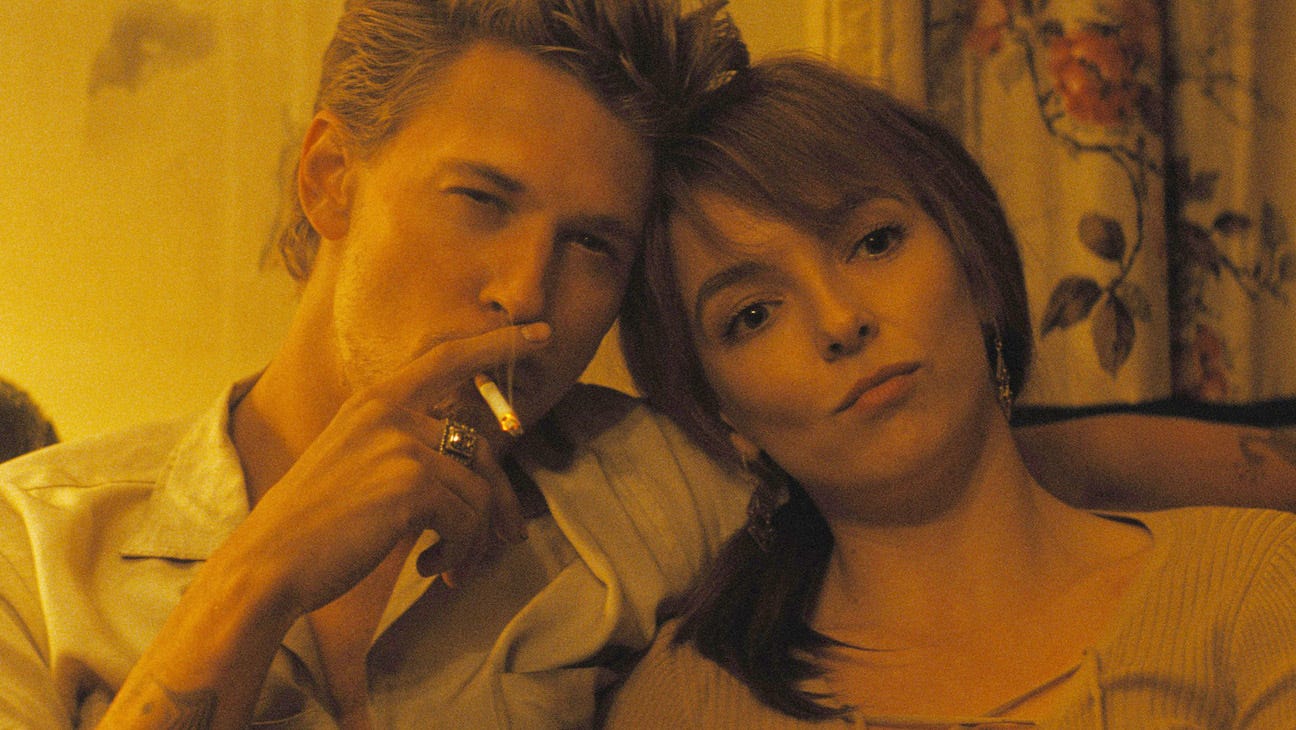
The Bikeriders
This intimate depiction of a Chicago motorcycle club meditates on associational culture, the social changes of the 1960s, and how gender and generation shape relationships and the life-course.
Please support my work by becoming a free or a paid subscriber to the newsletter. Paid subscribers can access my full archive of posts at any time, and are vital to me being able to continue producing and expanding this newsletter.
This post is part of the regular ‘One Take’ series analysing the politics of a film currently showing at the cinemas.
Content warning: Alcohol; Narcotics.
Note: Given that, at time of writing, The Bikeriders is still showing in UK cinemas, this analysis only lays out as much of the film’s scenario as is necessary so as to avoid spoilers. It is therefore suitable to be read either before or after watching the film, while hopefully still enriching the viewer’s appreciation of it either way.
The Bikeriders is based on photojournalist Danny Lyon’s 1968 book of the same name, documenting his time with the Chicago Outlaw Motorcycle Club. It was made by writer-director Jeff Nichols with Lyon’s cooperation, and the script draws extensively on the original audio recordings of his interviews with the club’s members.
In Chicago in 1965, Kathy Bauer (Jodie Comer) meets, swiftly falls in love with, and marries rebellious biker Benny Cross (Austin Butler). Benny is a member of the Vandals Motorcycle Club, led by its charismatic founder Johnny Davis (Tom Hardy). As the Vandals develop a fierce local reputation for hard drinking and roughhousing, their exploits are documented by Lyon (Mike Faist), who also interviews Kathy and various members of the gang, including Johnny’s deputy Brucie (Damon Herriman), mechanic Cal (Boyd Holbrook), good-humoured Cockroach (Emory Cohen), and bad-tempered Zipco (Michael Shannon).
Benny’s reckless disregard for danger and his own personal safety increasingly concerns Kathy, putting her at loggerheads with Johnny, who sees Benny as his natural heir as the Vandals’ leader. Meanwhile, the club grows with its notoriety, adding new chapters in other cities. Amid an influx of new members, Johnny struggles to maintain his authority, and the atmosphere within the Vandals takes a much darker turn as the 1970s approach.
Bad civil society
As I watched The Bikeriders, one three-word phrase recurringly flashed through my mind: ‘bad civil society’.1 This was the title of a 2001 article by politics scholars Simone Chambers and Jeffrey Kopstein that pushed back against the then dominant notion of civil society as an unalloyed good, at a point in time when American democracy and societal cohesion was seen as threatened by allegedly declining levels of social capital.2 Chambers and Kopstein countered that some forms of civil society could, while distributing valuable public goods to their members, simultaneously inculcate them with hateful ideologies and reward toxic behaviours.
The Vandals turn what might otherwise be a deeply individualistic pastime, motorcycling, into an inherently collective one. Members pay in their subs and in return partake in drinking and socialising together, in a shared identity connoted by their donning of the club’s regalia. They gain not only a heightened sense of status from their membership, but also a degree of protection and impunity in a violent and heavily (but unevenly) policed society. Johnny compares it to a family; Brucie’s wife Gail (Phuong Kubacki) more mockingly refers to the other Vandals as ‘your boyfriends’ when alerting Benny to a potential standoff between them and another set of bikers. Both descriptors capture the club’s self-contained, semi-closed off structure and the closeness of the masculine bonds within it.
Violence is integral to the Vandals as an institution. It is exercised internally, especially by Johnny, as a means of maintaining internal hierarchy and order in what is ostensibly an egalitarian organisation. It is also exercised externally as the club both provokes and avenges violence against its members. However, spectacular violence and rebellion serves to inspire incomers and copycats, and this organic expansion dilutes the members’ intimate knowledge and trust of each other, as well as Johnny’s capacity to use violence as a disciplinary tool and set the terms of its deployment. The violence of the Vandals becomes more vicious, more unpredictable, more regularly inflicted upon each other.
Historical rebellion and reaction
The Bikeriders tells the story of a period of rapid social and cultural change, between the mid-1960s and mid-1970s, through the prism of a group who seem to embody it, but as the film progresses it becomes clear that they are being left behind by. There is a strong sense of 1950s nostalgia about the Vandals. Johnny, we learn, was inspired to set up the gang by watching the 1953 Marlon Brando film The Wild One on television, while Austin Butler – whose star status was built on playing Elvis Presley in 2022’s Elvis – strongly echoes the spirit of that decade’s juvenile delinquency films. All of this is further evoked by a soundtrack slightly out of temporal sync with the period it covers, with its mixture of rhythm and blues, beat groups, garage rock, and a couple of tracks by the Shangri-Las.
The Vandals’ stylised, undirected rebellion, their position as white, working-class men routinely shown at leisure, is at significant remove from the political struggles of the period. The ubiquity of Black music and singers on the film’s soundtrack conversely draws attention to the racial homogeneity of the gang, at a time of intense civil rights struggle, including in Chicago.3 Zipco, who takes intense pride in his own manual labour, labels his brother a ‘pinko’ for going to university. Of Latvian descent, he rails against students tearing up their draft cards when he himself wanted to go and fight in Vietnam, but was turned down by the Army. There is added irony in all of this being documented by college-educated Danny Lyon, who in real life had previously been involved with the civil rights movement, and increasingly became disillusioned with the political and racial views of the Chicago Outlaws.
The scale of transformation in American society during the late 1960s and early 1970s highlights the relative conformism of the original Vandals – perhaps best captured by Cockroach’s stated aspiration to become a motorcycle police officer. Their own predilection for alcohol puts them at odds with newer members who prefer cannabis, and even heroin. Their own capacity for lawbreaking and violence is greatly surpassed by that of newer members, many who have themselves served in Vietnam, or in the case of the aspiring member known only as ‘The Kid’ (Toby Wallace), comes from an impoverished background. Road violations, brawling, arson, and the physical settling of vendettas make way for drug dealing, larceny, and assassinations – a transition from associational culture to organised crime.
Generation and gender
The Bikeriders is also very much a film about intergenerational relationships and the lifecycle. If the Vandals – whose members range from young to middle-aged men – have anything to rebel against, it is against maturing, against the idea that their growing older means having to adopt wider norms around propriety, against the prospect that they might no longer be young enough for this lifestyle. Moreover, for all its homosociality, the Club also proves excessively compatible with settling down and embracing domesticity, with wives and girlfriends – especially Kathy – routinely present even at its ostensibly most masculinist social occasions.
Yet as time passes, the Vandals provide an exemplar for younger men who aspire both to imitate and join and to succeed and surpass them. It is this process, as well as the hazards of motorcycling and gang membership, that accelerates the original members’ sense of ageing, of being left behind, of losing control. Social occasions are no longer safe for attendance by wives and girlfriends, and membership is no longer congruent with the responsibilities of being husbands and fathers.
All of this is most epitomised by the triangle of relationships at the heart of the film, between Kathy, Benny, and Johnny. The real Kathy Bauer was in her mid twenties with children of her own when she met the still teenage Benny, and in the film she relates to him partly as patient, long-suffering wife, and partly as indulgent mother figure, tasked with caring for him during the aftermaths of his frequent encounters with violence, and rarer moments of emotional vulnerability. As she tells Danny, ‘I thought I could change him, y’know…not to be different but to be – I don’t know, like he’s wild!’ As his most frequent interviewee, she is an ideal interlocutor, exceeding Danny’s proximity to the Vandals over time, but her gender also placing her outside that world in a manner analogous to his social class and education. As such, she functions both as admonishing critic and affectionate chronicler of the club and its evolution.
Johnny’s relationship with Benny, meanwhile, veers between friendship, father figure and son, and something more homoerotically charged. Admiring of Benny’s loyalty to and ability to command respect from his fellow Vandals, and fearing of the changes afoot in the club and his own inability to manage them, Johnny sees in Benny a kindred spirit and potential heir. Kathy, for all her patience and intimacy with the Vandals, increasingly sees Johnny as a rival for Benny’s affections and commitment, and the club as a rival to their marriage as the dominant institution in Benny’s life. Benny, enigmatic and elusive, a character almost entirely of Kathy’s retrospective narration, is the perennial teenage boy, inclined to flee rather than face up to the different versions of growing up that both Kathy and Johnny require of him.
If you’ve enjoyed this post, you can also show your appreciation by sharing it more widely, recommending the newsletter to a friend, and if you’d like, by buying me a coffee.
I’m sure the same was true of most of the other patrons in the half-empty auditorium at Orpington Odeon that same Saturday night.
Simone Chambers and Jeffrey Kopstein, ‘Bad Civil Society’, Political Theory, Vol. 29, No. 6 (2001) pp. 837–865.
See Alan Anderson and George W. Pickering, Confronting the Color Line: The Broken Promise of the Civil Rights Movement in Chicago (Athens, GA: University of Georgia Press, 2007).