
Saving Mr. Banks (2013)
This film retells the story of the making of Mary Poppins, and reflects upon the autobiographical aspects of storytelling, and the subsequent conflicts that arise in adaptation.

Please support my work by becoming a free or a paid subscriber to the newsletter. Paid subscribers can access my full archive of posts at any time, and are vital to me being able to continue producing and expanding this newsletter.
This post is part of the ‘Rewound’ series of analyses of objects or episodes from cultural and political history.
Content warnings: Alcoholism; Death; Bereavement; Child abuse.
Spoiler alert: This analysis of the film Saving Mr. Banks and its themes reveals plot details for the purpose of enhancing that analysis.
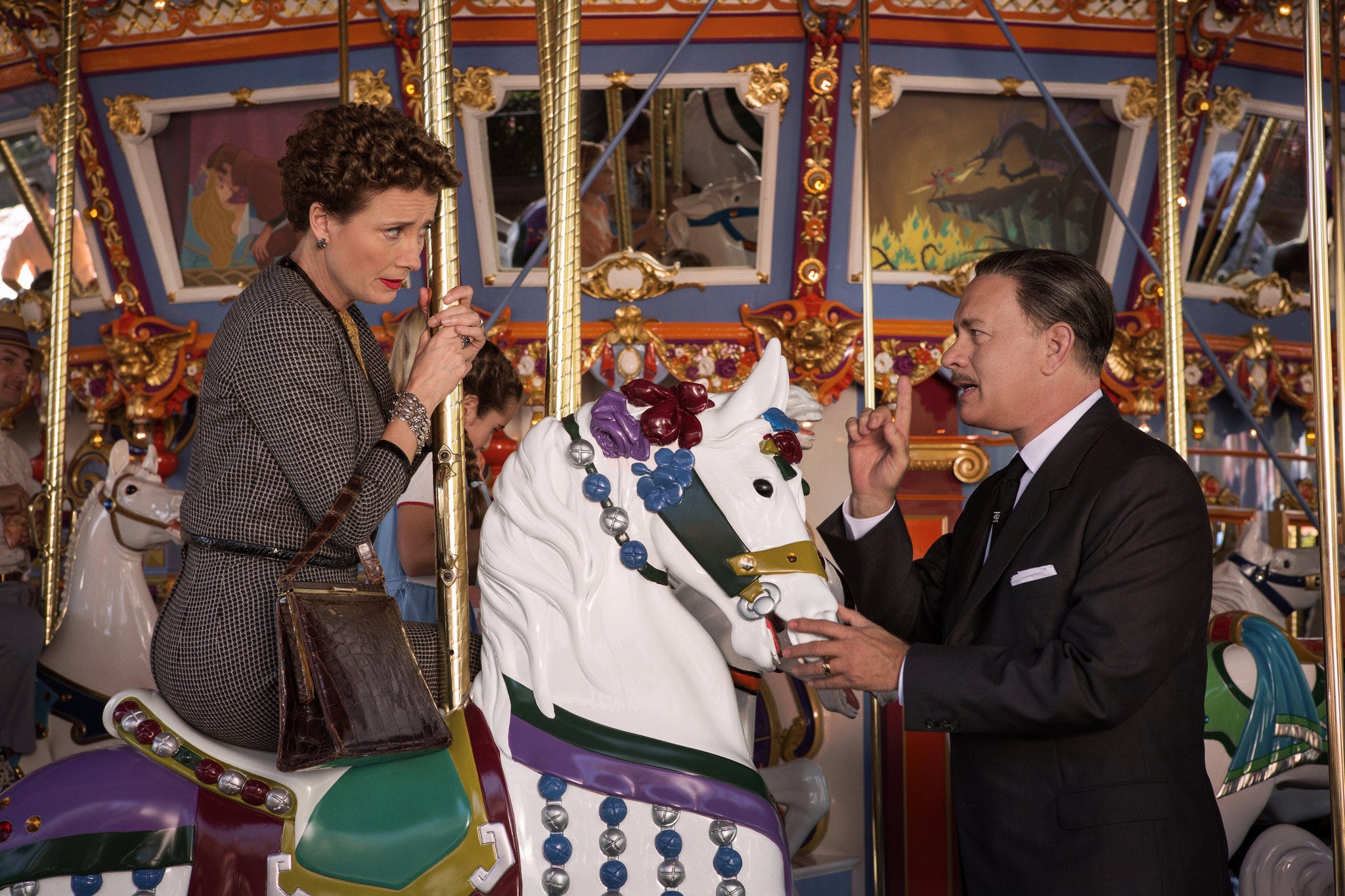
Saving Mr. Banks depicts the strained relationship between P. L. Travers (Emma Thompson), author of the Mary Poppins book series, on the one hand, and Walt Disney (Tom Hanks) and his colleagues at Disney Studios on the other. It is also about P. L. Travers’ own relationship with her father, Travers Goff (Colin Farrell), who died when she was a child.
In 1961, the financially struggling, London-based author is convinced by her long-suffering publisher Diarmuid Russell (Ronan Vibert) to accept Disney’s invitation to travel to Los Angeles and collaborate in the cinematic adaptation of her Mary Poppins stories. Travers remains deeply sceptical about the project and repeatedly clashes with screenwriter Don DaGradi (Bradley Whitford) and song-writing brothers Richard M. (Jason Schwartzman) and Robert B. (B. J. Novak) Sherman. She is nonetheless gradually won over by her kindly chauffer Ralph (Paul Giamatti) and by Walt Disney himself, and his creative vision. However, her mood is soured by the proposed inclusion of an animated sequence in the film, which she had been explicitly promised would not occur; she refuses to go ahead with the adaptation, and returns to London.
The relaying of these events intersects with scenes from P. L. Travers’ childhood in early twentieth-century Australia. Aged seven, the author, real name Helen Goff (Annie Rose Buckley), moves with her parents and younger sister to Allora in Queensland. Travers Goff is a loving father with a penchant for imaginative play, but struggles with the strains of his job as a bank manager, and with worsening alcoholism, placing great strain on Helen’s mother, Margaret (Ruth Wilson). Helen is left heartbroken when her father subsequently succumbs to tuberculosis.
Back in the 1960s, Walt Disney learns following P. L. Travers’ departure about her earlier life, and realises that her fastidiousness about details in the Mary Poppins film owes to how her books draw on her own experiences. This includes her having based the character of George Banks, father of the two children Mary Poppins is nanny to, on her own father. He travels over to London and persuades her that he can bring her stories to life on screen in a manner befitting the original material. When the film is finished, Disney does not invite P. L. Travers to its premiere in Los Angeles, fearing what her public reaction to it might be; but she shows up at the event anyway, watches the film for the first time, and is visibly moved.
The adaptation process
This is a film about the making of a film, and more specifically about adaptation from book to film. It sets out a contest over a piece of intellectual property, in which the legal power lies with P. L. Travers and the commercial power with Disney and his company. Yet while this balance of forces is the basis of Saving Mr. Banks’ central scenario, the question of whether the film will or will not be made, we already know that the answer is in the affirmative. Rather, the film’s meditation is on who morally owns a story and its subject matter: the author, or their readers?
We come to understand just how and why P. L. Travers sets so much store by the fixed nature of her characters and stories as she created them and insists on fidelity to those, even as it manifests in her most unreasonable behaviour. Yet her cynicism is not justified: Disney and his staff are not blasphemers, but in spirit faithful interpreters and proselytisers. They are on the side of the children who make up her stories’ existing and potential audience, epitomised by Walt Disney’s longstanding promise to his own daughters to make a Mary Poppins film. Cinema is a medium principally for deepening and extending her stories’ connection.
The literature-cinema relationship stands for a range of other connected apparent oppositions. Literature connotes Britain, which connotes the past, the Edwardian London being reconjured in the Mary Poppins film, which P. L. Travers is seemingly a relic of. Cinema means America, which means the present and future, the sunlit Los Angeles of the 1960s and its tourist attractions, including Disneyland itself. P. L. Travers sees this world as anathema to what she and her books stand for, telling Disney’s filmmaking team that ‘unlike yourself, Mary Poppins is the very enemy of whimsy and sentiment’, deriding their script as ‘flim-flam’, lacking in ‘reality’ and ‘gravitas’. The challenge for Walt Disney is to persuade her of his sincerity, and of the worthiness of America and cinema as heir to Britain’s literary heritage.
Authorhood, autobiography, and trauma
However, there is a third space and time at play here, which is Allora, Queensland, in the 1900s. It is a world that climatically is far closer to California than Britain, and whose semi-rural settler-colonial promise is akin to that which the American West would have held at the same time. P. L. Travers speaks of Mary Poppins and the rest of her cast of characters as if they were living, breathing inhabitants of a present reality, but ‘P. L. Travers’ is herself an invention of Australian Helen Goff. This diminishes the gap between her and the alleged American pretension she is so critical of, particularly once Walt Disney learns the truth.
Saving Mr. Banks does this not to expose P. L. Travers as a hypocrite, nor to reject the notion of authenticity entirely. Rather, it does so to break down the gap between fiction and reality, to offer the former as a light shone upon the latter. We realise as the film progresses the extent of the autobiographical elements of her writing. If P. L. Travers closely resembles Mary Poppins in her cultivated propriety and etiquette, it is because she based both her authorly persona and most famous creation on her mother’s sister, Helen Morehead (Rachel Griffiths), who came to stay with the Goff family when Travers Goff fell ill. She is particularly concerned that, whatever his failings, Mr Banks is never depicted as cruel, because he embodies her own father.
The film’s split-time structure captures the traumatic nature of these childhood experiences. It suggests that P. L. Travers continues to live them, to witness her father’s alcoholism and death, as she wrangles with Walt Disney and his staff and the adaptation process. Her writing demonstrates a yearning to redeem not life itself, but the people she has loved and set disappointed hopes by. She tells the Sherman brothers that Mary Poppins ‘doesn’t sugar coat the darkness in the world that these children will eventually, inevitably come to know’. This is in contrast with her own Aunt Helen, who had promised her when she arrived at the Goff family home in Allora that she would help restore her father back to health.
The Disney mythos
Walt Disney changes P. L. Travers’s mind about both himself and the film by confiding in her with a difficult memory from his own childhood: of his hard-headed businessman father making him deliver newspapers in severe winter conditions in Kansas City, under threat of corporal punishment. It is a story very different from the artifice she perceives and resents in California, an American version of the realness she values. Yet he tells it to her to stress the need for both of them to break the cycle of remembering their pasts in that way. ‘Now we all have our sad tales, but don’t you want to finish the story? Let it all go and have a life that isn’t dictated by the past?’
For Walt Disney, the beauty of fantasy is not escapism but the opportunity for salvation, to transform the world in the future rather than conceal its past, as he implies that she has done. His studio’s adaptation of her work, with its added musical numbers and animated sequences, can offer the catharsis she craves.
In movie houses all over the world, in the eyes and heads of my kids and other kids, and mothers and fathers for generations to come, George Banks will be honoured. George Banks will be redeemed. George Banks, and all that he stands for, will be saved. Now maybe not in life, but in imagination. Because that’s what we storytellers do. We restore order with imagination. We instil hope again and again and again.
This speech thus identifies the continuity between their craft, across the respective media they work in. Walt Disney’s new understanding with P. L. Travers establishes American culture as a legitimate successor to Britain’s, and cinema as a legitimate successor to literature.
Walt Disney Pictures did not initiate the making of Saving Mr. Banks, which originated with Australian producer Ian Collie in the early 2000s. It only came to the studio – which had hitherto steered clear of making films representing its own famous, divisive founder – once it was already scripted, leaving Disney with the choice of killing the production or overseeing it, and opting for the latter. Nonetheless, it ought to be seen as part of a more reflective turn from Disney over the past decade or so. The company has reasserted its sense of ownership over its own canon through a sequence of live-action remakes of animated films, and more recently through its centenary celebrations, which strongly informed the production of its 2023 animated movie Wish, as I have written about elsewhere.
Saving Mr. Banks is a particularly explicit example of this tendency. It is a film about making a film, conscious of the multiple layers of mythmaking that this entails and that it is engaged in. Yet it does so not for the purpose of simply deconstructing the filmmaking process, or Disney’s canon, but rather finding warmth and value, and renewed purpose, in revisiting them.
If you’ve enjoyed this post, you can show your appreciation by sharing it more widely, recommending the newsletter to a friend, and if you’d like, by buying me a coffee.