Rage Against The X-Factor
The 2009 battle to be UK Christmas No 1 pitted competing ideas of musical tradition against each other, as well as bringing legacy and new media together.

Please support my work by becoming a free or a paid subscriber to the newsletter. Paid subscribers can access my full archive of posts at any time, and are vital to me being able to continue producing and expanding this newsletter.
This post is part of the ‘Research and Reflections’ occasional series, consisting of pieces based on my ongoing academic research, as well as on my musings on and responses to current affairs and personal developments.
Content warning: Video with flashing images.
It is now, frighteningly, 15 years since Rage Against the Machine’s ‘Killing in the Name’ unexpectedly beat X-Factor winner Joe McElderry to the 2009 Christmas No 1 slot in the UK singles charts, after a hugely successful social media campaign. In this post, I want to explore how this chart battle pitted differing conceptions of a musical moral economy against each other, pitting popular music’s past in competition with its present for ownership of the British ‘Christmas No. 1’ tradition. Looking at how this occurred at the intersection of different media industries and formats also sheds light on shifts and continuities in the balances of power between them and their consumer bases.
Rage Against the Machine and ‘Killing in the Name’
Formed in California in 1991, Rage Against the Machine (RATM) comprised vocalist Zack De La Rocha, guitarist Tom Morello, bassist Tim Commerford, and drummer Brad Wilk. After signing to Sony subsidiary Epic, they enjoyed global commercial success in the 1990s, releasing three original albums, before going on hiatus in 2000. Their sound combined heavy metal with elements of both hip hop and funk, marrying heavy riffs with staccato beats, over which De La Rocha half-rapped, half-roared leftist lyrics, railing against institutional racism, corporate capitalism, American foreign policy and mass media vacuity, and championing both domestic and Third World resistance movements.
The band’s left-wing activism has also extended to public support for causes such as the Zapatista Army of National Liberation in Mexico these concerns partly reflect Rage’s own ethnic diversity: De La Rocha is half-Mexican, Morello half-Kenyan. Jeffrey A. Hall has characterised the apparent contradictions the band represent – rejecting capitalism and consumerism while selling millions of records on a major label – as a form of real irony, in which they recognise their own participation in the reality they examine and establish a dialectic relationship with it, involving listeners in this process too.1
Released in late 1992, in the aftermath of the Los Angeles riots, ‘Killing in the Name’ was RATM’s debut single, and arguably their signature song. It is built around Morello’s juddering, repetitive riff, with De La Rocha alternately hissing and yelling repeated slogans about police racism: ‘Some of those who work forces/are the same who burn crosses’, ‘Those who died/are justified/for wearing the badge/ they’re the chosen whites’, as well as the track’s title and the taunting ‘Now you do what they tell ya’.
Then, following a squealing guitar solo, the song quietens down and its infamous crescendo commences. ‘Fuck you, I won’t do what you tell me!’, De La Rocha intones eight times, quietly but increasingly menacingly, before shouting the refrain a further eight times, and finishing with a final cry of ‘Motherfuckerrrrrr…uh!’. Upon its original release, the song reached No. 25 in the UK singles charts, its controversial reputation enhanced when Radio 1 DJ Bruno Brookes accidentally played the uncensored version of the song during the chart rundown.
The X-Factor, popular music, and reality television
From the 1990s, a new generation of music-themed reality television shows were successfully launched, starting in the UK with Pop Stars and then Pop Idol, both screened on ITV in the early 2000s. Pop Idol entailed expert judges auditioning unsigned singers, with the selected finalists then being whittled down by public vote until a successful singer had been selected, and made a television star of one of its judges: Simon Cowell, who had worked in the music industry since the 1980s, recruiting a string of successful acts, and whose caustic persona made him popular with audiences.
Cowell then launched his own entertainment company, Syco, through which he produced his own reality television music competition, The X-Factor, on which he also starred as a judge, and which was screened on ITV from September through to December annually from 2004. The winner would secure a contract with Syco, which then released their debut single just before Christmas. Cowell sold Syco to Sony in 2005 but continued to run the company on their behalf. He also established a celebrity profile in the US as well, firstly as a judge on US music reality TV show American Idol and as executive producer of America’s Got Talent.
Amid the fragmentation and hollowing out of British music’s mainstream, X-Factor’s prime time Saturday night slot and huge viewing figures – 19.4 million people watched the 2009 final – gave the show’s contestants and guest performers an unparalleled public platform.2 X-Factor’s first winner, Steve Brookstein, released his single in 2004 only early enough to chart on Boxing Day in 2004, when charity record ‘Do They Know It’s Christmas?’ by Band Aid 20 was Christmas No. 1. 3However, thereafter Shayne Ward, Leona Lewis, Leon Jackson and Alexandra Burke each topped the Christmas charts after winning the show.4 The song selected for Burke was Leonard Cohen’s ‘Hallelujah’, prompting a backlash from fans of the late American singer-songwriter Jeff Buckley, who considered his 1994 cover of it to be the definitive version, and launched an online campaign to try and get Buckley’s rendition of the song to No. 1 instead. Buckley’s version was downloaded 81,000 times in total in the run-up to Christmas, a fraction of the 576,000 copies Burke’s sold, but enough to get it to number two in the charts.5
Chris Hackley, Stephen Brown, and Rungpaka Amy Hackley have described X-Factor as a ‘marketization of liminal existentialism’, temporarily placing its contestants outside the social structure and offering the possibility of its transcendence, while Cowell served as a ‘trickster figure’, directing the ritual and enabling the television audience to engage in a sense of communitas.6 Nick Stevenson, meanwhile, described the show as eroding the boundaries between politics, education, and entertainment through its interactive dimensions, and as presenting neoliberal capitalism, with its hyper-competitiveness and perennial insecurity, as popular entertainment.7
‘Rage Against the Machine for Christmas No 1!’
The same year that rival ‘Hallelujah’s were vying for Christmas No. 1, Jon Morter, a part-time rock radio DJ from Essex, had launched his own Facebook campaign to get Rick Astley’s 1987 hit ‘Never Gonna Give You Up’ to Christmas No. 1, in tribute to the ‘Rickrolling’ fad – a prank involving tricking web users into clicking on a hyperlink that took them straight through to the song’s video.8 The campaign was only a muted success, reaching the lower echelons of the chart.
The following year, as X-Factor once again approached its series finale, Morter and his wife Tracey launched another campaign, this time to get ‘Killing in the Name’ to the top of the charts instead of whoever the winning contestant turned out to be. As some of the proceeds of the X-Factor winner’s single would go to charity, they also set up a Just Giving page that would enable people who joined the campaign’s ‘Rage Against the Machine for Christmas No 1!’ Facebook group to donate to homeless charity Shelter.9
By 4th December, the group had around 45,000 members, and the campaign began to gain press coverage.10 By the 8th, 300,000 people had joined and bookmakers had made it second favourite for Christmas No. 1 behind X-Factor at 9-2, with some newspaper columnists voicing their support.11 At a press conference held ahead of X-Factor’s final weekend, Cowell denounced the campaign as ‘stupid’, but this was merely tantamount to further publicity.12 The Facebook group’s membership had surpassed 700,000 around the time that Joe McElderry, an eighteen-year-old from South Shields, was announced as the show’s winner on the evening of Sunday, 13 December.13 His debut single was to be a rendition of ‘The Climb’, a ballad originally sung by Miley Cyrus in her recent film, Hannah Montana: The Movie.
The chart battle commences
However, supporters of Jon Morter’s campaign had already been downloading ‘Killing in the Name’ since that morning, giving it an early head start, and by Monday it led ‘The Climb’ on several music purchasing websites, although McElderry was still anticipated to overtake Rage once physical copies of his song became available in shops on the Wednesday. Midweek charts compiled by the Official Charts Company indicated that ‘Killing in the Name’ had been downloaded 175,163 times, compared to 109,726 downloads for ‘The Climb’.14
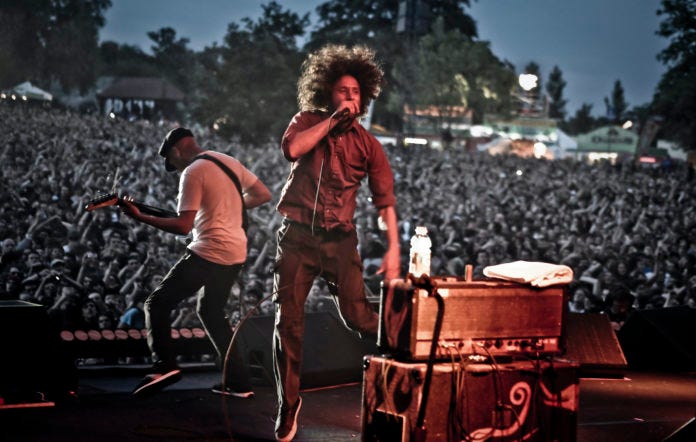
Around this time, RATM, who had reformed in 2007 to start playing live shows again, themselves began to voice their own public support for the campaign, championing its anti-establishmentarian spirit; other high-profile endorsers included the Foo Fighters’ Dave Grohl and former Beatle Paul McCartney.15 The band themselves were interviewed live from LA on the BBC Radio 5Live Breakfast Show on the Thursday, before giving what was supposed to be a censored rendition of the song, only for De La Rocha to renege on his promise not to swear, leading to it being faded out and presenter Shelagh Fogarty apologising to listeners.16 RATM also subsequently announced plans to hold a free gig in the UK if they got to No. 1.17
Meanwhile, McElderry launched the CD version of his single on the Wednesday with an appearance at HMV in his native South Shields.18 Yet while ‘The Climb’ sold around 100,000 copies on that day alone, taking its total sales to date to 216,795, the lateness of the single’s pressing meant HMV and Asda were still the only retailers to have stocked it, and it still languished behind ‘Killing in The Name’, downloaded 253,476 times in total.19 Over the following 24 hours, the gap narrowed further, with 297,192 sales for ‘The Climb’ to ‘Killing in The Name’s’ 306,115.20
According to Jon Morter, the race between the two remained extremely tight up until the Saturday evening, at which point he encouraged the Facebook group’s members – who now numbered nearly a million – to buy a live version of ‘Killing in The Name’, whose sales would still count towards the song’s final chart position. This version was subsequently downloaded 72,000 times before midnight, taking ‘Killing in The Name’ to the Christmas No. 1 spot with 502,672 downloads in total, to ‘The Climb’s’ 450,838 downloads and physical single sales.21
The campaign’s aftermaths
The campaign raised an estimated £100,000 for Shelter in the run-up to Christmas, while Morello announced he would donate his share of the royalties to Youth Music, a UK charity that provided music-making opportunities to underprivileged young people.22 RATM made good on their promise to play a free UK gig, performing for 40,000 randomly selected fans in Finsbury Park in North London in June 2010 – and presenting a cheque for a further £62,000 to Shelter.23 The band embarked upon another long hiatus from 2011; a third reunion initially scheduled for 2020 was delayed by the COVID pandemic and then cut short in 2022 by an on-stage injury to De La Rocha, with drummer Brad Wilk stating earlier this year that RATM ‘will not be touring or playing live again’.24
Jon Morter (who is now divorced from Tracey) has subsequently embarked upon a series of other music-related initiatives, including successfully campaigning to save the BBC radio station 6Music, participating in the Justice Collective set up to raise money for Hillsborough Disaster-related charities and which attained another Christmas No. 1 in 2012 with a cover version of The Hollies’ ‘He Ain’t Heavy, He’s My Brother’, and more recently assisting in novelty band The Kunts’s efforts to attain a Christmas No 1 with a succession of anti-Conservative Party diatribes.25
As for X-Factor, its 2010 series attained its highest ratings yet, with winner Matt Cardle succeeding where McElderry had failed in taking the Christmas No. 1 slot.26 Yet although some acts who made their names on the show, such as One Direction, Olly Murs, and Little Mix, subsequently enjoyed sustained success, its own audiences subsequently decreased year-on-year, culminating in there having been new series since the 15th, which ran in 2018, and there being currently no plans to revive it.27
The moral economy of X-Factor
The 2009 battle for Christmas number one pitted against each other divergent conceptions of the singles chart as moral economy, in which acts of consumption were reinterpreted as inherently ethical, political and gestural, operating through their own intermedial networks, with their own remembered traditions and convenient memory lapses, and their own replication and recycling of older popular cultural products.
X-Factor’s success during the mid-to-late 2000s relied in part on the familiarity of its brand, formulae, and output: of the progression through specific stages over the series, from auditions to live finals, as well as the conventions of the talent show and the reality TV programme more generally; its ritualization both within the cycle of the week and year, embedding it in the practices of Saturday night television viewing and the run-up to Christmas; the celebrity of the judges and guest performers; the contestants’ ‘real life’ story arcs that adhere to stereotypical comic, tragic and heroic narratives; and their renditions of well-known standards.
Yet it also required a degree of cultural forgetting from its audience: to invest themselves emotionally in the stories of the series’ contestants, to pick a favourite and vote for them each week, and if they win, buy their debut single – but then to just as easily jettison that investment and memory of it, to go through the same process again twelve months later. These debut singles have since 2008 been cover versions of songs likely to have been relatively unknown to the intended market, whether the work of older singer-songwriters or recent minor hits (as with ‘Hallelujah’ and ‘The Climb’ respectively).
X-Factor also exemplified the resilience of some long-established media industry giants and entrepreneurs, such as Cowell, adapting existing media and venerable genres to a new media environment by integrating them with digital forms such as texting, MP3s, and social media, facilitating a more pervasive reach and greater levels of audience engagement.
Amid the hostile scrutiny that came the programme’s way during the 2009 Christmas chart battle, Cowell defended The X-Factor in populist terms, depicting the charts as a ‘democracy’ in which its output secured the support of the most music buyers, and denouncing its critics as elitist snobs unwilling to respect the people’s choice – an interpretation that extended the show’s own façade of subservience to the will of the viewing public, via paid-for-votes.28 He and the other judges, most notably McElderry’s mentor on the show and fellow Tynesider, Cheryl Cole, characterised the campaign as cruel in the way it sought to prevent an aspirant star from an ordinary background from achieving his dream – again defining the chart battle in moral and vaguely political terms.29
The moral economy of the Christmas No. 1
By contrast, the campaign to get Rage Against the Machine to number one fused the assertion of two somewhat discordant traditions. The first of these was that of the Christmas No. 1 itself. Jon Morter steered clear of excessive criticism of The X-Factor itself as a form of musical-televisual entertainment, instead specifically criticising its monopoly over the Christmas No. 1 spot, and harking back to an earlier idealised age in which the battle to top the festive charts was fun and unpredictable. He also dismissed the criticism that both McElderry and Rage were signed to subsidiaries of Sony as simply beside the point.30
This chimed with a longstanding conception, ingrained in radio and television charts shows, that the competition between artists and labels to sell the most records is itself a form of entertainment, with heightened significance in seasonal context. Cowell rejected the idea X-Factor had destroyed a great tradition, highlighting how ‘terrible’ some of the songs that had gotten to number one at Christmas prior to the show’s launch had been, some supporters of the campaign claimed he was simply missing the point: Christmas was supposed to be a time when unconventional or novel songs could reach the number one spot, and ‘Killing In The Name’ was very much within this tradition.31
Yet not everyone bought this line either. Comedian David Baddiel, writing for The Times, instead harked back to the unabashed Christmas song of the 1970s and 80s, stressing the exoticism that the season and its traditions held for him growing up in a Jewish household.32 Detractors of the Morters’ campaign also decried it as unseasonal, with Cowell describing it as ‘Scrooge-like’, while Cole asserted: ‘If that song – or should I say campaign – by an American group is our Christmas No 1, I'll be gutted for [Joe McElderry] and our charts.’33
The moral economy of alternative rock
The other tradition manifest in the campaign was that of the alternative rock canon. Jon Morter was himself a rock enthusiast, and a fan of Rage in particular, and stated in one interview that he had selected ‘Killing in the Name’ as the record to try and get to Christmas number one because ‘We’re not going to have this anymore. The band’s name itself says it all. It’s perfect really.’34 It was a song that carried strong connotations of where and when it was made, a time-place central to the narrative of alternative rock’s insurgency against the mainstream. It also possessed its own pedigree in a British context, with commentators often referring to the occasion it was played uncensored on Radio 1.
The campaign offered an opportunity to, through the act of consumption, invert the hegemonic structures of the media and desacralize the festive season, in contradiction of Jon Morter’s stated desire to save the Christmas number one tradition, and thereby make, or remake, musical history, altering its present through a deliberate resurrection of its past. This was in many ways in keeping with RATM’s modus operandi. Although seemingly oblivious to the campaign until it reached a crescendo, the band were nonetheless enthused by what they subsequently repeatedly described in interviews as an organic, grassroots movement, illustrative of the power young people could hold when they came together to make a change.35
Yet other commentators questioned as to how ‘cutting edge’ a moment this could be considered when the campaign’s aim was to elevate a song now nearly 20 years old to the top of the charts, rather than a new release.36 Moreover, it is striking how little attention was actually paid within the discussions around the campaign to the song’s historic political context and meaning as a denunciation of institutional racism. Rather, it simply harked back to a tradition of rock as rebellion for its own sake. This self-referentiality, this combination of revival and unawareness, meant the campaign’s relationship with the alternative rock canon mirrored X-Factor’s with the pop canon. Even the valuable work it did in raising money for Shelter seems to have been a post-rationalisation of its objective, a statement of ethicality that again simply duplicated X-Factor’s own philanthropic gestures.
The Morters and new media
Furthermore, ‘Killing in the Name’s’ victory owed much to Jon Morter’s own skilled exploitation of old and new media. Though he denied at the time that his campaign had been in anyway manipulative, he revealed in a much later interview with the Radio Times some of the methods he and Tracey had utilised, including taking over unrelated Facebook groups without stated administrators so that he could message their members about the campaign; deliberately employing a confrontational approach in early radio interviews to create drama and intrigue; and of course his final manoeuvre in getting people to download live versions of the song as well.37 Cowell himself later struck a conciliatory note, publicly congratulating the Morters on the success of their campaign and claiming to have offered them both jobs with Syco.38
Jon and Lynn Morter were outsiders who had grasped the possibilities available through the relatively new formats of Facebook and legal downloading sites to direct consumer power in a way that challenged hegemonic music industry narratives of success and novelty, albeit while leaving industry structures untouched and merely accelerating monetary flows within existing directions. It was also a campaign very much of its time, relying on the accessibility but also degree of uniformity of contemporary new media formats to narrativise and orchestrate music purchasing patterns.
The subsequent rise to greater parity of other social media platforms such as Twitter and Instagram (and more recently TikTok and BlueSky), the growing popularity of music streaming and accompanying decline in music downloading, and changes in chart rules from 2014 to reflect this, with a hundred streams of a song now recorded as equivalent to one download or hard copy single purchase, all entail a more diffuse and fragmented media environment than the one the Morters navigated in late 2009.39
If you’ve enjoyed this post, you can also show your appreciation by sharing it more widely, recommending the newsletter to a friend, and if you’d like, by buying me a coffee.
You might also enjoy these posts from the Academic Bubble archive:
Jeffrey A. Hall, ‘‘No Shelter’ in Popular Music: Irony and Appropriation in the Lyrical Criticism of Rage Against the Machine’, Studies in Popular Culture, Vol. 26, No. 1 (2003), pp. 77–89.
John Plunkett, ‘The X Factor: More than 19m Watch Joe McElderry Win’, theguardian.com (14 Dec. 2009), https://www.theguardian.com/media/2009/dec/14/x-factor-joe-mcelderry.
‘Official Singles Chart Top 100: 26 December 2004 – 01 January 2005’, Official Charts, https://www.officialcharts.com/charts/singles-chart/20041226/7501/.
‘Official Singles Chart Top 100: 25 December 2005 – 31 December 2005’, Official Charts, https://www.officialcharts.com/charts/singles-chart/20051225/7501/; ‘Official Singles Chart Top 100: 24 December 2006 – 30 December 2006’, Official Charts, https://www.officialcharts.com/charts/singles-chart/20061224/7501/; ‘Official Singles Chart Top 100: 23 December 2007 – 29 December 2007’, Official Charts, https://www.officialcharts.com/charts/singles-chart/20071223/7501/; ‘Official Singles Chart Top 100: 21 December 2008 – 27 December 2008’, Official Charts, https://www.officialcharts.com/charts/singles-chart/20081221/7501/.
‘Hallelujah Set for Chart Trinity’, BBC News (16 Dec. 2008), http://news.bbc.co.uk/1/hi/entertainment/7786171.stm; ‘Christmas Double for Hallelujah’, BBC News (22 Dec. 2008), http://news.bbc.co.uk/1/hi/7794709.stm.
Chris Hackley, Stephen Brown, and Rungpaka Amy Hackley, ‘The X-Factor Enigma: Simon Cowell and the Marketization of Existential Liminality’, Marketing Theory, Vol. 12, No. 4 (2012), pp. 451–469.
Nick Stevenson, ‘Education, Neoliberalism and Cultural Citizenship: Living in ‘X Factor’ Britain’, European Journal of Cultural Studies, Vol. 13, No. 3 (2010), pp. 341–358.
Helen Pidd, ‘Rage Against the Machine beats X Factor’s Joe to Christmas No 1’, theguardian.com (20 Dec. 2009), https://www.theguardian.com/music/2009/dec/20/rage-against-machine-christmas-number-1.
Julie Carpenter, ‘Rage against the Pop Machine’, The Express (18 Dec. 2004).
‘Rage Against the Machine to Take on ‘The X Factor’ for Christmas Number One’, New Musical Express (4 Dec. 2009).
Michael Brear, ‘Rage Against the Machine Backed for Christmas No. 2’, Racing Post (8 Dec. 2009).
Rosie Swash. ‘Rage Against the Machine for Christmas No 1: The Celebrities Wade in’, theguardian.com (18 Dec. 2009), https://www.theguardian.com/music/2009/dec/18/rage-against-machine-christmas-no1.
‘Cowell in Rage at Bid to Foil X-Factor Joe’s No 1’, Evening Standard (14 Dec. 2009).
‘Rage Against the Machine Beating ‘X Factor’ by 65,000 Sales in Christmas Number One Race’, New Musical Express (16 Dec. 2009).
‘Dave Grohl Pledges His Support to Rage Against the Machine in ‘X Factor’ Chart Battle’, New Musical Express (17 Dec. 2009); Swash, ‘Rage Against the Machine for Christmas No 1’.
‘BBC Forced to Apologise for Rage Against the Machine Swearing Live on Radio’, New Musical Express (18 Dec. 2009).
‘Rage Against the Machine Vow to Stage Free UK Gig if They Clinch Christmas Number One’, New Musical Express (19 Dec. 2009).
Bev Lyons, ‘Rage Grows over X-Factor; Joe Could Be Denied No1 Slot By ‘92 Hit’, Daily Record (16 Dec. 2009).
‘Rage Against the Machine Beating ‘X Factor’ to Number One by 36,681 Copies’, New Musical Express (17 Dec. 2019); Rosie Swash, ‘Rage Against the Machine v Joe McElderry: Chart Update!’, theguardian.com (17 Dec. 2019), https://www.theguardian.com/music/2009/dec/17/rage-against-machine-joe-mcelderry.
‘Rage Against the Machine’s Christmas Number One Lead over ‘X Factor’ Narrows’, New Musical Express (18 Dec. 2019).
‘Cowell Offers Jobs to Couple who Orchestrated Rage Campaign’, BreakingNews.ie (21 Dec. 2009), https://www.irishexaminer.com/lifestyle/arid-30439126.html; ‘How to Beat The X Factor to the Christmas Number One’, RadioTimes.com (16 Nov. 2011), https://www.radiotimes.com/news/2011-11-16/how-to-beat-the-x-factor-to-the-christmas-number-one.
Robin Murray, ‘Shelter Thank Rage Against the Machine’, Clash (9 Sep. 2010), https://www.clashmusic.com/news/shelter-thank-rage-against-the-machine/; ‘Rage Against the Machine Guitarist to Donate Song Profits to Charity’, Irish Examiner (16 Dec. 2019).
Sean Michaels, ‘Rage Against the Machine Announce Free London Concert’, guardian.com (12 Feb. 2010), https://www.theguardian.com/music/2010/feb/12/rage-against-machine-free-concert-x-factor; Murray, ‘Shelter Thank Rage Against the Machine’.
‘Rage Against The Machine Drummer Brad Wilk Says Band May Have Already Played Its Last Show’, Blabbermouth.net (30 Apr. 2014), https://blabbermouth.net/news/rage-against-the-machine-drummer-brad-wilk-says-band-may-have-played-its-last-show; Evan Minsker, ‘Rage Against the Machine Will Not Tour Again, Brad Wilk Says’, Pitchfork (3 Jan 2024), https://pitchfork.com/news/rage-against-the-machine-will-not-tour-again-brad-wilk-says/.
Tim Glanfield, ‘6 Music Saviour Was “Very Close to Stopping the Whole Campaign”’, RadioTimes.com (2 Feb. 2012), https://www.radiotimes.com/audio/6-music-saviour-was-very-close-to-stopping-the-whole-campaign/; James Drummond, ‘Essex Couple Back Hillsborough Justice Collective Against Cowell’, Essex Chronicle (21 Dec. 2012), https://web.archive.org/web/20121224012727/http://www.thisistotalessex.co.uk/Essex-couple-Hillsborough-Justice-Collective/story-17637755-detail/story.html; ‘Official Singles Chart Top 100: 23 December 2012 – 29 December 2012’, Official Charts, https://www.officialcharts.com/charts/singles-chart/20121223/7501/; Andrew Trundell, ‘The Kunts return with ‘Boris Johnson Is STILL A Fucking C**t’ and Tell Us about Their Tory-Toppling Bid for Christmas Number One’, NME.com (17 Dec. 2021), https://www.nme.com/news/music/the-kunts-boris-johnson-is-still-a-fucking-cunt-listen-video-interview-christmas-number-one-3120965.
Neil Wilkes, ‘‘X Factor’ Final Peaks with 19.4 million’, Digital Spy (13 Dec. 2010), https://www.digitalspy.com/tv/a292894/x-factor-final-peaks-with-194-million/; ‘Official Singles Chart Top 100: 19 December 2010 – 25 December 2010’, Official Charts, https://www.officialcharts.com/charts/singles-chart/20101219/7501/.
Ellie Robinson, ‘‘The X Factor’ is Ending after 17 Years’, NME.com (29 Jul. 2021), https://www.nme.com/news/music/the-x-factor-has-officially-been-cancelled-after-17-years-3005947.
Jason Deans, ‘Simon Cowell v the NME: ‘I Don’t Take Music too Seriously’’, theguardian.com (15 Dec. 2009), https://www.theguardian.com/media/organgrinder/2009/dec/15/simon-cowell-v-nme.
Victoria Shaw and Anthony Barnes, ‘X Factor Winner Shrugs off Internet Campaign’, Press Association (18 Dec. 2009).
‘Rage Against the Machine Vs The X Factor – Campaign Organiser Speaks’, New Musical Express (10 Dec. 2009); Edd McCracken, ‘X-Rated: The Cowell Backlash; He Rules Our TV Screens...But Critics Claim He’s Killing Music’, Sunday Herald (13 Dec. 2009).
Deans, ‘Simon Cowell v the NME’; Neil McCormick, ‘Rage Against Simon Cowell’, Daily Telegraph (11 Dec. 2009); Paul McInnes, ‘For All the Rage Against the Machine, It’s Still a Safe Bet’, theguardian.com (20 Dec. 2009), https://www.theguardian.com/music/2009/dec/20/christmas-number-1-ratm-joe; Mark Steel, ‘Where Next in the Battle Against the Establishment?’, Independent (23 Dec. 2009).
David Baddiel, ‘All I Want for Christmas is a Festive Pop Song – Minus The X Factor’, The Times (12 Dec. 2009).
‘Simon Cowell: Rage Against the Machine Vs ‘X Factor’ is ‘Very Scrooge’’, New Musical Express (15 Dec. 2009); ‘Cole Hits Out at ‘Mean’ Christmas Single Campaign’, ITN (18 Dec. 2009).
McCracken, ‘X-Rated’.
Anthony Barnes, ‘‘Let the People Decide’ on Festive Number One’, Press Association (16 Dec. 2009); ‘Rage Against the Machine: ‘This is a Victory over Sterile Pop’’, New Musical Express (20 Dec. 2009).
David Lister, ‘Rage Against Being Told what to Do’, Independent (19 Dec. 2009); Barbara Ellen, ‘Opinion: Why I Rage on Behalf of the Ordinary Joes’, The Observer (20 Dec. 2009).
‘How to Beat The X Factor to the Christmas Number One’.
Pidd, ‘Rage Against the Machine beats X Factor’s Joe to Christmas No 1’; ‘Cowell Offers Jobs to Couple who Orchestrated Rage Campaign’.
See ‘Rules for Chart Eligibility: Singles’, Official Charts, https://www.officialcharts.com/media/661003/official-uk-singles-chart-rules-jan-2022.pdf.


