OPEN Dalston and the Demolition of The Four Aces
In campaigning, ultimately unsuccessfully, to prevent the destruction of a celebrated local venue, OPEN Dalston offered an alternative vision of the place of heritage in the built environment.

Please support my work by becoming a free or a paid subscriber to the newsletter. Paid subscribers can access my full archive of posts at any time, and are vital to me being able to continue producing and expanding this newsletter.
This post is part of the ‘Research and Reflections’ occasional series, consisting of pieces based on my ongoing academic research, as well as on my musings on and responses to current affairs and personal developments.
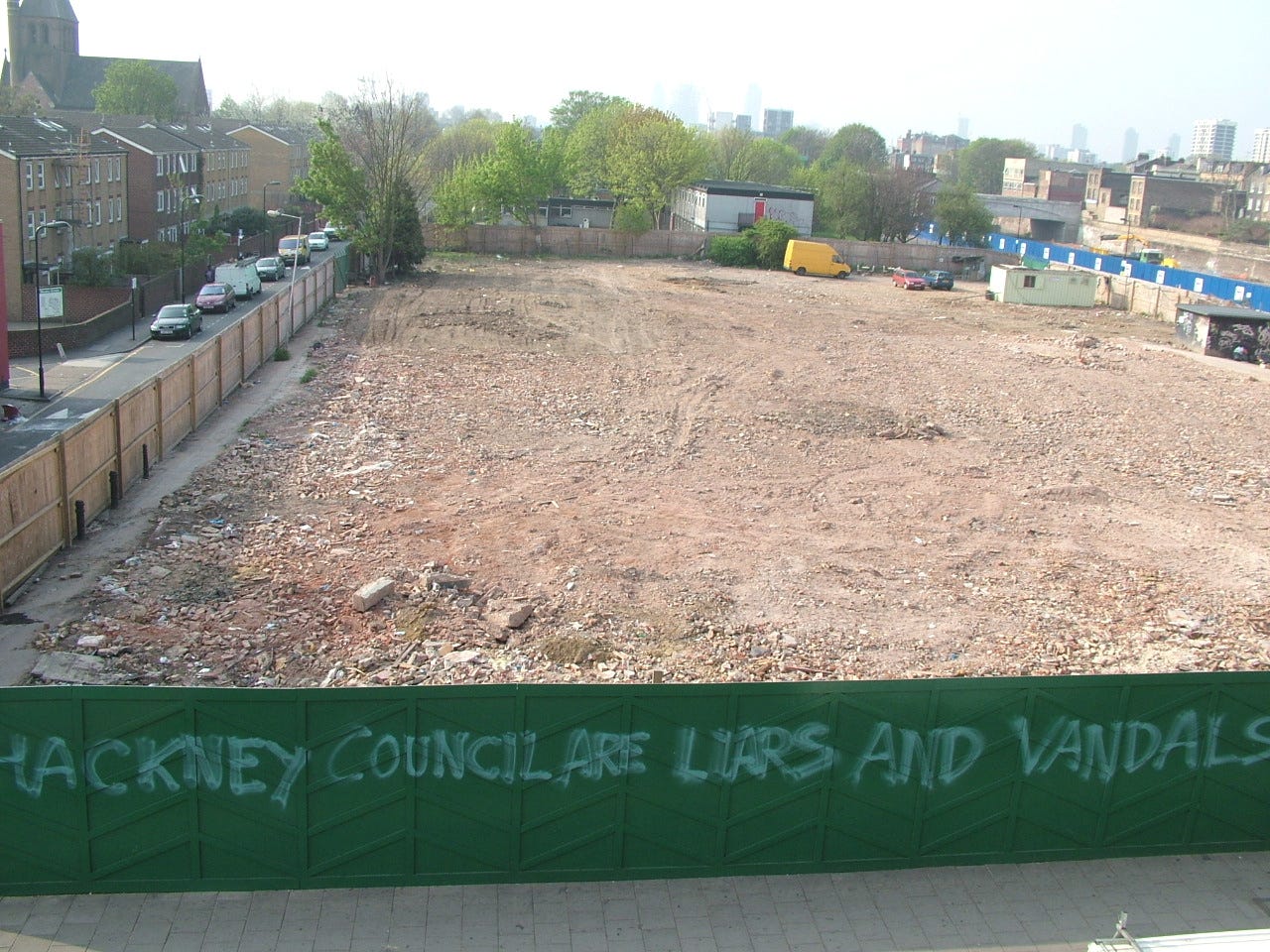
In February 2007, Hackney Council began demolishing a row of buildings between Nos. 4 and 14 Dalston Lane, despite some fierce local opposition. This included the destruction of an iconic venue that was perhaps best-known as the former home of the legendary Black music club, The Four Aces, but which had fulfilled multiple other leisure and communal functions over more than a century of usage.
Beginning its existence in 1886 as the vast North London Colosseum and Amphitheatre, accommodating popular circus entertainments, it was renamed the Dalston Theatre in 1898, now hosting music hall variety acts. With the growing popularity of film and the shift towards purpose-built venues for screening them, it was converted amid much fanfare into a cinema in 1920. As filmgoing declined in the post-Second World War period, amid expanding television ownership, the cinema closed in the 1960 and was briefly used as a storage facility.
It was then that the pioneering Black music promoters ‘Sir’ Charles Collins and Newton Dunbar intervened, making it the new home of The Four Aces, the club they had originally set up in neighbouring Islington. Enormously popular with the capital’s Afro-Caribbean population, it hosted iconic Jamaican ska and reggae and American soul performers, as well as providing the locus of a burgeoning Black British music scene. In the late 1980s, Dunbar handed control over the site to Joe Wieczorek, who had originally cut his teeth running illicit warehouse raves. The renamed Club Labrynth became an influential and heavily frequented dance music venue, accommodating shifting and diversifying trends such as hardcore, trance, and jungle.
In the late 1990s, Hackney Council, which had originally bought the premises in 1977, repossessed the club and began making plans for the venue’s sale and redevelopment. Given the site’s rich cultural and architectural heritage, the proposal was fiercely opposed locally, a petition against the demolition accruing 25,000 signatures. Initial efforts to find a buyer stalled, and the building fell into disrepair. Eventually, the council, in collaboration with the London Development Agency (LDA) and Transport for London (TfL), concocted a plan to obtain permission for the former theatre and its adjacent houses to be knocked down and for tower blocks to be erected in their stead; the site would then be sold to a developer, and the profits used to subsidise the construction of a planned rail and bus interchange in Dalston. This was what would come to pass, but not without considerable obstruction and delay from an organisation recently established to hold local regeneration projects up to closer scrutiny: OPEN Dalston.
The establishment of OPEN Dalston
The Organisation for Promotion of Environmental Needs was incorporated as a company limited by guarantee on 11 December 2004. Its initial memorandum of association set out its principal objectives as follows:
a) To promote excellence in the quality of the built environment in relation to the design and execution of building works, the provision of transportation, the provision of amenities or otherwise and changes thereto
b) To ensure that persons effecting or proposing to effect changes to the built environment have proper regard to the needs of residents and businesses affected by such changes and to the maintenance of a sustainable residential and business community in the locality affected by such changes
OPEN’s first two directors were local solicitor William Parry-Davies, who also served as secretary, and hairdresser Roland Foley. They were joined as directors by Belfast-born garden designer Marie Murray in May 2006, and then in August of the same year by the Reverend William Campbell-Taylor and Lady Jill Lowe, wife of law scholar and disability rights campaigner Baron Low of Dalston, who had recently been elevated to the House of Lords as a crossbencher. Parry-Davies stood down as both director and secretary in October (eventually resuming the former role in 2013 and the latter in 2014).
In a December 2005 post for its nascent, soon-to-become prolific and much-visited blog, OPEN set out its priorities, explaining that recent property sales, dereliction of existing buildings, and plans for new development in Dalston meant that ‘Many of the historic buildings and businesses which give the area its special character are now under immediate threat.’ It cited stopping the demolition of the buildings at 4-14 Dalston Lane, including the former Dalston Theatre, as one of its three ‘urgent aims’, stating its objective of instead having a public consultation into how those existing buildings might be incorporated into any eventual new development.1
Resisting demolition
Hackney Council’s Property Services department gave notice in November 2005 of its intention to demolish the buildings at 4-14 Dalston Lane at some point early the following year. However, OPEN successfully issued a judicial review application, with a High Court judge ruling the council could take no action until the court had considered all the evidence at a future hearing. OPEN argued that the council could not demolish the buildings without a full planning process, not least given that it had acquired them at public expense and was still consulting on a local area action plan. It accused the local authority of having deliberately neglected the premises, ruining the theatre’s art deco interiors to the point of discouraging English Heritage from listing it as a protected building. Nonetheless, OPEN insisted the buildings could be restored and brought back into use, accusing the council of behaving unimaginatively and undemocratically in not incorporating them into its redevelopment plans.
Despite protests organised by OPEN and written objections from the Theatre Trust, Ridley Road Market Traders Association, and Charles Collins, among others, the council’s planning subcommittee voted in favour of demolition at a tempestuous meeting in February 2006. OPEN questioned why Hackney Property Services considered it necessary to destroy the buildings when it had not yet even submitted a planning application for what might replace them, and also whether the council’s planners could objectively advise the subcommittee on the matter when they had previously sat on a Greater London Authority steering committee with TfL and LDA representatives to decide on a masterplan for Dalston that contained to provisions for retaining heritage buildings.
In the wake of the subcommittee’s decision, protestors occupied the theatre to prevent its demolition; the council sought, initially unsuccessfully, judicial backing to evict them. Meanwhile, the LDA put forward a proposal for replacing the buildings with a set of tower blocks, the tallest of which was to be 19 storeys high. In another contentious meeting in July, the subcommittee’s usual chair withdrew owing to a conflict of interest. Its vice-chair, Labour councillor Darren Parker, chaired the meeting instead and with the committee divided, cast a deciding vote in favour of the development, despite himself being an employee of the Commission for Architecture and the Built Environment, a non-departmental public body that also supported the redevelopment. The council ratified the decision in September, arguing that the proposed sale of the site to developer Barratts was necessary to raise funds for TfL’s £38 million bus station development nearby.
Once again, OPEN sought legal recourse, while Communities Secretary Ruth Kelly temporarily instructed Hackney Council to desist from proceeding with the buildings’ destruction, although she subsequently concluded that there was no need for the proposals to be reconsidered. Nonetheless, in November, the High Court renewed its injunction against demolition pending a final hearing. By this point, police had successfully entered the theatre and evicted the protestors. Later that month, the High Court denied OPEN permission to proceed with judicial review of the LDA’s planning application, deeming that Hackney was entitled to depart from its own commitments to protect historical buildings if it saw fit. Facing potentially unlimited liability for the council’s legal costs, OPEN decided against applying to extend its injunction against demolition, leaving the local authority free to proceed.
Interpreting demolition
OPEN’s blog and broader public commentary sought to puncture the progressivist, future-oriented narratives purveyed by Hackney Council, the LDA, and others in local government and associated state agencies, which presented wholesale urban transformation and major infrastructure projects as an unalloyed public good. Such framing, while accompanied by tokenistic nods to local heritage and democracy, centred on the idea that such change was not only beneficial but also inevitable. OPEN responded by detailing extensively, repeatedly, the historical series of events, deliberate choices, and apparent collusion by the council and others that had led to the degradation of the former Dalston Theatre and its neighbouring buildings, enabling their destruction to be presented as a fait accompli. It regularly featured photographs amended to demonstrate what the prospective redevelopment would look like, to emphasise its perceived ugliness and visual incompatibility with the existing built environment. It also highlighted the dearth of affordable housing contained within the new tower blocks, and warned of an alternative potential dystopian future of dereliction and congestion.
After finally withdrawing its legal challenge to the project, the tone of OPEN’s blogging shifted towards a pre-grieving of the soon-to-be-demolished buildings. In an elegiac post titled ‘The story that was never told’, it described the premises as having been ‘doomed’ and ‘on death row’ since the 1990s. It challenged the productive onus of optimistic forecasts of economic growth by emphasising the inability of regeneration boosterists to appreciate the value of what they already possessed.
The Philistines
Noun: the natives or inhabitants of ancient Philistia
Adjective: those who pursue only material gain and who place no value on beauty, culture or artistic creations;
Philistinism: the vandalism of our heritage and culture as justified by institutional policy.
Once demolition began in February 2007, OPEN documented the destruction in text and accompanying photos. When images of construction work and its associated machinery so often carry connotations of coming prosperity, here the site of wrecking crews provided an ironic commentary on ruination, with jarring accompanying captions such as ‘"We are championing the historic environment and using the Borough’s heritage as a key component of economic regeneration... " Hackney Council, September 2005’.
Yet alongside the pessimism and mourning, OPEN also offered an alternative futurity, in which the new did not displace, but rather complemented and revived the old. In doing so, even in the face of the ultimate inability to achieve one of its original stated urgent aims, it continued to emphasise the possibility of an alternative vision to that of developers and their political supporters. This was epitomised in its lengthy recollection of the history of 4-14 Dalston Lane, the multiple shifts in the entertainment and community functions served by the former Dalston Theatre, connecting the story of the Four Aces and the Black patrons and artistes it hosted to a longer, local narrative. This was an example of a building that simultaneously and organically manifested multiple presents and modernities.
The developers will not be building the new Jerusalem in Dalston but towerblock [sic] flats for sale which will overshadow and blight the area. They will be seen as a buy-to-let opportunity to house a transient population. Sub-standard designs may well lead to them becoming the slums of the future. We will see our children living at height with nothing for them except a dark playground at the bottom of the canyon between the skyscrapers. It is a hypocritical betrayal of Dalston’s community, and of hard won Council policies, to condemn future generations to this and, without a second thought, to wipe out our children's and grandchildren’s heritage into the bargain. We do not want to live in the past, but we do want to live with it.
If you’ve enjoyed this post, you can also show your appreciation by sharing it more widely, recommending the newsletter to a friend, and if you’d like, by buying me a coffee.
You might also enjoy these posts from the Academic Bubble archive:
The other two urgent aims declared by OPEN in 2005 were ensuring that any development surrounding TfL’s planned extension of the Tube to Dalston Junction station met the needs and expectations of local residents and workers, and to raise public awareness and influence over Hackney Council’s embryonic ‘Dalston Area Action Plan’.


