
Love Lies Bleeding
This 1980s-set erotic thriller transforms the conventions of the genre through its same-sex couple protagonists, queering the world of bodybuilding it takes place within.

Please support my work by becoming a free or a paid subscriber to the newsletter. Paid subscribers can access my full archive of posts at any time, and are vital to me being able to continue producing and expanding this newsletter.
This post is part of the regular ‘One Take’ series analysing the politics of a film currently showing at the cinemas.
Content warning: Domestic violence; Drug use.
Note: Given that, at time of writing, Love Lies Bleeding is still showing in UK cinemas, this analysis only lays out as much of the film’s scenario as is necessary so as to avoid spoilers. It is therefore suitable to be read either before or after watching the film, while hopefully still enriching the viewer’s appreciation of it either way.
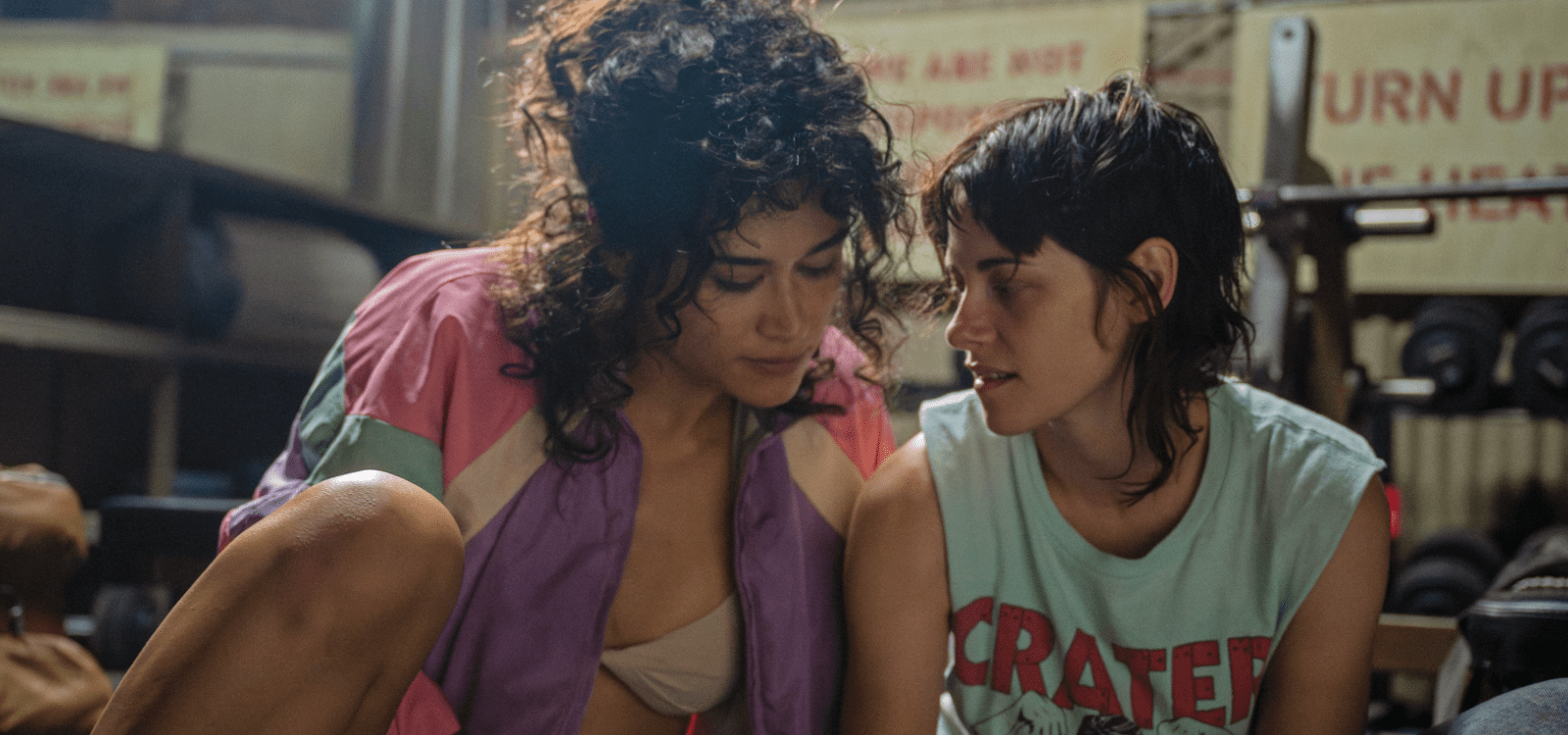
In 1989, introverted Lou Langston (Kristen Stewart) is managing a gym in a town in the American Southwest, where she encounters and quickly becomes smitten with Jackie Cleaver (Katy O’Brian), a bisexual bodybuilder from Oklahoma who has drifted out that way. Jackie is in training for a bodybuilding competition in Las Vegas, and Lou helps her with her preparations by procuring steroids for her. The two move in together as romance blooms between them.
Jackie has taken up a job waitressing at a nearby gun range owned by Lou’s menacing criminal father Lou Langston Sr (Ed Harris), from whom Lou has long been estranged, and whom the FBI are investigating. The range is managed by J.J. (Dave Franco), who is married to, and violently abusive towards, Lou’s sister Beth (Jena Malone), deterring the protective Lou from moving away. However, when Jackie – whose temperament is increasingly affected by her steroid use – seeks revenge on J.J. on Lou’s behalf, she initiates a spiral of violence that imperils the two lovers and their relationship.
Queering the erotic thriller
As Moira Donegan remarked in a recent discussion with Jeet Heer about Love Lies Bleeding and Drive-Away Dolls, both films aim to reinvigorate older genre models by integrating them with a newer type of ‘lesbian plot’ – in Love Lies Bleeding’s case, the erotic thriller. This type of film, which had its commercial heyday in the late 1980s and early 1990s, drew upon the older conventions of film noir – not least in its entanglement of fall guy with femme fatale – but also updated them by integrating other elements, including from standard thrillers and softcore pornography. At its core is the close relationship between sexual desire and violence, the former routinely culminating in the latter.1
Love Lies Bleeding draws upon many of these elements, not least in its highly charged lesbian sex scenes, as well as its often shocking moments of brutality, but also in its setting in the period so associated with the erotic thriller. Yet before discussing those dimensions in more detail, I want to address the way in which the lesbian plot is not simply a novel twist on the erotic thriller, but actively transforms it. By having two female protagonists, it replaces the fall guy-femme fatale opposition with a dynamic in which each character displays aspects of both types.
Jackie on the surface is the character who is closer to the fall guy, a position partly suggested by her status as an out-of-towner and as an athlete.2 She routinely demonstrates an insouciance bordering on naïveté, a tendency to rely on her natural physical traits rather than thinking situations through. This is in marked contrast to the more calculating Lou, who shows far greater worldliness as Jackie’s supplier, trainer, and lover. Yet it is, however, Lou with whom the audience are invited to identify more, whose desiring gaze at Jackie we are originally invited to share, whose personal situation we become much more acquainted with. It is Jackie whose unpredictability keeps Lou forever slightly off-balance, compelling her to use her nous reactively.
Masculinity, femininity, and violence
In one regard, Love Lies Bleeding is centrally concerned with patriarchy and the ways in which the family unit enables men’s violence. It is obvious from our introduction to Beth and J.J. and their two children that J.J. is physically abusive towards his wife, and tension bubbles beneath a thin veneer of domesticity. Beth’s tolerance of this is encouraged by Lou Sr, whose approach to his son-in-law’s conduct towards his daughter is discretion and dissuasion from going too far. Lou Sr runs a family business in which he and J.J. maintain the gun range’s façade of legitimate fun that conceals a gun-running operation.
This is the world that Lou and Jackie as queer women inhabit, negotiate, and resist. When we are introduced to Jackie it is during a transient sexual encounter with J.J. that is patently transactional: a route to a job on the gun range. For Lou, managing the gym is a means of maintaining some independence and distance from her father even as her geographic mobility is curtailed by her desire to protect her sister. They are explicitly contrasted as a pair with Beth and J.J. during a double date at a restaurant. This heteronormative ritual is subverted by the inclusion of a same-sex couple, while the coupling of couples as a mutual performance of domestic contentment is undermined by J.J.’s simmering anger with Beth.
Existing in this world requires that Lou and Jackie also resort to violence. This arises initially from the need to protect themselves, each other, and Beth, from the threat men pose to them. Nor do they always demonstrate unmitigated agency in that violence, with Lou Sr in particular seeking to manipulate their proclivity for it to his own ends. Yet their violence also arises from the interpersonal dynamic of their own relationship, and is a product of their own emotions and calculations – their jealousies, their desires for vengeance, their instincts for self-preservation. And it is directed not only at men but also increasingly at other women, even each other.
Bodybuilding culture and the 1980s
Setting Love Lies Bleeding at the end of the 1980s and close to the Mexican border locates it at the geographic and chronological extremes of Ronald Reagan’s America. It also exists at a cultural extreme too, in the world of bodybuilding. Hulking figures lift weights, contorted faces expressing both the strain of bodily exertion and a narcissistic thrill at their own physical capabilities. The walls of the gym are littered with aspirational motivational quotes like ‘Pain is just weakness leaving the body’. All this is reminiscent the intersection of bodybuilding and cinema in the action thrillers of the 1980s, the films of right-wing coded stars like Arnold Schwarzenegger and Sylvester Stallone.3 Yet all of this jars with the shabbiness of the gym itself – suggesting a tawdry reality beyond the spectacular transformation of the body.
Love Lies Bleeding, however, queers this world through the presence of Jackie, with her eroticised yet muscular physique, sexualised in a manner that challenges dominant ideas of femininity, desirable to and desiring of both men and women. She captures the contradictions in the New Right political project, between neoliberalism and neoconservatism. As a homeless, bisexual, biracial woman, raised in a foster family, she is at the intersection of different groups the Republicans framed as immoral and sought to discipline. Yet she also embodies a capacity for human self-transformation. She believes she can transcend her circumstances by participating in a heavily commercialised subculture holding opportunities for women who offer their bodies for display, in a manner at odds with dominant notions of female domesticity.
The supply and consumption of performance-enhancing drugs also captures the instability in the New Right project. The pursuit of success fuels a lucrative illicit trade that runs counter to ideas of fair competition and period moral panics about drug usage. Sequences of shots showing Jackie’s figure seemingly mutating with each steroid injection, moreover, form part of a surrealist tendency that becomes more pronounced as the film proceeds. This too is part of the queerness of Love Lies Bleeding: its introduction of horror and fantasy elements into the erotic thriller. Jackie’s physical and psychological transformation is central to this, at the hinge between sexuality and violence, but also between the sublime and the grotesque.
If you’ve enjoyed this post, you can also show your appreciation by sharing it more widely, recommending the newsletter to a friend, and if you’d like, by buying me a coffee.
On the genre conventions of the erotic thriller, see:
Douglas Keesey, ‘They Kill for Love: Defining the Erotic Thriller as a Film Genre’, CineAction, Vol. 56 (2001), pp. 44–53.
Nina K. Martin, Sexy Thrills: Undressing the Erotic Thriller (Chicago, IL: University of Illinois Press, 2007).
Linda Ruth Williams, The Erotic Thriller in Contemporary Cinema (Bloomington, Indiana: Indiana University Press, 2005).
I was minded in this regard of Burt Lancaster as boxer ‘The Swede’ in the 1946 film The Killers, and of John Cassavetes as racing driver Johnny North in the 1964 remake.
This theme is explored more in this excellent episode of Radio 4’s Screenshot with Ellen E. Jones and Mark Kermode on gym culture in cinema.
Screenshot is a great programme. So to what extent would you say LLB is the new Bound? Do the more nuanced race elements make this very different?