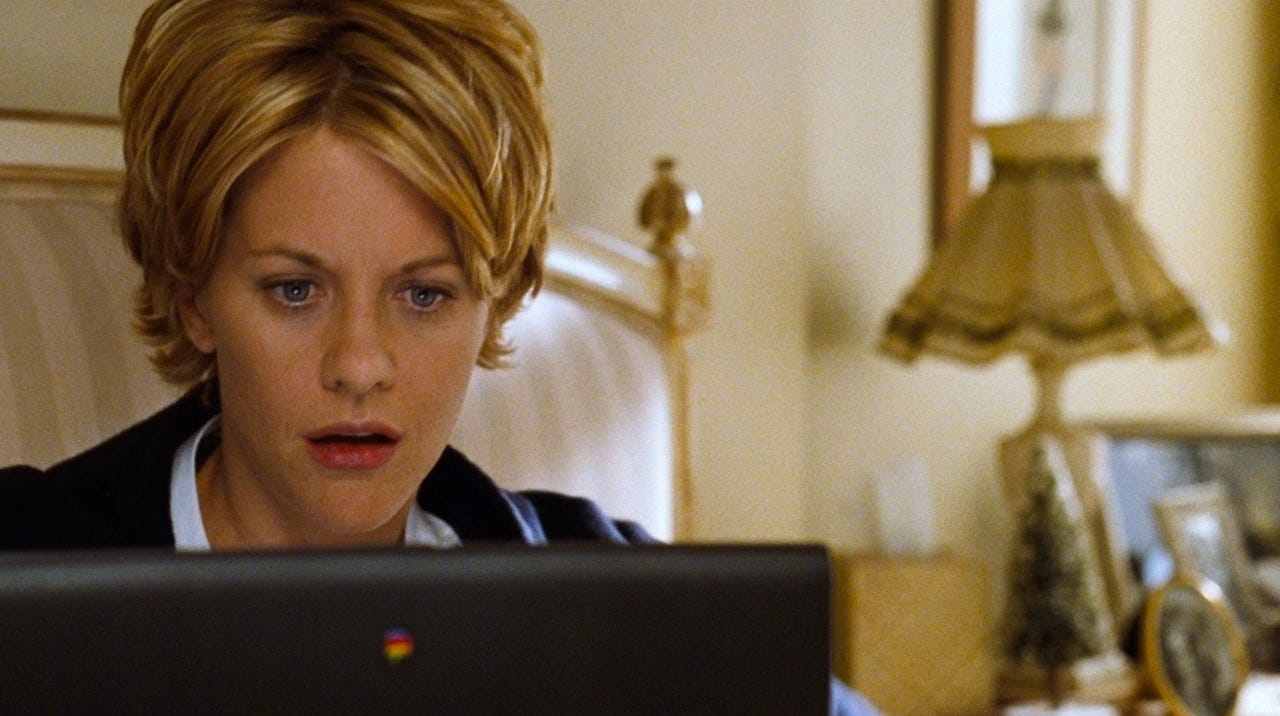
You’ve Got Mail (1998)
You’ve Got Mail’s anonymous online relationship between two professional rivals served to normalise the internet as a space for forming genuine romantic attachments.
Please support my work by becoming a free or a paid subscriber to the newsletter. Paid subscribers can access my full archive of posts at any time, and are vital to me being able to continue producing and expanding this newsletter.
This post is part of the ‘Rewound’ series of analyses of objects or episodes from cultural and political history.
Spoiler alert: This is an analysis of the film You’ve Got Mail and its themes, rather than a review, and as such reveals plot details for the purpose of enhancing that analysis.
This week marks the 25th anniversary of the original cinema release of You’ve Got Mail, the 1998 romantic comedy directed and co-written by Nora Ephron, and starring Meg Ryan and Tom Hanks in its lead roles. It is a film that has a double charm for me. Firstly, it is as enjoyable a two hours’ entertainment as you would expect from a film involving those three people in their 1990s pomp. Secondly, with its focus on an anonymous relationship conducted via email, it is very much of its precise moment, when the internet began to change the nature of social relations, but was not yet utterly integral to them.
There had already been several films made in the 1980s and 1990s that involved computer networks and then the nascent World Wide Web in their central premise. These tended to be thrillers with dystopian elements, such as the 1995 film The Net starring Sandra Bullock. You’ve Got Mail, by contrast, is about the internet becoming routinised: a component of a pleasant present, not a frightening future.
You’ve Got Mail
Nora Ephron, with her sister Delia, based the film’s screenplay on Miklós László’s 1937 Hungarian play Parfumerie. It had already been adapted by Hollywood for the 1940 film The Shop around the Corner, directed by Ernst Lubitsch and starring James Stewart, and then in 1949 as the Judy Garland vehicle In the Good Old Summertime.
Set in contemporary New York, You’ve Got Mail introduces us to whimsical Kathleen Kelly (Meg Ryan). She runs an Upper Westside Manhattan children’s bookshop, ‘The Shop Around The Corner’, which she took over from her late mother, with assistants Christina (Heather Burns) and George (Steve Zahn), and her mother’s best friend, Birdie (Jean Stapleton). She is in a relationship with intensely serious newspaper columnist Frank Navasky (Greg Kinnear), but is simultaneously involved, under the pseudonym ‘Shopgirl’, in a burgeoning anonymous email correspondence with a man she knows only as ‘NY152’. They share no real details about their respective lives, save that NY152 has a dog called Brinkley.
NY152 is in fact cynical Joe Fox (Tom Hanks), who runs bookstore chain Fox Books with his father Nelson (Dabney Coleman) and grandfather Schuyler (John Randolph). He too is in a relationship about which he is ambivalent, living with hardnosed book editor Patricia (Parker Posey). Joe, with his best friend and right-hand man Kevin (Dave Chapelle), is in the process of launching a branch of Fox near The Shop Around the Corner. Kathleen’s colleagues are anxious about the new competition, but she remains bullish.
Kathleen and Joe meet when he visits The Shop Around The Corner with his aunt and brother (both of whom are children, products of his grandfather’s and father’s still active love lives). They get on well but Joe feels obliged to conceal his full identity after hearing Kathleen speak dismissively of Fox Books. She discovers who he is when the two meet again at a party with their respective partners. They clash, and subsequent accidental encounters are equally prickly.
Meanwhile, the opening of the local Fox branch has an immediately deleterious impact on The Shop Around The Corner’s sales. As Shopgirl, she asks NY152 for advice about her business troubles (remaining vague about the details), and he advises her to take the fight to her rival. She does so, with the help of Frank’s crusading journalism, successfully casting Joe in a negative media light.
Shopgirl and NY152’s correspondence brings them closer. They agree to meet in person at a restaurant, but when Joe arrives and sees Kathleen sitting there and realises that is who Shopgirl is, he decides not to reveal his own online identity to her. Instead, he shows up as himself, as if by chance, and continues to antagonise her. Fearing she has been stood up, and angered by Joe’s presence, she brutally puts him down, causing him to leave. Kathleen subsequently emails NY152 to express her sadness at his nonappearance, and her remorse at having so callously treated her rival; NY152 apologises and expresses the opinion that whatever she said was probably deserved.
Admitting to each other that they are not in love, Kathleen and Frank amicably separate. Joe also tires of Patricia’s mean self-centredness, and moves out. With the media campaign having done nothing to stymie its falling sales, Kathleen is forced to close The Shop Around The Corner. Joe, feeling remorseful, visits Kathleen, and the two strike up an unlikely friendship. At the same time, she and NY152 continue to communicate via email and agree again to meet up in person.
When Kathleen tells Joe about the planned meeting, he expresses his sadness that under different circumstances, she and he might have stood a chance of romance. Kathleen is visibly moved, torn between her feelings for him and for her anonymous correspondent. When she later arrives at the park where she had arranged to meet NY152, Joe appears with Brinkley. Kathleen is overjoyed to realise that Joe and NY152 are one and the same person, and the two embrace.
Introducing the internet
The internet in You’ve Got Mail is an event, not ubiquitous, and not instantaneous. Kathleen and Joe communicate via email exclusively from their computers at home. The experience is captured by Kathleen in the first of her emails to NY152 shared with the audience:
I turn on my computer. I wait impatiently as it connects. I go online...and my breath catches in my chest until I hear three little words: “You’ve got mail.”
Their communications are framed through the visual and sonic accoutrements of Web 1.0: the screeching of a dial-up modem; the AOL logo on screen. All this is intended to feel fresh but familiar. ‘I like to start my notes to you as if we’re already in the middle of a conversation,’ Kathleen states, and indeed when we are first introduced to her and Joe, they already are. The messages they exchange are imbued with this conversational quality through often having them read (non-diegetically) aloud firstly by the reader, transitioning to the voice of the sender.
Online and offline relationships
The paradox is that Kathleen and Joe are really, as she admits in this same email, ‘People who don’t know each other’s names...and met in a chat room where we both claimed we’d never been before.’ Their agreement not to divulge specifics about their lives gives their conversations an abstract, philosophical feel, grounded via Kathleen and Joe peppering them with cultural and local references. This anonymity, paradoxically, allows them to get closer to expressing and understanding who they essentially are.
This is in sharp contrast with the relationships they are in with Frank and Patricia. The everyday minutiae and routines of these pairings and their deeper integration into each others’ lives only serve to thinly disguise the absence of any real romantic love. ‘Is it infidelity if you’re involved with someone on e-mail?’, Kathleen asks Christina. Yet neither she nor Joe ever really exhibit any genuine sense of guilt for their burgeoning online romance, and the will they/won’t they? element comes entirely from their antagonistic in-person professional rivalry.
Though heavily affected by her correspondence with NY152, Kathleen seeks to downplay its significance. She tells Christina, ‘We just e-mail. It’s really nothing,’ and that ‘…I don’t know his name, or what he does, or where he lives exactly, so it'll be easy for me to stop seeing him, because I’m not.’ Yet as she later confides in NY152:
The odd thing about this form of communication is that you’re more likely to talk about nothing than something. But I just want to say that all this nothing has meant more to me than so many somethings.
This, to the Ephrons’ credit as observers of contemporary human habits, rather mirrored the findings of some of the research into online romantic relationships during the late 1990s and 2000s. That people might be less invested in these relationships than those occurring in ‘realspace’, and that they might prove less durable, and yet this made little difference to how much enjoyment participants drew from them.1 That people tried to present an idealised but not dishonest version of their selves, and paid a great deal of attention to minor cues in order to do so.2
Two worlds colliding
The transformative moment comes when NY152 and Shopgirl first resolve to meet, with the promise of transferring their private online dynamic into their everyday lives. Joe’s realisation that Shopgirl is Kathleen, and his withholding the fact that he is NY152, shifts the dynamic. It raises his awareness of the situation to that of the audience, while Kathleen remains ignorant.
Joe initially uses the disjuncture between his and Kathleen’s knowledge of the situation to taunt and needle her, in revenge for the media character assassination he has undergone. Yet Kathleen turns the tables, impassionedly and unfavourably comparing him to the man she is expecting to meet. He ‘is kind and funny’ with ‘a wonderful sense of humor’, and has ‘not a cruel or careless bone in his body’, while Joe is ‘nothing but a suit’.
This forces Joe to reflect upon another disjuncture, between his online and offline self, especially when he is confronted with an email from Kathleen recounting that night’s events from her perspective, including her sense of remorse for what she had said to ‘A man who has made my professional life a misery.’ Initially tempted to come up with an excuse for NY152’s absence, Joe is instead vague about the details but honest about his feelings:
Dear friend: I cannot tell you what happened last night. But I beg you from the bottom of my heart to forgive me for not being there. For what happened. I feel terrible that you found yourself in a situation that caused you additional pain. But I’m absolutely sure that whatever you said last night was provoked. Even deserved. Everyone says things they regret when they’re worried or stressed. You were expecting to see someone you trusted…and met the enemy instead. The fault is mine. Someday I'll explain everything. Meanwhile...I’m still here. Talk to me.
When Kathleen next suggests in her correspondence with NY152 that they meet, she receives an elliptical response promising that they will, ‘But I’m in the middle of a project that needs...tweaking.’ The project is Joe repairing his in-person relationship with Kathleen, only acceding as NY152 to meeting her in person once that friendship has reached a point when he is ready as Joe to confess his own lament that their own earlier conflict had pre-doomed any chance of romance between them.
Unlike Frank, he is a real competitor with NY152 for her affection, and she realises just how alike the two actually are: an in-person version of what she dreamed life with NY152 might be like; ‘the promise of someone else’, as she had previously described her relationship with NY152. She is overcome with emotion that those online and offline worlds have melded: ‘I wanted it to be you. I wanted it to be you so badly.’
If you’ve enjoyed this post, you can also show your appreciation by sharing it more widely, recommending the newsletter to a friend, and if you’d like, by buying me a coffee.
B. Cornwell and D.C. Lundgren, ‘Love on the Internet: Involvement and Misrepresentation in Romantic Relationships in Cyberspace vs. Realspace’, Computers in Human Behavior, Vol. 17, No. 2 (2001) pp. 197–211.
Nicole Ellison, Rebecca Heino, and Jennifer Gibbs, ‘Managing Impressions Online: Self-Presentation Processes in the Online Dating Environment’, Journal of Computer-Mediated Communication, Vol. 11, No. 2 (2006), pp. 415–441.


This movie fascinated me growing up. The internet was new back then.
It is SUCH a different moment to have mail stuck to interaction with a BOX rather than in our hands 24-7.