Duck and the Diesel Engine (1958)
The rivalry between the two characters at the heart of this book encapsulated the contest between competing versions of the British railway system’s present and future.

Please support my work by becoming a free or a paid subscriber to the newsletter. Paid subscribers can access my full archive of posts at any time, and are vital to me being able to continue producing and expanding this newsletter.
This post is part of the ‘Rewound’ series of analyses of objects or episodes from cultural and political history.
Dear Friends,
We have had two visitors to our railway. One of these, “City of Truro”, is a very famous engine. We were sorry when we had to say goodbye to him.
The other visitor was different. “I do not believe”, writes the Fat Controller, “that all diesels are troublesome, but this one upset our engines and made Duck very unhappy”.
The Author1
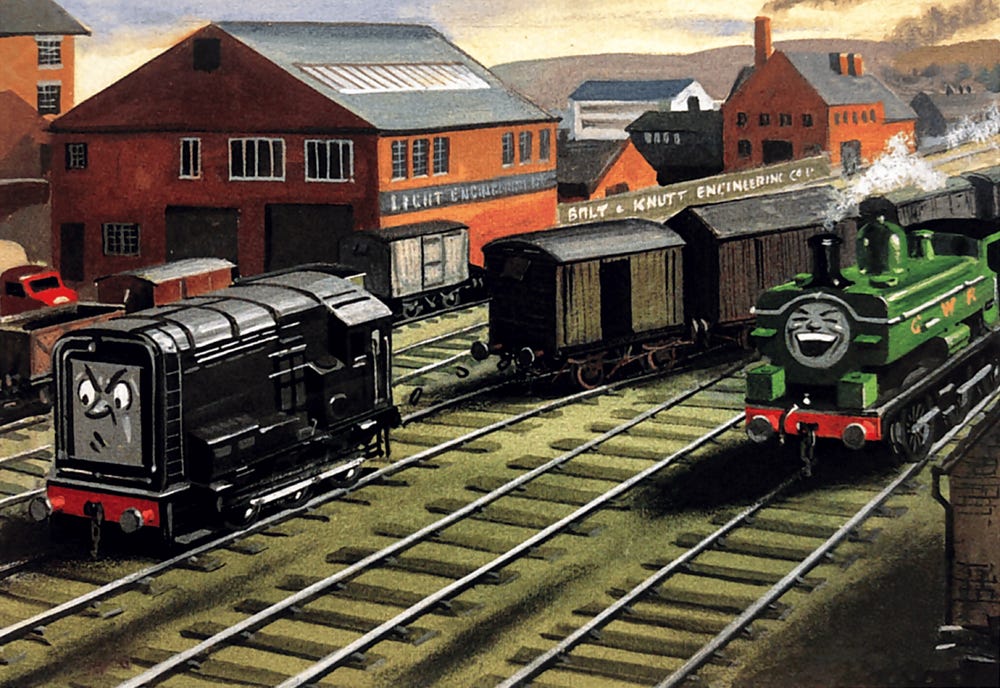
Thus begins Duck and the Diesel Engine, the 13th entry in the Reverend Wilbert Awdry’s Railway Series of children’s books about talking engines, and one that marked a shift to a slightly darker tone than present in earlier volumes. Its hero, Duck, had been introduced two volumes earlier, in 1956’s Percy the Small Engine: an earnest, hard-working tank engine, formerly of the (pre-nationalised) Great Western Railway (GWR) and unendingly proud of it, brought in by the Fat Controller to help out on the main line.
Its villain, simply named Diesel, was introduced by Awdry at the behest of the series’ editor, Eric Marriott, who wanted the books to better reflect the present reality of British Railways’ rapid rollout of diesel engines. Awdry, who disliked diesel engines, acceded but in doing so made the first diesel engine to appear the The Railway Series its greatest villain, whom he would never include again in any of his subsequent books (although subsequent diesels that appeared in the series were not uniformly bad).2
Duck and the Diesel Engine opens with ‘Domeless Engines’, in which the famous City of Truro – the real-life GWR locomotive that in 1904 reportedly became the first engine to reach 100mph – visits the railway, and strikes up a friendship with Duck. Gordon, the largest and proudest engine on the railway, is disgruntled by the attention received by City of Truro, and makes a disparaging remark about him not having a dome. However, when Gordon himself seeks to break the 100mph barrier, a strong wind blows of his own dome, much to his embarrassment (and Duck’s amusement).
In ‘Pop Goes the Diesel’, Diesel is brought to the railway on a trial by the Fat Controller. His flattering manner impresses the other mainline engines, Gordon, James, and Henry, but not Duck, who is suspicious of the newcomer’s motives and affronted by his braggadocio. He is therefore gratified when Diesel makes a fool of himself by trying and failing to shunt some dilapidated, disused trucks. Diesel’s anger is exacerbated by the other trucks tauntingly singing a mocking parody of ‘Pop Goes the Weasel’ about him.
Diesel blames Duck for his humiliation and takes revenge in ‘Dirty Work’. He tells the trucks, in mock confidence, about rude nicknames he claims Duck gave Gordon, James, and Henry. As Diesel had intended, the trucks promptly use the nicknames to taunt the engines and attribute them to Duck. Duck subsequently finds the three engines blockading his entrance to the shed as they confront him with the allegation that he had been besmirching them. The Fat Controller intervenes and asks Duck about the claims, which he denies; he then defuses the situation by sending Duck to go and work for a little while at another station, much to Diesel’s delight.
The book’s closing story, ‘A Close Shave’, sees Duck working at the other station with the kindly engine Edward. Having helped a goods train to the top of the hill, he is returning only to find that the tail end of trucks has broken away and are now dementedly chasing him back down the line. Duck slows down to impede the trucks’ progress and narrowly avoids collision with another train, but instead crashes into a barber’s shop that has been set up at the end of a siding. The angry barber lathers Duck’s face for disrupting his business, but the Fat Controller arrives to explain that Duck’s bravery had prevented a worse accident. He informs Duck that the truth of Diesel’s character had been outed after he told lies about Henry, prompting the Fat Controller to send him away. The story and book finishes with Duck being triumphantly welcomed home by the other engines.
Heritage and modernity in The Railway Series
As a keen railway enthusiast, Awdry was always a stickler for technical accuracy, and frequently drew on real incidents for story ideas. As the 1950s progressed, however, this rooting of his worldbuilding extended further, into contemporary place and time. In collaboration with his brother George, he developed a fictional island, Sodor, near Man, as the location for the stories. Its relationship with the mainland was developed through the newly crowned Queen Elizabeth II’s visit to Sodor in 1953’s Gordon the Big Engine, and by the engines travelling over to England in 1957’s Eight Famous Engines. The periodisation of the books began in earnest with 1948’s James the Red Engine, Awdry’s preface to which had noted:
We are nationalised now, but the same engines still work the Region. I am glad, too, to tell you that the Fat Director, who understands our friends’ ways, is still in charge, but is now the Fat Controller.3
However, this contemporaneity carried seeds of representing a technological world that was passing. In 1952’s Toby the Tram Engine, the eponymous character is brought to the railway by the Fat Controller after his own tramline is closed down – mirroring the closures of Britain’s last remaining tramlines during that period. In 1954’s Edward the Blue Engine, a steam traction engine named Trevor is saved from scrap – the first time this threat of an engine’s destruction was seriously raised in the books – and put to work in the vicarage orchard.
Awdry was, by his own description, ‘out of sympathy with British Railways’ nationalization and felt that anything that could be done to preserve an independent railway was worthy of support’.4 He became involved with the Tallylyn narrow gauge railway in Wales, which with decades of declining fortunes behind it had evaded nationalisation in 1948 but seemed destined to close until it was taken over by a preservation society that ran it successfully as a tourist attraction. This provided the inspiration for 1955’s Four Little Engines, which introduced a similar independent narrow-gauge railway (and the engines operating on it) running on Sodor and intersecting with the Fat Controller’s railway.5
This was in contrast with the primary impulse at the British Transport Commission, British Railways’ parent organisation. Its 1955 report, Modernisation and Re-equipment of Britain’s Railways, stressed the need for overdue capital investment in British Railways to enable it to attract the necessary traffic for it to attain self-sufficiency, and bolster the broader economy. This meant that:
…steam must be replaced as a form of motive power, electric or diesel traction being rapidly introduced as may be most suitable in the light of the development of the Plan over the years; this will involve the electrification of large mileages of route, and the introduction of several thousand electric or diesel locomotives.6
Great Westernisation versus dieselisation
GWR in Duck and the Diesel Engine signifies heritage and tradition, but not unproductivity. We might rather read it as embodying a discarded modernity. There is the pride in past achievement, but that is in City of Truro’s achievement of a speed record that remained impressive over half a century later. “He went 100 miles an hour before you were drawn or thought of',” Duck tells Gordon.7 There is a celebration of an independent regional identity rather than centralisation, borne out in Duck’s conversation with City of Truro:
“I see you are one of Us.”
“I try to teach them Our ways,” said Duck modestly.
“All ship-shape and Swindon fashion. That’s right.”8
This is efficiency as epitomised by a famous business brand, rather than a state-based one. At the start of ‘Pop Goes the Diesel’, Duck’s hard work ensures everything on the line runs ‘like clockwork’, but his manner grates with the other engines:
“There are two ways of doing things,” Duck told them, “the Great Western way, or the wrong way. I’m Great Western and…”
“Don’t we know it!” they groaned.9
Duck is in one sense an outsider on Sodor, a relatively recently arrived mainlander who strives to improve the operation of the local railway by importing and imposing his own professional culture into a more idiosyncratic world and onto more truculent engines. Yet he also stands for values that that railway and those engines at their best also epitomise – a kind of steam universalism.
Diesel, by contrast, stands in for a very different, far more unwelcome type of modernity, and outsider. His very name implies he is standing in for diesels as a whole. Whereas the other engines’ speech patterns and anthropomorphisation are based on the mechanical repetitive rhythm of steam propulsion, Diesel is described as having an ‘oily voice’, that he uses especially when falsely flattering others, associating his particular fuel type with untrustworthiness.10
The Fat Controller emphasises from the outset the conditionality of Diesel’s place in the order of things in Sodor, and Duck’s far more established place, introducing Diesel by stating: “I have agreed to give him a trial. He needs to learn. Please teach him, Duck.”11 But Diesel subsequently tells Duck:
“Your worthy Sir Topham Hatt thinks I need to learn. He is mistaken. We Diesels don’t need to learn. We know everything. We come to a yard and improve it. We are revolutionary.”12
The implication that Diesel is an alien agitator, a harbinger of alleged advancement based upon an uncritical veneration of the new and disregard for the natural order of things, emblemises familiar xenophobic right-wing tropes about socialism and associates them with British Railways’ own state-driven railway modernisation programme. As is virtually always the case in The Railway Series, pride leads to a fall and Diesel’s claims to unlimited expertise are thrown into sharp relief by the exposure of his context-specific ignorance as he tried to shunt the wrong trucks.
Conspiracy, mob justice, and martyrdom
Diesel being subsequently taunted by the trucks – truly the lowliest of all orders on Sodor – affronts Duck, who had previously passed up the opportunity to intervene and prevent Diesel’s humiliation, but who nonetheless extends his solidarity to Diesel rather than tolerate the subversion of the status of engines over trucks. As Henry puts it: “We engines have our differences; but we never talk about them to trucks”.13 Diesel, however, who has no such moral code, does exactly the opposite: fraternising with the trucks with the purpose of breaking the other engines’ sense of solidarity with Duck. When asked by the Fat Controller about the other engines’ allegations that he had made the trucks laugh at them, Duck meaningfully responds, “No steam engine would ever be so mean as that.”14
Diesel successfully manipulates Gordon, James, and Henry into a form of industrial mob justice, using their combined presence to effectively block Duck from his place of work and residence. In doing so, they act on misinformation given additional salience by their own status consciousness and simmering resentment of Duck’s perceived sense of superiority. Duck is therefore effectively martyred, in keeping with the heavily Christianised worldview that infused Awdry’s writings: sent into reluctant exile as apparent punishment for a wrongdoing he did not commit, at the apparent behest of the Godlike Fat Controller; the real wrongdoer, Diesel, temporarily victorious in this act of unwarranted revenge.
Yet as is already strongly hinted, the Fat Controller’s omniscience persists; he distrusts Diesel, and disbelieves the accusations against Duck:
“Now Diesel, you heard what Duck said.”
“I can’t understand it Sir. To think that Duck of all engines…I’m dreadfully grieved Sir; but know nothing.”
“I see.” Diesel squirmed and hoped he didn’t.15
Duck’s return is seemingly preordained by his own act of willing bravery in the face of another nightmarish occurrence, the trucks showing their own seeming autonomy of movement and agency to break free of a goods train to chase him instead. The Fat Controller thereafter though also confirms what had been strongly implied, that he did not believe Diesel, and when Diesel revealed his true character by telling lies about Henry as well, “…I sent him packing.” Duck, he promises, will be “coming home” to the Yard; upon his arrival after being mended, ‘there was a really rousing welcome for Duck the Great Western Engine’.16
It is a fitting finale and final line, not just completing Duck’s moral arc of righteousness, unjust persecution, self-sacrifice, and recuperation, but also reaffirming his rightful position at the heart of Sodor’s in-group of engines, and legitimising his identity and values as integral to that community. All of this is rendered possible by his counter-positioning with Diesel, the full outsider who through his deeds and eventual expulsion ultimately reinforces Duck’s belonging, the malign actor whose lack of morality showcases the strength and hegemony on Sodor of his rival’s principles.
If you’ve enjoyed this post, you can show your appreciation by sharing it more widely, recommending the newsletter to a friend, and if you’d like, by buying me a coffee.
You might also enjoy these posts from the Academic Bubble archive:
Rev. W. Awdry, Duck and the Diesel Engine (Leicester: Edmund Ward, 1958), p. 3.
See Brian Sibley, The Thomas the Tank Engine Man: The Story of the Reverend W. Awdry and His Really Useful Engines (London: Heinemann, 1995), pp. 288–232.
Rev. W. Awdry, James the Red Engine (Leicester: Edmund Ward, 1948), p. 3.
Quoted in Sibley, The Thomas the Tank Engine Man, p. 186.
Ibid., pp. 183–192, 205–210.
British Transport Commission, Modernisation and Re-equipment of Britain’s Railways (London: British Transport Commission, 1955), p. 6.
Awdry, Duck and the Diesel Engine, p. 8.
Ibid., p. 6.
Ibid., p. 20.
Ibid., pp. 22, 36.
Ibid. p. 22.
Ibid., p. 24.
Ibid., p. 34.
Ibid., p. 42.
Ibid., p. 44.
Ibid., p. 62.


