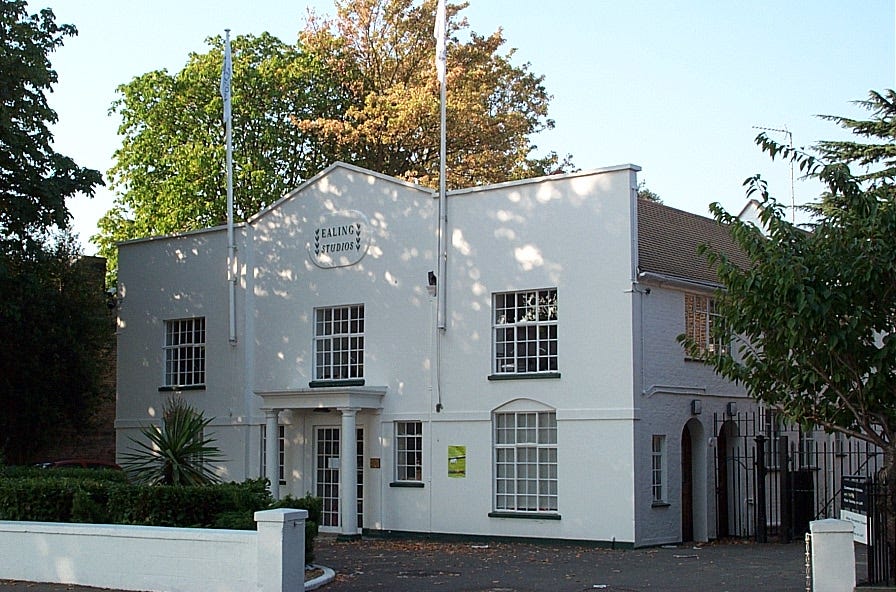
Ealing Studios (1977)
Published in the mid-1970s, Charles Barr’s Ealing Studios was a key text in the development of British film studies, but also embodied the declinist zeitgeist of that seemingly troubled decade.
Please support my work by becoming a free or a paid subscriber to the newsletter. Paid subscribers are vital to me being able to continue producing and expanding this newsletter.
You can also support my work by making a one-off payment, at a price you consider affordable.
This post is part of the newsletter’s regular ‘Rewound’ series of analyses of objects or episodes from cultural and political history.
Charles Barr’s Ealing Studios is fascinating as much for what it says about when it was written, as as an analysis of its subject. Taught by filmmaker-turned-professor Thorold Dickinson at Slade School of Fine Art in the 1960s, Barr became a key figure in the UK’s nascent academic film studies field, joining the University of East Anglia in 1976, in a post originally sponsored by the British Film Institute, and spending the next 30 years working there. Like many of his contemporaries, much of his work – though far from all – was concerned with the historical development of a British national cinema. This includes (as editor) All Our Yesterdays: 90 Years of British Cinema (1986), English Hitchcock (1999), and British Film: A Very Short Introduction (2022).
First published by Charles and Tayleur in 1977, Ealing Studios illustrates how the development of a notion of a British film canon was bound up with the cultural and political context of the 1970s. While British studios had long struggled to capture a larger share of the country’s domestic audience from their Hollywood competitors, the size of that total audience shrank drastically from 193 million admissions in 1970 to 110 million in 1980.1 At the same time, British television channels were also beginning to screen older films, as well as documentaries about film history. Such circumstances were conducive to the work of Barr and his peers, encouraging a view of film not as instant, disposable, mass entertainment, but as of artistic merit, with validating traditions, to be watched selectively. Moreover, given their links with the worlds of film and television, their interpretation was far from simply academic. The publication of Ealing Studios, for example, was taken as an opportunity by the makers of Arena: Cinema on BBC Two to do a special episode on Ealing, to which Barr was a contributor – illustrating the role of film studies scholars in shaping wider ideas about British film history.
Furthermore, Ealing Studios is notable for the way Barr viewed Ealing’s wartime and post-war ideals from the jaded perspective of the 1970s. This was a decade marked by high inflation, uneven economic growth, rising unemployment, and industrial unrest – when many of the policy levers wielded by the government no longer seemed to work as effectively, and many of the preconceptions underpinning those levers no longer seemed to hold. Taken in conjunction with its loss of empire and its secondary role within the Cold War, the idea Britain was in inexorable decline enjoyed widening purchase. Such narratives were deeply misleading: these economic indicators are better understood as signifying a transition from an industrial to a post-industrial economy, and the 1970s was also a period of declining inequality and of significant gains for anti-racist, feminist, and gay liberationist social movements.2 Those achievements unsurprisingly cut little ice with the developing New Right, who led the charge to dismantle post-war social democracy, but ostensibly left-of-centre commentators were also prone to declinist interpretations of contemporary Britain. Barr’s reading of Ealing films accordingly found in many of them a kernel of the cultural malaise that now seemed to have set badly in.

Ealing Studios
Barr had an article on Ealing published in Screen in 1974, which he later identified as laying the groundwork for the first edition of his book.3 Ealing Studios began with Barr setting out a brief history of the studio’s establishment and early leadership of producer Sir Michael Balcon and a broad overview of the studio’s approach in his first chapter, before detailing the evolution of its filmmaking style in the context of the Second World War in its second, the establishment of its core filmmaking team in the third, and the pattern and character of production at Ealing during the late 1940s in the fourth. Subsequent chapters dealt with the Ealing films written by T. E. B. Clarke, and then the comedies Whisky Galore! (1949), Kind Hearts and Coronets (1949), and The Man in the White Suit (1951) respectively. The final chapters at the book were concerned with the ‘stagnation’ of Ealing’s productions in the 1950s, the mixed-calibre cohort of later comedies produced at the studio, and the end of filmmaking by the studio at the end of the decade, before concluding with an epilogue.
Ealing Studios was dominated by extensive analysis of the films themselves, with intertextual references to other works, but also located them within a characterisation of the studio’s own relatively non-hierarchical and collective approach to filmmaking. This picture of Ealing’s inner workings was reconstructed with the aid of interviews with several of its key personnel, including Balcon himself, writer and producer Monja Danichewsky, screenwriter Diana Morgan, and Barr’s former mentor Dickinson.
A second edition of the book was published in 1993 by Studio Vista. Adjoined to the original text was a new chapter, ‘Retrospect 1993’, which slightly reassessed Ealing’s legacy following the dismantlement of the post-war settlement that the studio’s films seemed close in spirit too. This chapter, Barr explained, had been informed by later discussions in the intervening years with other important Ealing personnel, including T. E. B. Clarke, director Harry Watt, editor and producer Sidney Cole, and art director and producer Michael Relph. University of California Press published a third edition in 1998, this time with an additional chapter on ‘Balcon after Ealing’, based on an essay Barr had originally published in a German book on Balcon’s work in the early 1980s.
Barr’s interpretation of Ealing
While Barr understood the Second World War as the crucial formative influence on Ealing’s approach to filmmaking, he nonetheless saw much of its ethos as set out in one of the films it made early in Balcon’s tenure, Cheers Boys Cheer. Released in 1939, this gentle comedy pitted the Greenleaf family brewery against a much larger, more cutthroat competitor, Ironside. Barr read this as a twofold metaphor, firstly for the rivalry between Britain and Germany, and secondly for Ealing’s self-image as a communally, benevolently minded studio within a far more hardnosed, commercially focused film sector. He subsequently expanded upon this dualism with reference to a 1963 essay by the journalist, novelist, and playwright Michael Frayn on the 1951 Festival of Britain, which Frayn saw as the last hurrah of ‘Herbivore Britain’, ‘the Britain of the radical middle classes—the do-gooders; the readers of the News Chronicle, The Guardian and The Observer; the signers of petitions; the backbone of the BBC’, a category he then expanded to also include ‘the Ealing Comedies’.4 It was at this point that the harsher values of the ‘Carnivores’ regained their ascendancy. Barr quoted Frayn’s analysis approvingly:
‘For a decade, sanctioned by the exigencies of war and its aftermath, the Herbivores had dominated the scene’—the perspective in which Frayn places the events of 1951 answers to the time-span of Ealing: it is precisely this decade during which the studio flourishes in responding to, and making films about, ‘the exigencies of war and its aftermath’. Ealing is indeed a part of this loose ‘Herbivore’ consensus (the very term like an echo of ‘Greenleaf’), which Frayn evokes, moulded by the same forces, then stranded and broken up in the 'fifties by the same forces, including its own resistance to change.5
Barr nonetheless resisted collapsing all of Ealing’s output into this framing, highlighting the extent of the studio’s experimentation and of the range of genres it made films in, among which comedy was but one. Moreover, he emphasised the considerable diversity within the group of films usually bunched together as the key ‘Ealing Comedies’. Rather, he stressed the existence of an Ealing ‘mainstream’ comprising the films written by T. E. B. Clarke and/or directed by studio stalwarts Charles Chrichton and Basil Dearden – which included, but were not limited to, comedies – and those which operated outside that mainstream, subverting its norms albeit without fully breaking free of it as a framework, within which he included the films of directors Alexander Mackendrick and Robert Hamer.6
T. E. B. Clarke and Passport to Pimlico
Barr’s chapter on T. E. B. Clarke focused particularly on the 1949 film Passport to Pimlico, which he said embodied the wider public perception of what an ‘Ealing Comedy’ was. Passport centred on the small inner-London community of Miramont Place in Pimlico, engaged in a quarrel between its residents and local government over what to do with a bombsite at its centre, when the accidental detonation of an unexploded bomb revealed it to be in the possession of a charter declaring the district to be Burgundian territory, and therefore independent of Britain, as well as in possession of the large quantity of treasure also found in the bomb site. Residents initially enjoy the freedom from post-war restrictions that this brings them, but an invasion by black marketeers and then diplomatic isolation by the British government imposes considerable difficulties and deprivations on the neighbourhood, which they endure and resist through a combination of togetherness and pluck. Barr saw Passport to Pimlico as a close cousin of two other films written by Clarke, his earlier 1947 comedy Hue & Cry, but also the 1950 police drama The Blue Lamp, which likewise focused on a London community closing ranks to respond to a crisis and deal with the threat that caused it, in this case the murder of kindly, middle-aged officer George Dixon by a pair of juvenile delinquents during a botched robbery.

In critiquing Clarke’s films – whose charms he was largely resistant to – Barr turned to the work of another essayist, George Orwell, ‘who, from his own more analytical perspective, was concerned as much as they were with Britain and the British character’.7 Barr saw in Passport to Pimlico, The Blue Lamp, and other Clarke scripts an embrace of both unofficial forms of communalism and of private liberties and pleasures, which Orwell characterised as at the heart of British identity in the 1940s, but also as incapable of surviving into the post-war world. Whereas Orwell addressed the death of such values in later works like 1984, published the year before Passport to Pimlico was released, Barr saw Ealing – and Clarke’s films specifically – as incapable of addressing the threats posed to its worldview and therefore of adjusting to a changing world, resulting in the worsening staidness of many of its films as the 1950s wore on.
Passport to Pimlico instead sought to recreate the unity of the war years through the effective siege of Miramont Place, and Barr detected a certain melancholy in the film’s recognition that the wartime spirit was ebbing away with the conditions that generated it. His reading was inseparable from the period in which he was writing, when many on the left advocated for a siege economy as a response to Britain’s problems. Barr noted a recent example of this, when historian A. J. P. Taylor asserted in the New Statesman that this economic model would allow for ‘import controls, rationing of essentials, direction of industry and labour, no private motoring, all sorts of lovely things. But this demands national unity and socialists who believe in socialism. Neither exists.’ He saw in Taylor’s claim an echo of Passport’s flippantly-put political message: ‘And the argument itself, nearly thirty years on, is extraordinarily evocative of the film—which in itself goes a long way to explaining the film’s enduring, classic status. The impulses that it plays out have a recurring appeal, are deeply rooted in our culture.’8 Yet Barr surmised that the real tragedy of the film was ‘that there should be so deep a compulsion to dream of consensus, to shy away from the conflicts that come up in an ‘open’ society rather than to follow them through clear-sightedly’. He concluded:
The last thing I want to do in writing of Passport to Pimlico is to be patronising about the anti-acquisitive philosophy itself, which is truly the one hope of a better world, and perhaps of a continuing world at all. But if there is one lesson to draw from the anti-acquisitive and small-is-beautiful movements of recent years, it is that these ideals are not cosy, negative options which can be secured by good intentions and a change of heart, but need to be fought out with passion and intelligence, both in order to overcome the inertia of vested interests, and to give these options power to appeal widely by offering alternative satisfactions for the human energies that will otherwise go into getting and spending and wasting. This is the flaw in the [film’s main protagonist Arthur Pemberton’s] dispensation, making it ultimately so vulnerable—and this has wider implications, for Ealing and for Britain: it offers essentially a cosy retreat, a soft option, operated not by harnessing and redirecting energies, but by denying them.9
Alexander Mackendrick and Whisky Galore!
Barr was, however, fulsome in his praise of Alexander Mackendrick, the Scottish-American director whose own dispensation he welcomed as a much-needed antidote-from-within to Ealing’s nostalgic tendencies. Mackendrick’s Whisky Galore! offered enough parallels with Passport to Pimlico for Barr to make fruitful comparison between the two. It is another comedy, set on the fictional island of Todday in the Outer Hebrides, during the Second World War. The depletion of Todday’s whiskey supply causes great consternation among the islanders, who are cheered when a freighter with a huge cargo of the beverage runs aground, only for Captain Waggett, the stern English commander of the local Home Guard, to refuse to let them salvage the cargo from the sinking ship for themselves. However, local shopkeeper Joseph Macroon persuades another English soldier, Sergeant Odd – who wishes to marry Macroon’s daughter Peggy, and who Waggett has tasked with guarding the freighter – to let the locals retrieve the whiskey so that the necessary betrothal ceremony, or rèiteach, can take place. Waggett discovers the deception and contacts customs and excise officer Farquharson, but the celebrants successfully hide all evidence of the rèiteach, including the whiskey, to Waggett’s embarrassment.
Barr identified patent similarities in how Whiskey Galore! and Passport to Pimlico depicted local communities mobilising to defy powerful national bureaucracies. Yet he also highlighted the contrasts in their comical constructs and styles, which he attributed to their ideological differences. Whereas in Passport to Pimlico and other Clarke films, characters are often slow in recognising possibilities arising from fantastical situations, and laughs come from the audience being one step ahead of them in realising what is happening, in Whisky Galore! the humour lies in how swift the islanders are on the uptake, their skill in concealing and communicating their intentions, and Waggett’s failure to understand them. The two films celebrate very different value sets: Barr argued that while Passport condemns acquisitiveness and finally achieves national consensus through reintegrating Miramont Place into Britain on its own terms, Whisky Galore!’s community are motivated principally by their desire for whiskey, and are never reconciled with Waggett, the main symbol of British officialdom, who returns humiliated to the mainland.
Barr preceded his analysis of Whisky Galore! by quoting lengthily from the proto-Thatcherite historian Corelli Barnett’s The Collapse of British Power, published in 1972. He cited approvingly its central thesis: that an English public-school mindset, service-minded and humane, but also backward-looking and overly romantic, could not come to terms in the twentieth century with rival states catching up with it, and made it averse to confronting Nazi Germany until too late. This was, Barr said, ‘the essential prolegomena to Ealing’.10 Barnett’s declinism provided a useful framework for him to analyse the failings not just in the Ealing ethos, but also in British film culture, and England/Britain more generally:
[The Collapse of British Power’s argument] is a thesis which it would be easy, but wrong, to caricature as simplistically hawkish and reactionary: in this context I can do small justice to its complexity and scholarship, but I believe it to be one of the seminal works on British culture. A few years ago I analysed in Screen magazine the muddled, nannyish, wet response to Sam Peckinpah’s magnificent Straw Dogs on the part of British critics; it was only later, on reading Barnett’s book, that I started to understand the deep-rootedness of the ideology within which these critics, with their panic at the idea of ‘force’ being in any circumstances justified, were operating.11 The book provides an equally illuminating perspective for Ealing—and for the affectionate adoption of Ealing to ‘speak for England’. Barnett shows the British pulling themselves convulsively together in time of war, and then relapsing back into mildness and conservatism and good intentions—the pattern readable overall in Ealing production.12
By contrast, Barr stressed admiringly the ‘Darwinian’ and ‘Machiavellian’ nature of the community in Whiskey Galore!, whose clear-eyed recognition of the fact of ‘survival of the fittest’ makes its persistence and victory possible. Such sentiments are of a part with Barr’s conditional backing for anti-acquisitiveness at the end of the previous chapter: necessary for social and even environmental reasons, but only viable if accompanied by willingness to confront rather than accommodate its enemies. This is in one sense in keeping with left-wing criticisms of social democracy’s apparent aversion to class conflict. Yet because Barr readily accepted the nascent New Right’s declinist framing of how and why Britain was going wrong, and of how society and humanity naturally functioned, the principal fight he picked in the name of progress was with social democracy itself, and the values underpinning it.
Epilogues
In his original epilogue to Ealing Studios, Barr remarked: ‘Ealing was taken over by television, but infiltrated its conqueror.’ While its approach seemed outdated compared to newer trends in filmmaking, television served the studio’s old audience with dramas adhering closely to the Ealing template and often made by former Ealing stalwarts. The chapter concluded: ‘British television, Britain itself. Si monumentum requiris, circumspice: if you want a monument to Ealing, look around.’13
Barr’s additional epilogue for the 1993 edition could hardly not emphasise how much had changed since the book was originally written. Britain’s film industry was now effectively no more than an offshoot of a television one that had itself shed much of the public service ethos Ealing’s films had subscribed to – partly a result of ‘a right-wing Conservative rule unbroken since 1979’. Thatcherism was, Barr reflected, a victory of ‘Carnivore’ values over ‘Herbivore’ ones, and while it shared elements of Ealing’s ‘Little Englandism’, it was an England governed by greed and individualism. Yet Barr also warned against a sentimental, backward-looking reaction to these changes:
Inevitably, all of this increases our distance from Ealing and changes the way we look back on the company and the films. The easiest and commonest response is a resigned nostalgia, an undifferentiated Ealing being used to stand for a now remote period of a productive film industry and of a broad political consensus.14
Nonetheless, Ealing was not ‘just a fossilised segment of a heritage culture’, and still had much to say about contemporary Britain. Firstly, Barr reiterated that a critique of ‘Herbivore’ values was present in some Ealing films, notably Mackendrick’s. Secondly, he remarked that Margaret Thatcher’s successor, John Major, was decidedly Ealing-esque in his self-presentation – ‘a defiantly small-scale and low-horizon figure’ – and in his muddled policy objectives, which steeped a programme of privatisation and centralisation in rhetoric about the importance of autonomous small communities.15
If it isn’t already screamingly obvious, I see an analogy in Barr’s ideological trajectory and that of New Labour. A rejection of what Ealing at its most stereotypical stood for, in favour of modernisation legitimised through alternative claims as to what was good about the studio’s body of work. An apparently equally hostile rejection of Thatcherism, in part because of the conservatism it shared with Ealing, undercut by morose acceptance of the New Right’s vision of how things were, if not of how they should be. A stated commitment to greater collectivism and democracy, but a willingness to pursue these ends through seemingly anathema means that ultimately rendered them less achievable.
And if you can see the coming of the ‘Third Way’ foreshadowed in the realm of film analysis, it raises questions as to how the culture emergent from the post-war settlement contained the seeds of its demise. Expanded state investment in culture and education provided the conditions from within which Barr ambivalently challenged the worldview they were rooted in. He did so through his analysis of Ealing and its output as an historical phenomenon, which also demonstrated their influence both on a solidifying understanding of a British film canon and within British culture more generally during the 1970s. Paradoxically, this meant treading a version of the path many Ealing films did: responding to adverse developments by looking backwards to something imperfect but worth salvaging, yet not ultimately providing a persuasive route forward because of the oppressiveness of this retrospection, too far convinced of the extent that decline had already set in.
If you’ve enjoyed this post, please consider supporting my work by becoming a free or a paid subscriber to the newsletter. Paid subscribers are vital to me being able to continue producing and expanding this newsletter.
You can also support my work by making a one-off payment, at a price you consider affordable.
Otherwise, please show your appreciation by sharing this post more widely, and referring the newsletter to friends.
For an account of the uneven fortunes of the British film industry across the twentieth century, see Bill Baillieu and John Goodchild, The British Film Business (Chichester: John Wiley & Sons, 2002).
On the development of declinist narratives about Britain during this period, see: Jim Tomlinson, ‘The Decline of the Empire and the Economic Decline of Britain’, Twentieth Century British History, Vol. 14, No. 3 (2003), pp. 201–221; and Jim Tomlinson, ‘De-industrialization Not Decline: A New Meta-narrative for Post-war British History’, Twentieth Century British History, Vol. 27, No. 1 (2016), pp. 76–99. For a synthesising history of 1970s Britain that captures some of the decade’s radical potential, see Andy Beckett, When the Lights Went Out (London: Faber & Faber, 2010).
‘‘Projecting Britain and the British Character’: Ealing Studios’, Screen, Vol. 15, No. 1 (1974), pp. 87–121.
The essay in question was Michael Frayn, ‘Festival’, in Age of Austerity, 1945–1951, Michael Sissons, Philip French, eds (London, Hodder and Stoughton, 1963), pp. 307–326.
Charles Barr, Ealing Studios (London: Charles & Tayleur, 1977), p. 8.
Ibid., pp. 48, 72, 82, 110.
Ibid., p. 90. The Orwell piece in question was ‘England, Your England’, the first part of his extended essay The Lion and the Unicorn: Socialism and the English Genius (London: Secker & Warburg, 1941).
Ibid., p. 105.
Ibid, pp. 106–107.
Ibid, p. 108.
Charles Barr, ‘Straw Dogs, A Clockwork Orange and the Critics’, Screen, Vol. 13, No. 2 (1972), pp. 17–32.
Barr, Ealing Studios, p. 109.
Ibid., 180–181.
Charles Barr, Ealing Studios, 2nd edn (London: Studio Vista, 1993), p. 182.
Ibid., pp. 182–183.


Wonderful piece of analysis. I had the pleasure of studying film under Charles Barr at UEA from 78-81. Lovely, if slightly chaotic man and very open minded. Thanks to your piece I now see the link to Sam Peckinpah and why he taught that as a module
What an absolute delight to read this excellent slice of social cultural history through a film lens. Much appreciated and will share.