A Family Affair (1937)
This drama championed the values of classical jurisprudence and traditional family life in face of the economic and social challenges of the 1930s.

Please support my work by becoming a free or a paid subscriber to the newsletter. Paid subscribers can access my full archive of posts at any time, and are vital to me being able to continue producing and expanding this newsletter.
This post is part of the ‘Rewound’ series of analyses of objects or episodes from cultural and political history.
Please note: This analysis of the film A Family Affair and its themes reveals plot details for the purpose of enhancing that analysis.
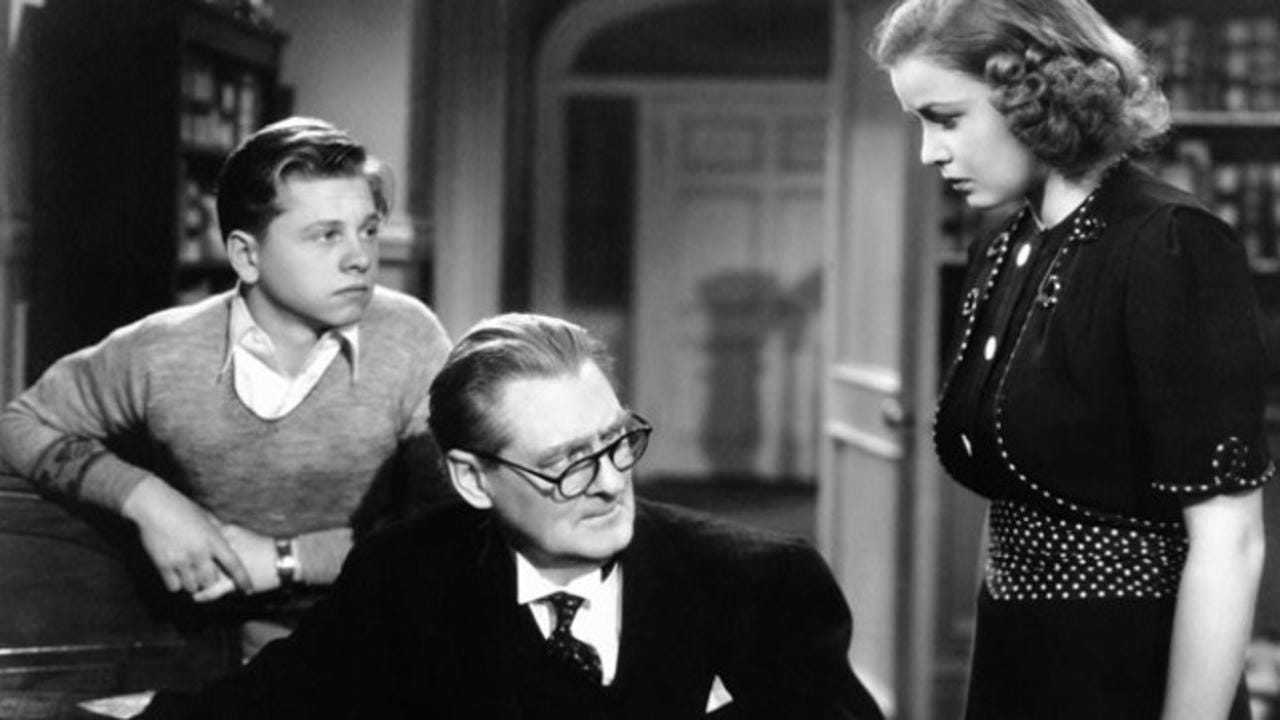
Made by MGM, A Family Affair focuses on the tribulations of James K. Hardy (Lionel Barrymore), a district judge based in the fictional Midwestern town of Carvel. Judge Hardy lives with his wife Emily (Spring Byington), sister-in-law Milly (Sara Haden), and teenage son Andy (Mickey Rooney). He has two adult daughters as well: returning college student Marion (Cecilia Parker), and eldest child Joan (Jill Haydon). The Judge’s problems begin when he places a temporary injunction on plans to build an aqueduct, which will transport water from Carvel to a growing nearby city, so that he can ensure its propriety before work on it begins.
This decision incurs the wrath of contractor Hoyt Wells (Selmer Jackson), and of local newspaper The Carvel Star and its publisher Frank Redmond (Charley Grapewin). The newspaper quickly turns local public opinion against Hardy for blocking so lucrative a project. Wells and Redmond also seek to blackmail Judge Hardy, conspiring to block his re-nomination as district judge. They later threaten to publish allegations about a roadhouse tryst involving Joan, which has led to her estrangement from her husband, Bill Martin (Allen Vincent), whose child she is secretly pregnant with. At the same time, Judge Hardy also faces fierce objection from Marion, whose fiancée Wayne Trent (Eric Linden) is employed to work on the aqueduct as a civil engineer.
Judge Hardy, however, successfully convinces Bill of Joan’s fidelity, and to attend the nomination meeting with him, at which Bill publicly denies rumours of their impending divorce. The Judge then reveals that the aqueduct project has been facilitated by an enabling act that would allow the neighbouring city to commandeer as much of Carvel’s river and surrounding valleys as it demands, resulting in the town’s inevitable ruin; and that he has therefore had the act struck down as unconstitutional. A Family Affair ends with Hardy being subsequently renominated as district judge by universal acclaim, before being reunited with his watching family. He also promises Wayne that a new enabling act will be passed, allowing an aqueduct to be built, but this time making sure Carvel gets ‘a square deal’.
Championing classical jurisprudence
Judge Hardy embodies certain classical ideas about jurisprudence that had long been dominant in the American legal system, including emphases on abstract, universal concepts, on broad public interest over faction, and on due process. These were ideas that came increasingly under attack during the interwar period, in the face of the challenges of regulating an increasingly complex economic and the clear existence of competing interests within them that judges themselves were hardly detached from.1 Yet A Family Affair ultimately serves as a re-endorsement of classical jurisprudence and its modern relevance.
Hardy stubbornly insists throughout the film, on thoroughly investigating the aqueduct project even when the man who initially brought the injunction he granted is persuaded by Hoyt Wells to drop it. He downplays his own agency in taking this decision, insisting that it is ‘The Law’ that demands it. Yet, at the same time, he also vigorously insists on his right to decide what the law means, citing his unblemished record (the Supreme Court having never reversed any of his decisions) and the sanctity of his office. He rejects challenges to this authority from not just private interests and actors, but also apparent expressions of the local general will.
As the film progresses, however, the audience are increasingly shown the virtuousness that underpins the Judge’s curmudgeonly procedural puritanism. This comes through in particular in his discussions with his children. When Andy bluntly asks his father, ‘Are you right or wrong?’, Judge Hardy refers him to a book passage that turns out to be his oath of office, a near sacred statement of commitment that nodded to both God and patriotism. And indeed, providence bears out his faith in his course of action, as the rottenness of the aqueduct project is eventually revealed through it.
Politics, commerce, and small town life
While Carvel, a picturesque town of 25,000 inhabitants, was intended to stand in for Middle America, Family Affair does not represent it particularly closely or warmly. Most of the film’s action, prior to the denouement, occurs in the Judge’s home or office, at a remove from broader public space. Inasmuch as we are given a concrete sense of what Carvel is like, it is through its turning against Hardy after his years of service, standing in for the fickleness and tyranny of majority opinion.
This corruption of the small town ideal owes to the film’s antagonists, Wells and Richmond. While they frequently ventriloquise Carvel’s collective aspirations of economic progress, Wells in particular is simultaneously an insider and outsider figure, who links Carvel to the anonymous neighbouring metropolis. He and Richmond are also shown to be manipulating the local judicial nomination process, accompanied by ominous references to the ‘political machine’ – a term that carried particular connotations with high-profile municipal malpractice in cities like New York.2
A Family Affair’s ambiguous relationship with politics is encapsulated by its climax at the renomination meeting, demonstrating both the vibrancy of the democratic process, and its potential manipulation by Wells, Richmond, and their henchmen. The ensuing revelations about the aqueduct project demonstrate how the intersection between legislation, big business, and urbanisation can rob ordinary, small-town Americans of their livelihoods. Yet in this process of truth-telling, Judge Hardy is also able to make clear the conflict between small towns’ and big cities’ interests, and between those of economic and political elites and the broader public. In doing so, he exhibits the capacity of the virtuous public servant to win out through democratic politics, and for government to be recaptured to work on the people’s behalf.
Restoring benign patriarchy
James Hardy’s position as local judge is intertwined with and partly mirrored by his role as family patriarch. As in his professional life, he must apply long-cherished principles in order to guide his offspring in a seemingly rapidly changing world. A Family Affair at times explicitly humorously makes the point that good judging is tantamount to good parenting, in a manner that reinforces its more subtle articulation throughout the film. At the same time time, the Hardy household is the principal conduit through which the Judge is plugged into Carvel’s social life, and also promises a retreat from its political struggles.
However, the proximity of the Hardies’ private lives to Carvel’s public sphere also menaces their wellbeing. Joan’s and Bill’s marriage is wrecked in its less salubrious locales, for example, and the local press’s interest threatens to destroy her reputation. The film is heavily concerned more generally with drastic economic and cultural change eroding America’s societal and moral fabric. Much of this is framed through the comparison and relationship between generations. Judge Hardy’s conflict in the film with Marion raises questions of the wisdom of his faith in timeless values like patience and duty, when these can no longer deliver his children the peace and security that he and Emily have enjoyed.
Yet when those values win out in A Family Affair’s finale, they not only alleviate the Judge’s professional difficulties, but also his family’s various personal crises. Through helping his father-in-law to expose the aqueduct project, Bill is reunited with Joan and their unborn child. The Judge’s final assurance to Wayne that the aqueduct project would proceed on a sounder basis also answers Marion’s earlier challenge to him. Through steadfast application of classical jurisprudence, he enables the family unit to be reintegrated and reproduced, and for conventional gender roles within it to be restored.
If you’ve enjoyed this post, you can show your appreciation by sharing it more widely, recommending the newsletter to a friend, and if you’d like, by buying me a coffee.
On this topic, see:
Samuel R. Olken, ‘The Decline of Legal Classicism and the Evolution of New Deal Constitutionalism’, Notre Dame Law Review, Vol. 89, No. 5 (2014), pp. 2051–2092.
Edward A. Purcell, Jr., ‘American Jurisprudence between the Wars: Legal Realism and the Crisis of Democratic Theory’, American Historical Review, Vol. 75, No. 2. (1969), pp. 424–446.
On the politics of New York in this period, see:
Emily Brooks, Gotham’s War within a War: Policing and the Birth of Law-and-Order Liberalism in World War II–Era New York City (Chapel Hill, NC: University of North Carolina Press, 2023).
Michael Wolraich, The Bishop and the Butterfly: Murder, Politics, and the End of the Jazz Age (New York: Union Square & Co., 2024).


Logging those refs of recent publications on New York too - Ta much!
Really interesting read - a long time since I've watched this but like a lot of b&w 1930s-40s films I saw it on TV in my young days.