
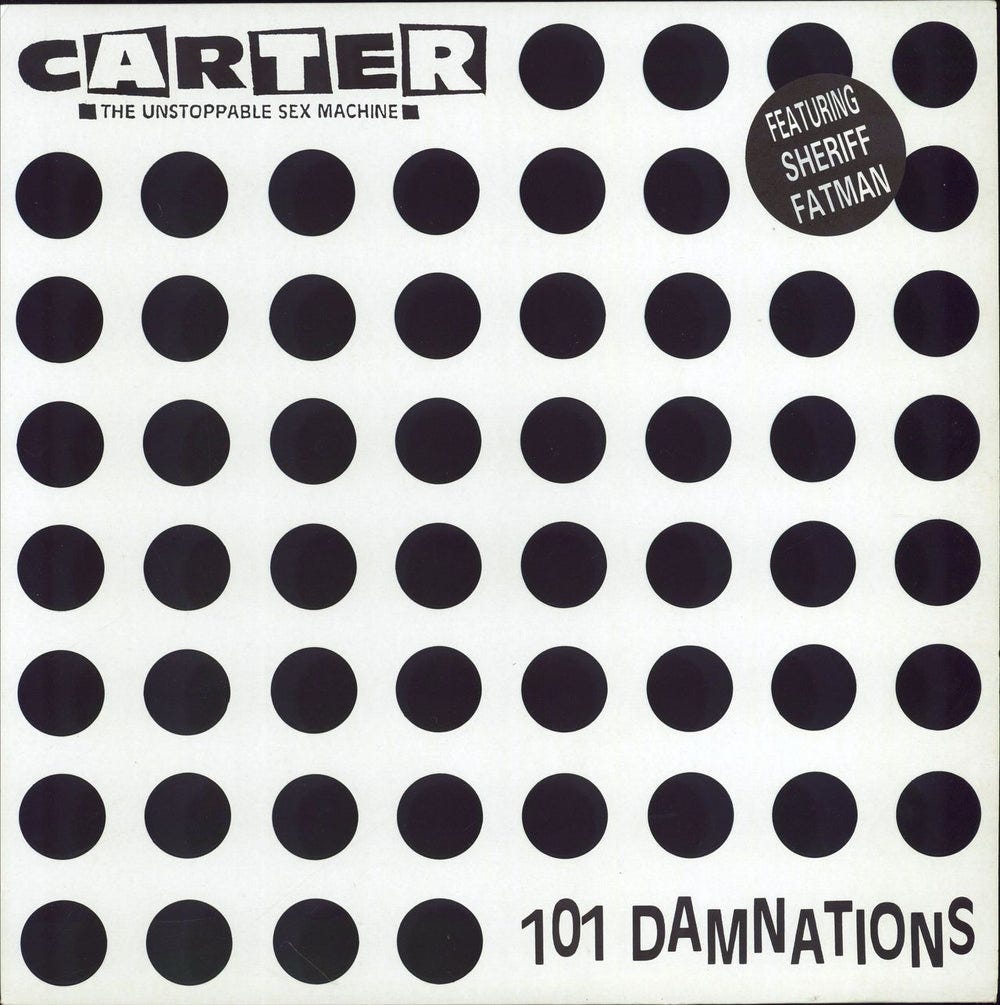
101 Damnations (1990)
Carter The Unstoppable Sex Machine’s debut album depicted a South London wrecked by Thatcherism, via the prisms of American popular culture and of organised religion.

Please support my work by becoming a free or a paid subscriber to the newsletter. Paid subscribers can access my full archive of posts at any time, and are vital to me being able to continue producing and expanding this newsletter.
This post is part of the ‘Rewound’ series of analyses of objects or episodes from cultural and political history.
Content warnings: Suicide; Violence; Flashing images (in video).
Two-and-a-half years after forming in 1987, Carter the Unstoppable Sex Machine – a pairing of South Londoners Jim ‘Jim Bob’ Morrison and Les ‘Fruitbat’ Carter – released their debut album, 101 Damnations, on independent label Big Cat Records in January 1990. It begins with ‘The Road to Domestos’: a short recording of a choir singing the hymn ‘Love Divine, All Loves Excelling’, ending with machine gun fire. Then comes the dramatic A Wonderful Life-inspired, suicide-themed ‘Every Time a Church Bell Rings’, followed by the pulsating ‘Twenty-Four Minutes to Tulse Hill’, in which Jim Bob delivers an absurdist, scattergun narration of a train journey through South London.
Track four is ‘An All American National Sport’, a first-person account of a homeless man subjected to a horrific and senseless arson attack. The fifth song, ‘Sheriff Fatman’ (see below), is one of the band’s signature songs, about a monstrous slum landlord; released as a single two months earlier, it would give them their first UK Top 40 hit on reissue in 1991. Side one concludes with the waltzing ‘Taking of Peckham 123’, detailing the experience of violence and crime in a high rise block of flats.
Side two commences with a surging instrumental, ‘Crimestoppers A’ Go Go’, while ‘Good Grief Charlie Brown’ is about Jim Bob’s parents’ divorce, sung almost as a dialogue with his father. ‘Midnight on the Murder Mile’ is a surreal account of being assaulted while walking home to Crystal Palace. The penultimate ‘A Perfect Day to Drop the Bomb’ furiously and paranoidly links urban violence with nuclear warfare. The album’s closer, ‘G. I. Blues’, drops the tempo significantly, sung from the perspective of an emaciated, traumatised veteran; it builds to a rousing finale, before concluding with ‘Dixie’ played on a fairground organ.
The Carter USM style
Carter USM’s fusion of cheap electropop and squalling guitar sounds something like an unlikely fusion of Soft Cell with The Clash. The pace on several of the songs is frenetic throughout (‘Twenty-Four Minutes to Tulse Hill’, ‘Midnight on the Murder Mile’); occasionally there is a slower build-up to a more furious crescendo, as with ‘Every Time a Church Bell Rings’ and ‘An All American National Sport’. The centrepieces of each side – ‘Sheriff Fatman’ and ‘Good Grief Charlie Brown’ – are musically upbeat pop songs that belie their darker lyrical themes. The pace only sustainedly drops on each side’s closer, ‘The Taking of Peckham 123’ and ‘G.I. Blues’.
Combined with this is an element that is much more of its time: the use of samples. Sampling had become widespread in hip-hop and dance music during the 1980s, and towards the end of the decade Carter USM and indie peers such as Pop Will Eat Itself and Jesus Jones had began to integrate it into guitar rock as well. Carter USM’s approach was decidedly low budget and opportunistic, using excerpts of older songs and film soundtracks, as well as recording sound from real-life settings (such as station announcements on ‘Twenty-Four Minutes to Tulse Hill’). These were used not to build songs around, so much as to densify the sonic collage, fleshing out the album’s aural evocation of a chaotic, disorientating urban and media environment.
This was very much of a piece with the album’s lyrical style. I will discuss their thematic dimensions, and more specifically their twin fixations of South London life and American popular culture, further below. To comment firstly on form, however, Jim Bob’s freeform wordplay relied on extensive usage of puns (including the album title and many of the song titles too), composition of lists, and surreal analogies. There is a lineage in approach that can be traced back to Elvis Costello and further to Bob Dylan, whose ‘Subterranean Homesick Blues’ Jim Bob directly quotes on ‘Twenty-Four Minutes to Tulse Hill’.
Yet there is also a shift. Costello frequently acknowledged his own debts to musical predecessors – such as openly conceding that his song ‘Pump It Up’ also imitated ‘Subterranean Homesick Blues’ – and regularly directly covered their songs and recorded new music with them, a modernist project of canon-building and musical progress. On the far more postmodern 101 Damnations, quotation is both more explicit and yet fundamentally empties those references – and the world they inhabit here – of positive value.
South London nightmares
That world is to a large degree a nightmarish vision of South London at the tail end of Thatcherism, epitomised in punning titles about districts like Tulse Hill and Peckham. These played on song and film titles respectively (namely Gene Pitney’s 1963 hit ‘Twenty Four Hours from Tulsa’, and 1974 crime drama The Taking of Pelham One Two Three). Two years after 101 Damnations, the band would have their only UK top ten hit with ‘The Only Living Boy in New Cross’, which similarly adapted the title of Simon & Garfunkel’s 1970 song ‘The Only Living Boy in New York’. In 1994, historian Roy Porter, himself originally from New Cross, wrote about what had become of that district in the preface to his book London: A Social History:
New Cross Road, which once wore an air of faded early Victorian elegance, is now a ceaseless roar of lorries hurtling down to the Channel ports. The big houses near the Marquis of Granby pub, once admired, are slums, squats or boarded-up, like many of the shops. Dossers and drunks litter the gardens, and some students of mine were mugged there last year. South London has gained a mean name for drug-dealing, racial violence, gangland crime and contract killing.1
101 Damnations shares these principal concerns with economic, physical, and social decline, amid the shrinkage of both the city’s industrial economy and the fraying of Britain’s social safety net. On the final verse of ‘Every Time a Church Bell Rings’, Jim Bob’s narrator frames his own suicidal inclinations in the context of unemployment and poverty:
The TV repossessed, and so
I tune in to the radio
Where the DJ’s playing the same old songs
To whistle while you’re signing on
‘An All American National Sport’, meanwhile, opens with the lines ‘I unpacked my troubles from an old Safeway’s bag/Underneath Cardboard City lights’, sarcastically using an optimistic First World War marching song to capture the peripatetic experience of homelessness, and conflating the Carboard City encampment that grew up in Waterloo during the 1980s with Charlie Chaplin’s 1931 film about a tramp. ‘Sheriff Fatman’ embodies the housing crisis in the monstrous figure of its titular character, ‘At six-foot-six and a hundred tonnes/The undisputed king of the slums’. While evoking earlier criminal landlords such as Nicholas van Hoogstraten and Peter Rachman, the song also locates him squarely in the context of the current urban and political environment:
Fatman’s got something to sell
To the capital’s homeless
And a Crossroads Motel2
For the no fixed aboders
Carter USM also explicitly link the absence of social and housing security with that of personal security, against a real-life backdrop of rising rates of violent crime. Violence in this set of songs is spontaneous, ubiquitous, and often motiveless, its victims particularly vulnerable, its perpetrators obscure or surreal. ‘These two characters’, who supply the homeless narrator of ‘An All American National Sport’ with food and cigarettes, turn on him in the song’s terrifying finale:
And those two scumbags had come back
With some matches and some petrol
Set fire to my bed and left me burning…
In Hell!
Similarly, ‘The Taking of Peckham 123’ addresses the resident of a block of flats, remarking ‘And the hands that do the dishes feel as soft as your face/As they rob you of your pension and they ransack your place’. In ‘Midnight on the Murder Mile’, about a notorious stretch of road between West Norwood and Crystal Palace, the narrator is ‘stitched up by the Boys Brigade, and I was beaten to a pulp’.
America, consumerism, religion, and disillusionment
Carter USM’s lyrics paint a picture of South London life via a mediascape that is overwhelmingly American in origin. The joke often lies in namechecking local place names and everyday life in pastiches of popular cultural texts from the other side of the Atlantic, at once familiar and yet exotic. Tulse Hill transplanted for Tulsa (and a train ride for a road trip). Jim Bob using the Peanuts cartoon character Charlie Brown as autobiographical vehicle for exploring his own childhood experiences. These citations signal excitement, progress, emotion, and above all the promise of fulfilment through consumption. Yet juxtaposing them with lyrical accounts of contemporary South London, delivered in a perpetually sneering vocal style, makes it clear that those promises are hollow, made already broken.
Moreover, American popular culture is directly implicated in the structural and kinetic violence 101 Damnations is centrally concerned with. It also connects the overseas military adventurism of the Cold War with the deteriorating living conditions of the neoliberal city, a shared legacy of Thatcherism and Reaganomics. This is especially evident in the album’s final two songs. ‘A Perfect Day to Drop the Bomb’ cribs the famed refrain from New York hip-hop act Grandmaster Flash and the Furious Five’s 1982 track, ‘The Message’: ‘Don’t push me cos I’m close to the edge/I’m trying not to lose my head’. The next verse concludes with the words: ‘Say, “War”/Everybody say, “Radiation”/Murder, inner city deprivation’.
The last song, ‘G. I. Blues’, takes its title from the 1960 Elvis Presley film of the same name, in which Presley played an American soldier serving in West Germany, shortly after he had himself finished his national service there. Yet the lyrics are based on 1978’s The Deer Hunter, and its depiction of physically and psychologically Vietnam War veterans; the youthful ‘blues’ of frustrated adolescent musical and romantic ambitions now a euphemism for PTSD. Its repeated closing refrain, mimicking ‘Dixie’, urges Bob Hope and Ronald Reagan, among others, to ‘Look away’. This highlights the historical and contemporary connections between American popular culture and militarism, Dixie having been a popular American Civil War anthem, while Hope regularly performed for serving American troops during his career, including in Vietnam, and hawkish President Ronald Reagan was previously a Hollywood actor.
There is a conjunction here with another common reference point on 101 Damnations, that of formal Christianity. The title of hymnal opener ‘Road to Domestos’ takes the site of the Apostle Paul’s conversion, and replaces the ancient Syrian city with a popular brand of domestic bleach. On ‘Every Time a Church Bell Rings’, the ringing bell and angel gaining wings signifies another suicide, while ‘Good Grief Charlie Brown’ concludes with Jim Bob reciting marriage vows, having detailed the breakup of his parents’ marriage. Both ‘The Taking of Peckham 123’ and ‘Midnight on the Murder Mile’ imagine victims of violence encountering Jesus on the threshold of death, the latter via public telephone:
Long distance information3, get me Jesus on the line
I need communion, confirmation, and absolution for my crimes
I need a character witness, Jesus, I think I’m about to die
I saw my whole life pass before me when the night bus passed me by
As with consumerism and American popular culture, religious rituals are invoked on 101 Damnations only to be emptied of their power to promise something better; recurring at different points in the lifecycle, but with no genuine prospect of redemption for the album’s cast of sinners and sinned against, not for South London.
If you’ve enjoyed this post, you can show your appreciation by sharing it more widely, recommending the newsletter to a friend, and if you’d like, by buying me a coffee.
Roy Porter, London: A Social History (London: Hamish Hamilton, 1994), p. xv.
A reference to the motel at the centre of the British television drama Crossroads, infamous for its low production values and poor-quality sets.
A parody of a line from Chuck Berry’s 1959 hit, ‘Memphis, Tennessee’.
Excellent analysis.
Carter were a big fixture of our playlists in that period! Good to be reminded of their biting lyrics and banging tunes.